

[비즈한국] South Korea and Italy are evolving beyond traditional trade in fashion and automobiles into strategic partners for 'critical mineral security.' The reason Italy, which had halted mine development for over 30 years, has reached out to South Korea is the need for a partner to move beyond mere extraction, and instead bridge the gap toward high-tech industries like batteries and semiconductors through refining and processing. In a landscape where critical minerals have emerged as assets directly linked to national security rather than just pricing issues, South Korea—having already established a robust battery and semiconductor industrial value chain—has become a realistic partner for Italy to turn its dormant mines back into industrial competitiveness.
President Lee Jae-myung and Italian Prime Minister Giorgia Meloni held a summit at the Blue House on the 19th and agreed to strengthen partnerships in the field of critical minerals, which are referred to as the foundation of high-tech industries, as well as in artificial intelligence (AI) and semiconductors. In particular, both nations reached a consensus on reducing dependency on specific countries and building a flexible supply chain through the Minerals Security Partnership (MSP), for which South Korea currently serves as the chair. Amidst global supply chain crises, resource security is emerging as a critical diplomatic agenda.
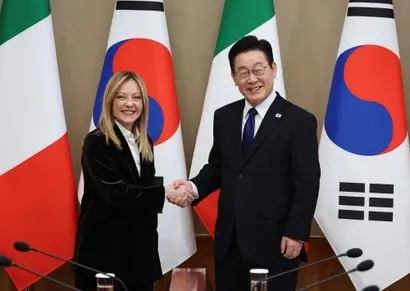
The most notable aspect of this summit is the two countries' commitment to specific cooperation on critical mineral supply chains. Italy has recently been paying close attention to resource security. Having suspended mine development for about 30 years, Italy announced last year that it would resume exploration and mining of critical minerals essential for energy transition and high-tech industries, such as lithium, graphite, copper, manganese, and rare earth elements. It is estimated that significant amounts of 17 out of the 34 critical raw materials designated by the European Union (EU) are buried within Italian territory, and the Italian government has allocated an initial budget of approximately 3.5 million euros (about 6 billion won) for exploration.
Prime Minister Meloni emphasized during the meeting that “we must promptly promote joint research and other efforts in the field of critical minerals” and that “cooperation in critical minerals and the semiconductor sector is vital for supply chain stability and securing strategic autonomy.” This is interpreted as a will to go beyond simple resource import relations and design a supply chain that connects everything from mineral extraction to final product manufacturing.
The cooperation between the two countries does not stop at bilateral trade. The core platform of this agreement is the 'Minerals Security Partnership (MSP).' The MSP is a multilateral initiative led by the U.S. in which allies such as South Korea, Italy, Japan, and the EU have gathered to ensure the transparency and stability of critical mineral supply chains. Within this system, where South Korea is currently the chair, the cooperation with Italy holds special significance.
The world is currently at the peak of supply chain risks due to domestic-first policies and the 'weaponization of resources.' In particular, the structure in which most critical minerals used in semiconductors and electric vehicle batteries are dependent on China has been a weak link in the South Korean economy. In this situation, the fact that value-sharing nations like Italy have decided to restart domestic mines and share technology and information with South Korea is interpreted as an effort to establish a 'safety valve' to secure alternative routes should unexpected supply disruptions occur.
President Lee Jae-myung stated during the summit, "If Italy's traditional strengths as a scientific powerhouse and South Korea's core DNA as a technological powerhouse join forces, our two countries can create great synergy," adding, "Let us broaden the base of our cooperation as value-sharing nations by jointly responding to global challenges, including the climate crisis."