

[비즈한국] The variables that investors in the domestic stock market should watch most closely this week are neither corporate earnings nor major economic indicators. While market attention is focused abroad, the ripple effects are being transmitted to the domestic financial market. The key variable is the statements from U.S. President Donald Trump.
President Trump is scheduled to attend the World Economic Forum (WEF) in Davos, Switzerland, this week and deliver a special address on the 21st (local time). It is expected that diplomatic and economic issues, such as the Russia-Ukraine war, the Middle East situation, the crisis in Venezuela, and measures to ease the cost of living in the U.S., will be mentioned. While a specific policy announcement is unlikely, the reason the market is on edge is that it is currently in a phase where it is reacting much more sensitively to the 'direction and intensity of words' that could potentially lead to policy changes.
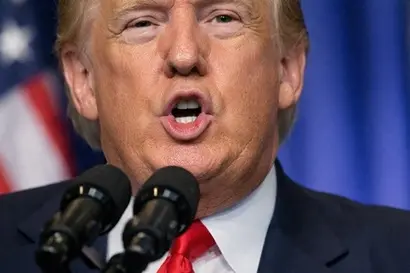
In fact, President Trump's remarks have already moved beyond the realm of diplomatic rhetoric and are evolving into concrete policy threats. Ahead of his attendance at the Davos Forum, he disclosed plans for retaliatory tariffs against European countries that opposed his so-called 'U.S. territorial acquisition of Greenland' proposal, specifying both dates and figures. His plan is to impose an additional 10% tariff on exports to the U.S. from Northern European countries such as Denmark, Sweden, Norway, and Finland, as well as traditional Western European allies like France, Germany, the UK, and the Netherlands, starting February 1st, and to raise this to 25% starting in June. He also added pressure by stating that he would maintain the additional tariffs until they cooperate with his and the U.S.'s initiative to merge Greenland.
Coincidentally, these countries are all key U.S. allies attending the Davos Forum. The theme of President Trump's speech at this forum is known to be 'How to cooperate in a world where disputes are intensifying,' making his tariff warnings at a gathering meant to discuss cooperation ironic. What the market is focusing on is not the diplomatic justification, but the speed at which words are being converted into actual policy risks.
The securities industry is also viewing this week not as a 'week of numbers,' but as a 'week of volatility.' Sangsangin Securities 001290 noted in a recent report that President Trump's all-encompassing intervention, government-controlled economy, and legal issues are converging, creating "a trend where the influence on industries and individual stocks is polarized." In particular, his comments surrounding war, energy, territory, and tariffs are cited as variables that stimulate volatility in oil and raw material prices, which in turn can lead to sectoral rotation in the domestic stock market through exchange rates and supply-demand dynamics.
This trend is already being detected in the domestic stock market. Recently, the temperature difference between industries has been more distinct than the direction of the KOSPI index itself. The semiconductor industry, led by AI, is maintaining a relatively firm trend, but trading is rapidly diverging in industries sensitive to exchange rates and geopolitical risks. In essence, external variables are acting as a phase that increases the difficulty of stock selection rather than affecting the index itself.
In this sense, the 'words' that President Trump pours out daily are closer to risk factors that need to be managed than targets of policy expectations from the perspective of the domestic stock market. Remarks related to diplomatic and security issues or 'affordability'—a core issue that has emerged in U.S. politics—could shake global interest rate expectations, which is highly likely to increase short-term volatility in the domestic stock market by immediately leading to changes in the won-dollar exchange rate and foreign investor demand.
The problem is the typical response strategy that investors fall into during such political event phases. It is dangerous to dismiss overseas political issues as variables unrelated to the domestic stock market, or conversely, to attempt to anticipate the direction of his remarks in advance. Looking at past cases, a single word from Trump has played a role in amplifying volatility by stimulating short-term supply, demand, and sentiment, rather than changing long-term trends. The impact has always been transmitted to the domestic market through exchange rates and foreign fund flows.
This week is no exception. Regardless of the direction of his remarks, the market moves first and interprets later. In that process, some sectors react excessively, while some stocks are left behind for no reason. In such a phase, a strategy of predicting the direction and placing bets is more likely to increase fatigue and trial-and-error than expected returns.
Therefore, what is needed is management, not prediction. First, it is necessary to check changes in the won-dollar exchange rate and foreign investor supply and demand. Political events increase short-term volatility in exchange rates, which is immediately reflected in foreign trading patterns. One should also be wary of lariats between industries. Chasing after specific themes is prone to turning into losses during a period of expanding volatility. Finally, patience in waiting for the short-term noise to clear is crucial.
This week, the domestic stock market should focus on 'words' rather than 'numbers.' However, those words do not last long. Once the speeches are over, the market will turn its gaze back to earnings and fundamentals. What investors should remember is not the sentences of the speech, but their own principles that do not waver in the face of volatility.