

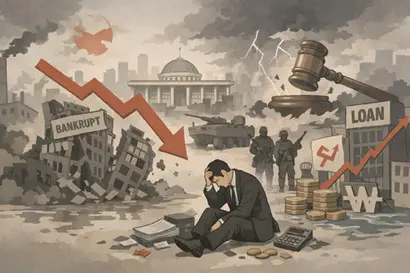
[비즈한국] It has been revealed that South Korean companies suffered the full brunt of the "triple high" (high interest rates, high inflation, and high exchange rates) last year, with the number of businesses filing for bankruptcy reaching an all-time high. Political uncertainty, including former President Yoon Suk-yeol's martial law declaration and the subsequent impeachment phase, also negatively impacted the economy, further complicating corporate management. As a result, businesses were unable to generate proper profits, pushing loan delinquency rates to their highest level in seven years. Although President Lee Jae-myung defined last year as a time of recovery and normalization, the economy and corporate management still have a long way to go before reaching full recovery.
In his "2026 New Year's Address" on the 1st, President Lee said, "I express my gratitude to the people who trusted the government and crossed the waves of crisis together last year," adding, "The year of Eulsa (2025) was a time of recovery and normalization for all of us, as we overcame our worries and anxieties." President Lee also emphasized, "With the swift supplementary budget and public livelihood recovery vouchers playing their roles effectively, consumer sentiment recovered to its highest level in 7 years and 7 months, and the economic growth rate is also on an upward trend," adding, "Frustration mixed with concern is turning into expectations." He then declared, "I will make this year a year of running vigorously like a red horse, and the inaugural year of South Korea's great leap forward."
Although President Lee emphasized that the economy revived last year due to the supplementary budget and public livelihood recovery vouchers, looking at the management situation of companies last year, they have not escaped the worst-case scenario. According to the courts, the number of companies that filed for bankruptcy in court last year (January-November) reached 2,037, exceeding the 2,000 mark for the first time in history. Considering that the number of bankruptcy filings in court throughout 2024 was 1,940, this means an increase of nearly 100 cases even before 2025 ended.
The number of companies filing for bankruptcy in court rose from 490 in 2014 (January-November hereafter), when the statistics were first compiled, to 537 in 2015, and then increased to 659 in 2016. The number of bankruptcies decreased slightly to 649 in 2017, but returned to an upward trend with 737 cases in 2018, rose to 848 in 2019 as the effects of COVID-19 began in earnest, and recorded 984 cases in 2020.
It fell back to 848 cases in 2021 when COVID-19 began to subside, but shifted back to an increasing trend in 2022 with 897 cases. In 2023, when the base interest rate began to rise, the number of companies filing for bankruptcy surged to 1,509, and then increased to 1,745 in 2024. Last year, as high interest rates, high inflation, and high exchange rates overlapped with the unexpected negative factor of former President Yoon's martial law declaration, the number of bankruptcy filings surpassed 2,000 for the first time ever.
The number of companies that legally went bankrupt after their bankruptcy applications were accepted by the court also reached a record high last year. The number of companies whose bankruptcy was approved by the court last year reached 1,812, an increase of 298 from 1,514 in 2024.
Even if they did not reach the point of bankruptcy, the number of companies struggling to pay back loans received from financial institutions due to sluggish management is also increasing. According to the Financial Supervisory Service, as of the end of October last year, the delinquency rate on won-denominated loans to companies at domestic banks was 0.69%, up 0.13 percentage points from the same month the previous year. This is the highest level in seven years since 2018. The delinquency rate for corporate loans peaked at 0.86% in 2018 (end of October), then fell to 0.60% in 2019, 0.42% in 2020, 0.30% in 2021, and 0.26% in 2022. However, it has been on a continuous upward trend, rising to 0.48% in 2023 as the burden of principal and interest increased due to the hike in base interest rates, and further increasing to 0.56% in 2024.
In particular, small and medium-sized enterprises (SMEs) were hit harder by the interest rate hikes and the worsening business environment. As of the end of October last year, the delinquency rate for won-denominated loans to SMEs at domestic banks was 0.93%, a jump of 0.19 percentage points from the same month the previous year (0.74%). An official from the business sector expressed concern, saying, "Although President Lee said he would make 2026 the inaugural year of a great leap forward, the triple high phenomenon of high interest rates, high inflation, and high exchange rates is intensifying this year as well," adding, "It seems unlikely that corporate bankruptcies or loan delinquencies will subside."