

[비즈한국] Due to the explosive growth of the artificial intelligence industry, demand is skyrocketing for data centers—often called "electricity-guzzling hippos"—but critics point out that the power supply system is failing to keep up. This is why there is outcry in the industry that even if a company secures 260,000 of NVIDIA's state-of-the-art GPUs, they will merely be "empty shells" if there is no electricity to power them. As global big tech companies team up with nuclear power firms to secure power directly, calls are growing in Korea to expand Power Purchase Agreements (PPAs), which allow power generators and businesses to trade electricity directly.
Data Centers Becoming Pools Without Water, PPA is the Solution
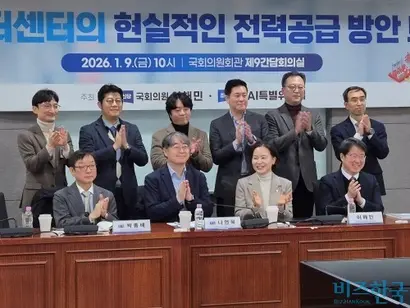
The "Seminar on Realistic Power Supply Plans for AI Data Centers," hosted by the office of Rep. Lee Hae-min of the Rebuilding Korea Party at the National Assembly Members' Office Building on the 9th, revealed the reality of the domestic AI data center industry struggling with power supply issues. Private experts and corporate representatives at the seminar agreed that even though AI data centers consume significantly more power than standard data centers, the current power supply infrastructure cannot keep pace with the speed of this change.
Cho Jung-min, Vice President of SK Broadband, remarked, "We can secure GPUs, but if there is no power to run them, the data center is just an empty shell," adding, "It is no different from providing a swimmer with a pool that has no water."
Park Jong-bae, a professor of Electrical and Electronic Engineering at Konkuk University who attended the seminar, suggested that activating Power Purchase Agreements (PPAs) could be an alternative. Prof. Park said, "About 70% of domestic data centers are concentrated in the capital area, while the Honam and Jeju regions have a surplus of renewable energy, so decentralization to non-capital areas is necessary," and added, "We must allow direct purchases between AI data centers and nearby power plants to reduce the burden of building transmission networks."
In reality, global big tech companies view power procurement as a core variable for technological competitiveness and are moving quickly. Meta has signed nuclear power supply contracts totaling 6.6 GW by 2035 with major energy companies like Vistra, Oklo, and TerraPower. This capacity is equivalent to five or six large-scale nuclear power plants.
Microsoft signed a contract in 2024 to restart Unit 1 of the Three Mile Island nuclear plant. Amazon has been the world's largest corporate purchaser of renewable energy for five consecutive years, and in 2024, it acquired a Talen Energy data center located near a nuclear plant to sign a PPA. Google is also aggressively pursuing PPAs under its moonshot goal of using "carbon-free energy 24/7."
They are expanding the scope of PPAs to include not just renewable energy but also nuclear power, securing energy supply stability. For global big tech, energy is no longer just a cost but a strategic asset that determines AI sovereignty.
In Korea, PPAs are Limited to 'Renewable Energy'
On the other hand, Korea's PPA system is struggling to gain traction due to various constraints. Under current law, direct contracts are restricted to renewable energy only, but the share of renewable energy generation in Korea as of 2024 is 10.6%, far below the OECD average of 32%. For data center users, the Korea Electric Power Corporation (KEPCO) electricity rate system is often still more economical.
The "Special Act on the Promotion of Distributed Energy," which took effect in June 2024, allowed for the use of collective energy (including LNG) and Small Modular Reactors (SMRs) in addition to renewable energy in specialized distributed energy zones. However, since the relevant public notices have not yet been established, there are no actual contract cases. A data center industry official stated, "Even if we try to pursue a PPA in Gangwon or South Jeolla Province, we are told it is impossible because there are no notices in place."
Lim Jang-hyuk, a researcher at Solutions for Our Climate, pointed out, "Under the current system, an 'N-to-N' structure where multiple power producers and multiple consumers sign contracts is impossible," adding, "Institutional improvements are needed so that power producers can create diverse products and consumers can choose from them."
Will the 'AI Data Center Special Act' Pave the Way for PPAs?
Legislative alternatives to solve the AI data center power issue have also been proposed. The "Special Act on the Promotion of AI Data Centers," representatively proposed by Rep. Lee Hae-min, includes provisions to grant "special exceptions for direct power trading," allowing power producers to supply electricity directly to data centers built in non-capital areas where there is surplus capacity in the power grid. It also includes the introduction of an "in-licensing timeout system" and exemptions from power grid impact assessments.
However, the "cherry-picking" controversy surrounding the expansion of PPAs persists. There is concern that if large data centers exit the KEPCO system to purchase cheaper electricity directly, the costs of maintaining the power grid could eventually be passed on to the public. For this reason, energy authorities remain cautious about expanding PPAs.
Experts point out that in order not to miss the golden time for the AI industry, PPAs must be brought into the institutional fold through the realization of grid usage fees and transparent cost-sharing models. In an era where energy procurement strategy is directly linked to AI competitiveness, Korea's choices are being put to the test.