

[비즈한국] The two pillars of Korea's semiconductor industry, Samsung Electronics005930 and SK Hynix000660, have finalized their performance bonus plans for 2025. With earnings improving due to the proliferation of artificial intelligence (AI) and increased demand for High Bandwidth Memory (HBM), both companies have expanded the scale of their bonuses, though they differ in their compensation structures and operational methods.
Samsung Electronics: DS 47%, MX 50%... Semiconductors and Mobile Lead Earnings
On the 16th, Samsung Electronics announced the 2025 Overall Performance Incentive (OPI) rates for each business unit via an internal notice. The Device Solutions (DS) division, responsible for the semiconductor business, will receive 47% of their annual salary as OPI. This is a significant increase compared to last year's 14%. This is interpreted as a result of rising general-purpose DRAM prices and expanded HBM supply contributing to improved earnings.
A common payout rate was applied across the memory, foundry, and system LSI business units within the DS division. The foundry unit reflected achievements in long-term supply contracts with major clients, while the system LSI unit was influenced by increased supply of image sensors for major smartphones. According to the preliminary 2025 fourth-quarter earnings report released by Samsung Electronics on the 8th, operating profit reached 20 trillion won, and the financial sector believes a significant portion was driven by the DS division. However, as operating profit by business unit is not disclosed, these specific figures are estimates.
In the Device eXperience (DX) division, the Mobile eXperience (MX) business unit saw its OPI rate set at 50% of annual salary, reflecting the strong sales of the 2025 Galaxy S25 series and the Fold/Flip 7. In contrast, the TV/Home Appliance (VD/DA), Network, and Medical Device business units received 12%. The automotive and audio subsidiary Harman and corporate management support organizations were confirmed at 39%. OPI is paid once annually, providing up to 50% of an individual's annual salary if business unit performance exceeds the target set at the beginning of the year.
Additionally, Samsung Electronics introduced a stock option element to its performance bonuses starting this year. Following the 'Performance Bonus Stock Compensation System' announced ahead of the OPI payout at the end of this month, employees can choose to receive between 0% and 50% of their bonus in stock. If they commit to holding the stock for one year, they receive an additional 15% of the selected amount as a pre-paid stock bonus.
SK Hynix: PS Estimated at 140 Million Won on Average... Performance Bonus Cap Abolished
SK Hynix has maintained its performance bonus system centered on Profit Sharing (PS) while abolishing the bonus cap starting this year. Previously, PS was limited to a maximum of 50% of annual salary (1000% of base salary), but through labor-management agreements, the company removed the limit and transitioned to a structure where the entire pool is derived from 10% of the previous year's operating profit.
The financial sector estimates that SK Hynix recorded an operating profit of approximately 45 trillion won last year. If this is simply converted by the total number of employees (approximately 33,000), the average PS per person is calculated to be around 136 million won. However, this is an estimate that does not account for individual tenure or performance. 80% of the calculated PS is paid in the current year, while the remaining 20% is deferred over two years.
SK Hynix also operates a 'Shareholder Participation Program' that allows employees to choose to receive a portion of their PS in company stock. Members can select 10% to 50% of their PS in stock, and if they hold it for one year, they receive an additional 15% of the purchase amount in cash.
Similar Systems, Why Is Satisfaction Different?
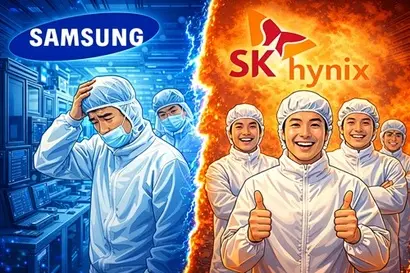
Although both Samsung Electronics and SK Hynix have integrated stock options into their performance bonuses, it is reported that there is a difference in employee satisfaction. The biggest difference is cited as the existence of a bonus cap. While SK Hynix has abolished the PS cap starting this year, strengthening the structure where earnings growth translates directly into compensation, Samsung Electronics maintains a system that limits OPI to a maximum of 50% of annual salary.
Because of this, it is said that many employees in the DS division, who essentially drove Samsung Electronics' performance, feel a sense of relative deprivation despite receiving top-tier bonuses within the company. Analysts suggest that the perception of structural limitations in compensation is a source of discontent, especially during this phase where 2025 earnings—which saw a clear industry upturn led by HBM—are being reflected.
However, it is also pointed out that the operational environments differ because the business structures and organizational scales of the two companies are different. Samsung Electronics operates multiple business units such as mobile, home appliances, and display in addition to semiconductors, necessitating a certain cap and stability in its compensation system. In contrast, SK Hynix has a single business structure centered on memory semiconductors, leaving more room to directly reflect earnings volatility in performance bonuses.