

[비즈한국] Coupang began offering purchase vouchers on the 15th as compensation for a personal data breach. However, dissatisfaction over the superficial nature of the vouchers and the manual redemption process has spread, with critics among consumers calling it a 'marketing ploy rather than an apology.' Notably, despite the icy public sentiment, user metrics are rapidly rebounding toward pre-incident levels. Even amidst the backlash, consumer choices are shifting back toward Coupang.
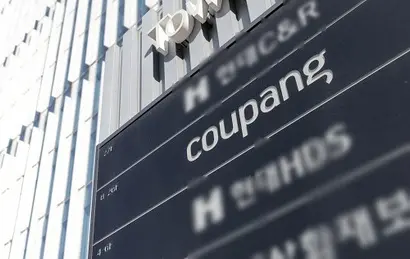
Controversy over compensation coupons: 'Manual application' and '3-month expiration'
Coupang began providing purchase vouchers to customers on the 15th as compensation for the largest personal data breach in its history. Coupang officially admitted last November that the personal information of approximately 33.7 million customers had been leaked. On December 29, Harold Rogers, Coupang's interim CEO, announced a compensation plan to provide 50,000 won in 'purchase vouchers' to each affected customer. At the time, Coupang described the compensation as reaching "approximately 1.7 trillion won" and an "unprecedented compensation plan."
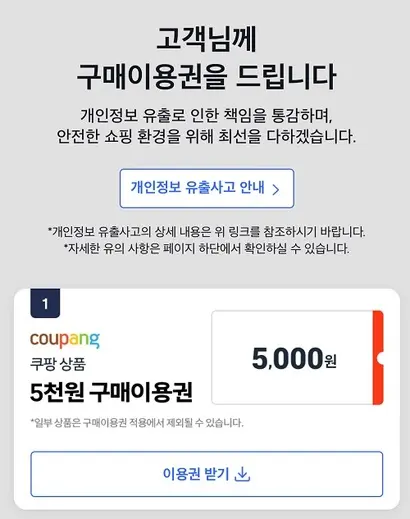
However, consumer reaction was cold. The biggest complaint is the 'fragmented' composition of the 50,000 won voucher. While it is marketed as a 50,000 won voucher, criticism arose over the fact that it is split into shopping (5,000 won), Coupang Eats (5,000 won), Coupang Travel (20,000 won), and R.Lux luxury goods (20,000 won).
This is because while the shopping and delivery amounts, which are frequently used in daily life, total only 10,000 won, the remaining 40,000 won is allocated to travel or luxury categories that require additional spending. At the time, consumers criticized the move as a "trick to offload luxury and travel products under the guise of compensation," but Coupang proceeded with the distribution as originally planned.
After coupon issuance began on the 15th, complaints were also raised regarding the distribution method. Instead of automatically providing coupons to all affected customers, Coupang chose a method where users must manually access the compensation page in the app and click an application button. It is a structure where the customer, the party being compensated, must actively seek out the compensation process. Some point out that Coupang may have intentionally created the barrier of 'manual application' to lower the redemption rate.
The short '3-month' validity period also fuels user frustration. Coupang has limited the application and usage period for the compensation to April 15. Although they boasted about a grand compensation plan worth approximately 1.7 trillion won, the right to compensation expires if the coupon is not used within the deadline.
Industry experts interpret Coupang's coupon compensation policy as a strategy aimed at both user retention and revenue recovery, going beyond a simple apology. While coupons can be used for products cheaper than their face value, the difference is not refunded, which naturally encourages consumers to spend more than the coupon amount. It is evaluated as being designed to recoup a significant portion of the cost incurred for compensation back into revenue.
1 million users returned before coupon issuance
Some civic groups declared a boycott of the 'purchase vouchers.' The 'Joint Action for Making a Safe Coupang,' composed of 135 civic and social groups, held a press conference in front of Coupang's headquarters in Songpa-gu, Seoul, on the morning of the 15th, criticizing the move as "merely superficial." Yang Chang-young, head of the People's Livelihood Hope Headquarters at People's Solidarity for Participatory Democracy, pointed out, "(Coupang's discount coupons) are just a sales tactic to boost fallen revenue, not compensation," adding, "They are consistent in their deception and tricks, from distribution to usage, such as making customers use coupons regardless of their intent."
Law firms representing victims in class-action lawsuits against the Coupang data breach are advising participants to refrain from using the compensation coupons. An official from the law firm Illo stated, "Although Coupang explains that the use of compensation coupons is unrelated to the lawsuit, we cannot rule out the possibility that they will claim this measure as grounds for a 'no-suit agreement' or 'partial compensation' in the future," adding, "We are advising victims participating in the lawsuit to avoid using the coupons if possible."
Even amidst criticism that the compensation plan is a 'marketing trick,' there are signs that consumers are heading back to Coupang. Since coupon issuance began on the 15th, posts sharing 'what is the best value to buy with Coupang coupons' and 'how to utilize the 20,000 won R.Lux voucher' have been increasing rapidly in various online communities.
Among Coupang delivery drivers, there is anticipation that order volume will increase following the coupon distribution. One delivery driver said, "There hasn't been a big change in volume until the 15th, but I am preparing because I expect it to increase significantly starting tomorrow."
This trend is also confirmed in user metrics. Although public sentiment toward Coupang cooled down, the number of app users, which had plummeted immediately after the data breach, had already begun to rebound before coupon issuance began.
According to Mobile Index by data tech firm IGAWorks, Coupang's DAU (Daily Active Users), which stood at 14.59 million as of December 31 last year, increased to approximately 15.67 million on January 12. While it is still lower than the 17 million range seen before the data breach, it confirms that the number of users is on a recovery trend. The industry expects that the number of Coupang users is highly likely to increase further following the coupon issuance.
However, some point out that it is difficult to see this numerical rebound as a direct reflection of restored brand trust. Lee Eun-hee, a professor of Consumer Science at Inha University, stated, "It will be difficult for the compensation plan offered by Coupang to play a decisive role in restoring consumer trust," but added, "However, because the convenience and price competitiveness of the platform are so strong, it is a case that shows the reality where even consumers who have negative feelings toward Coupang eventually end up using the service again."