

[비즈한국] South Korea is accustomed to 'fast travel' but is vulnerable when it comes to 'equitable travel.' While high-speed railways and expressways are densely laid out, options diminish rapidly once you leave the metropolitan areas and major cities. Even areas near islands and border regions repeatedly face situations bordering on 'isolation' due to weather and time constraints. While major airlines and low-cost carriers (LCCs) have expanded air routes centered on demand, the aviation network connecting transport-marginalized regions has effectively remained a void.
Amidst this, a propeller passenger plane has reappeared after three years, riding the favorable wind of regulatory changes that eased seat capacity limits. A startup airline, 'SumAir,' which identifies as a Regional Air Mobility (RAM) provider, has thrown its hat into the small-aircraft market, which had previously been considered 'unprofitable airspace.'
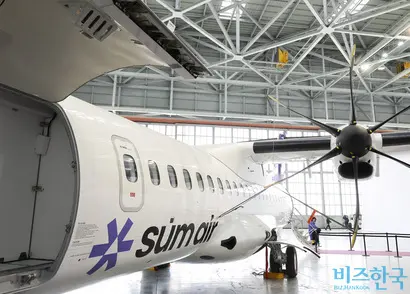
SumAir, a newcomer to the aviation industry, held an induction ceremony for its first aircraft at Gimpo Airport on the 15th. SumAir was established in 2022 with the goal of connecting aviation-marginalized regions like islands. It obtained a small air transport business license in February last year and is preparing to begin operations after introducing its first aircraft in January of this year. Once it receives its Air Operator Certificate (AOC), which was applied for in September of last year, it plans to begin operating the 'Gimpo-Sacheon' route within the first half of this year. By 2028, it plans to expand its service scope to Ulleungdo, Baengnyeongdo, Heuksando, and Tsushima, Japan.
Instead of competing with major airlines or existing LCCs, SumAir plans to focus on connecting island regions or regional airports that other domestic airlines do not serve. It also aims to build east-west routes and Honam-Gangwon routes where KTX does not operate. Choi Yong-duk, CEO of SumAir, stated, "We will target areas that domestic airlines do not serve, primarily focusing on island regions and aviation-marginalized areas," adding, "We will contribute to the vitalization of regional airports."
CEO Choi emphasized that SumAir can contribute not only to tourism but also to the improvement of living infrastructure in island regions. He noted, "Baengnyeongdo has demand for Marine Corps transport, and there are no hospitals on Ulleungdo," pointing out, "We also play a role in guaranteeing essential mobility by supporting emergency medical situations." SumAir plans to establish an emergency patient transport system through medical cooperation with Bumin Hospital, one of its shareholders.
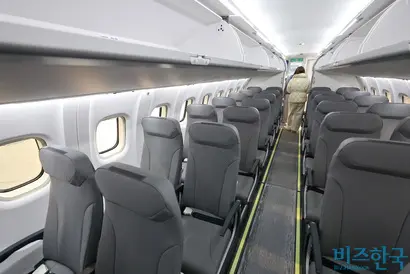
The first aircraft is a newly manufactured ATR 72-600, a 72-seat turboprop. It is characterized by higher economic efficiency compared to jet planes and the ability to take off and land on runways as short as 1,200 meters.
Alexis Vidal, Chief Commercial Officer (CCO) of ATR, who participated in the ceremony to introduce the aircraft, explained, "The ATR 72-600 consumes 45% less fuel than the existing B737 model, offering carbon reduction benefits," and added, "It has the advantage of 25% lower cost per seat compared to jet aircraft." Regarding the safety of the turboprop, he stated, "There are already 1,300 ATR aircraft operating in over 100 countries," and "It can operate even in crosswinds of 35 knots (18m per second), the same as other jets."
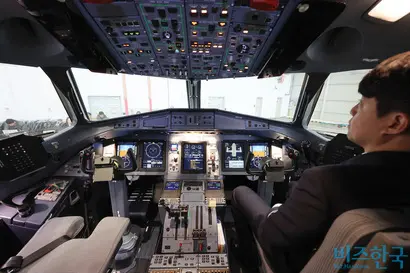
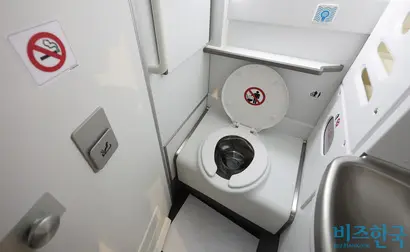
SumAir's challenge is to overcome the failures of past small-scale airlines. Previously, small airlines struggled due to consumer prejudice against propeller planes and declining profitability. Hi Air, which operated the ATR 72 model, failed to generate stable profits and ceased operations in 2023. SumAir expects higher profitability than previous small airlines as the seat limit for small air transport businesses was eased from 50 to 80 seats in 2024. Once SumAir begins operations, it will be the first airline to benefit from these relaxed licensing criteria.
To create local demand, SumAir signed memoranda of understanding (MOU) with local governments, including Ulsan Metropolitan City and Gyeongsangnam-do, last year and is currently cooperating with them. The company announced that it intends to set airfare at a reasonable level comparable to existing transportation means to island regions.

SumAir CEO Choi Yong-duk said, "As we are receiving proposals for routes from various local governments, we are not just stopping at increasing routes but are designing air services that are truly needed by the regions," adding, "We are aiming to set airfares not at a burdensome price just because it is a flight, but at a competitive level of around 140,000 to 150,000 won, which is the cost of using a KTX and ferry when traveling from Seoul to Ulleungdo."