

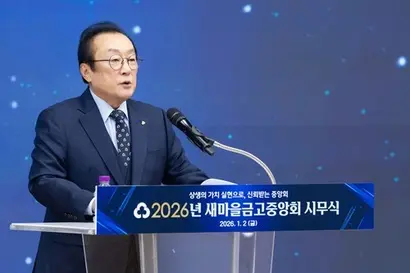
[비즈한국] Newly re-elected Kim In, Chairman of the Korean Federation of Community Credit Cooperatives (KFCC), is facing a harsh reality immediately upon taking office. The government has signaled high-intensity management and supervision, and with the cleanup of record-level insolvent branches expected, the pressure for internal restructuring is greater than ever. To make matters worse, allegations of sexual harassment surrounding Chairman Kim himself have further compounded the burden on his leadership.
Tasks of structural reform and strengthening soundness are piling up
In the 20th KFCC chairmanship election held last December, Chairman Kim In was elected with approximately 79% of the vote. He received high marks for successfully navigating the bank run crisis during his term and for lowering the delinquency rate, which had soared to 8.37%, down to 6.78% through preemptive sales of non-performing loans.
Chairman Kim had served as acting chairman after his predecessor, Park Cha-hoon, was indicted on bribery charges, and was elected as the 19th chairman in the first direct-vote by-election participated in by local MG branch heads in 2023. With this re-election, Chairman Kim’s term will continue for four years until March 14, 2030.
Despite receiving overwhelming renewed support, Chairman Kim faces a mountain of tasks. The most urgent is to resolve the government's distrust and restore faith in its management and oversight direction. Since taking office, President Lee Jae-myung has emphasized the overall structural reform of the financial market, stating multiple times, "We can no longer leave financial blind spots neglected where the scale has grown but the management and supervision system remains lax." He particularly took issue with the reality that institutions managing bank-level assets while claiming to be grassroots finance operate outside the framework of existing financial regulations.
Under this backdrop, the KFCC, often pointed out as a representative financial blind spot, has recently emerged as a top target for government reform. In the '2026 Economic Growth Strategy' released on the 9th, the government identified insolvency in the KFCC as a potential risk factor, alongside uncertainty in foreign exchange and real estate markets and household debt.
Recently, the Ministry of the Interior and Safety and the Financial Supervisory Service extended the 'Special Management Period' for the KFCC and deployed a large number of dedicated personnel. The Financial Services Commission increased the number of staff dedicated to managing and supervising the KFCC at the Financial Supervisory Service by 10, effectively transitioning the management system, which had been operating on a concurrent basis, to a 'permanent management system.' Consequently, the intensity of supervision is expected to increase further. Financial authorities plan to expand the number of branches under supervision while accelerating the cleanup of delinquent loans and the restructuring of insolvent branches.
Rapid increase in insolvent branches... Chairman Kim also faces legal risks
Although the KFCC's delinquency rate fell from the 8% range to the 6% range during Chairman Kim's previous term, it is still considered high, given that commercial bank delinquency rates are typically below 1%. Accordingly, the KFCC has identified securing financial soundness as a key task to be resolved preemptively during Chairman Kim's extended term. A KFCC official said, "We plan to prioritize structural improvement and the strengthening of soundness."
Poor soundness management at individual branches is also under fire. Last year, the number of insolvent branches cleaned up by the KFCC reached 22, the highest level in 10 years since 2015. The number of cleaned-up insolvent branches, which was only one in 2020, jumped to 12 in 2024 and nearly doubled last year. This is analyzed as being due to the high-interest rate trend and real estate market downturn over the past few years, which caused the delinquency rate for Real Estate Project Financing (PF) loans to skyrocket, pushing the loss-absorption capacity of individual branches to its limit.
According to Korea Ratings recently, among the 1,250 KFCC branches, the number of branches receiving grade 4 (vulnerable) and grade 5 (dangerous) in management status evaluations increased significantly from one at the end of 2022 to 159 at the end of June last year. The market expects the scale of insolvent branch cleanups this year to be larger than last year. Regarding this, the KFCC stated, "As the year-end settlement is not yet complete, the specific number of branches subject to merger has not been determined."
To increase the financial soundness of individual branches, the KFCC is pushing for a plan to raise the capital adequacy ratio standard to 7%, the level of savings banks. Furthermore, it plans to strengthen internal controls over all loan operations, such as digitizing the lending process to block illegal and fraudulent loans. To improve the existing practice of focusing on real estate and mortgage loans, it has decided to apply a 110% weight to real estate and construction loans when calculating the net capital ratio, and to limit the Project Financing (PF) loan limit to within 20% of total loans.
A KFCC official explained, "This does not mean we will raise the capital adequacy ratio to 7% immediately, considering the realistic conditions of individual branches; we plan to gradually increase the standard every year."
However, the challenges Chairman Kim must resolve are not limited to financial soundness. While bearing the heavy responsibility of organizational renewal and restoring external trust, the internal burden on the federation is growing even larger due to sexual harassment allegations surrounding Chairman Kim himself.
It is reported that in a phone call with an employee, identified as A, in 2024, Chairman Kim used derogatory profanity several times while referring to the body of a victim of a past sexual assault case, identified as B. Accordingly, A filed a complaint against Chairman Kim with the Women and Youth Division of the Seoul Yongsan Police Station in December 2025, and a police investigation is currently underway. The police are said to have recently investigated Chairman Kim as the accused, following the completion of the complainant's interrogation. A source at the Seoul Yongsan Police Station said, "Chairman Kim has also been investigated, and the investigation is currently ongoing."
This allegation surfaced even before the election and was discussed as the biggest variable in his re-election. While Chairman Kim overcame the political hurdle by winning renewal with an overwhelming percentage of votes, the legal risk is evaluated as still ongoing. The KFCC commented, "As this is a case where an individual has been sued, the company does not know the details of the investigation process."