

[비즈한국] Hanwha000880 has spun off its ‘Hanwha Machinery & Services Holding’ through a demerger. While ostensibly a corporate restructuring aimed at operational efficiency, the business and capital markets are interpreting this as a move far beyond mere reorganization. It is a rare instance where four key pillars are simultaneously at play: clarifying the succession scheme, perfecting the governance structure, enhancing shareholder value, and addressing the ‘Korea Discount.’
“No Brotherly Conflict”: Resolving Governance Dispute Risks
The most significant characteristic of this spin-off is the structural separation of the business domains of Vice Chairman Kim Dong-kwan and Vice President Kim Dong-seon, two of Chairman Kim Seung-yeon’s three sons.
Vice Chairman Kim has established himself as the lead for ‘heavy industrial’ sectors—such as defense, shipbuilding, and energy—that require large-scale capital and long-term investment. This is interpreted as a choice considering both the group’s stability and alignment with national strategic industries. Conversely, Vice President Kim takes on ‘light assets’ businesses, such as robotics, food tech, and retail, which require rapid adaptation to market changes.
Within Hanwha, this is being evaluated as “laying down tracks that are so distinct they cannot possibly overlap, moving beyond simple role-sharing between brothers.” The interpretation is that the company aimed to effectively pre-empt any possibility of future management disputes, regardless of changes in shareholding structures or financial performance.
Burning 450 Billion Won in Treasury Shares… A Bold Move Abandoning the ‘Magic of Treasury Shares’
A detail that the capital market is particularly noting is the cancellation of treasury shares amounting to 5.9% of common stock, roughly 456.2 billion won. In past demergers, treasury shares have often been used as a tool to indirectly bolster the controlling shareholder’s influence, often dubbed the ‘magic of treasury shares.’
Hanwha has proactively removed this point of contention. Beyond simply responding to the government’s ‘Value-up’ policy, this sends a clear message to the market: “There will be no erosion of shareholder value in the process of governance reform.” While it represents a short-term financial burden, it is viewed as a choice that will reduce governance-related discount factors in the mid-to-long term.
Consequently, the task for Vice President Kim Dong-seon, who will lead the new entity, is clear: he must prove both stable cash flow and a future growth story. Firstly, the earnings generated by Hanwha Vision in the global AI security market will act as a financial pillar for the new entity. Added to this are Hanwha Semitech, which has proven its technical prowess through HBM equipment orders from SK Hynix000660, and Hanwha Robotics, which handles food tech and robotics.
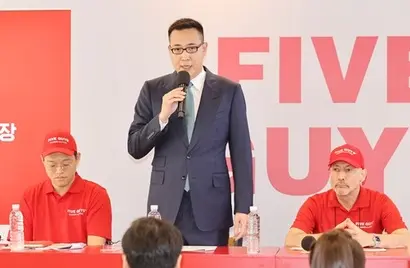
For Vice President Kim, who has demonstrated his acumen in the consumer market through the Five Guys business, the remaining challenge will be proving his management philosophy—‘the combination of high technology and lifestyle’—with concrete numbers, alongside the earnings recovery of Hanwha Galleria.
‘Hanwha Energy’ Becomes the Key to Governance… The Deciding Factor is the New Entity’s ‘Profitability’
The final destination of this reorganization is, ultimately, Hanwha Energy. With the structure completed where Hanwha Energy—owned 80% by the three brothers (Kim Dong-kwan 50%, Kim Dong-won 20%, Kim Dong-seon 10%) and 20% by a financial investor—becomes the largest shareholder of Hanwha Corp., the group has achieved one of the most simple and transparent governance structures among major domestic conglomerates.
However, it is pointed out that alongside the rosy interpretations of this spin-off, potential risks and limitations are clear. First, the structure where the owner family’s stake remains equal in both entities after the spin-off provides stability in the short term, but leaves uncertainty regarding future potential share swaps or stake transfers in the mid-to-long term.
If the scenario discussed in the market—where Vice Chairman Kim Dong-kwan sells his stake in the new entity to increase his stake in the surviving entity—were to materialize, shareholders might face a phase where they have to scrutinize potential conflicts of interest during the consolidation of control. This means the question, “It looks fair now, but what is the next move?” has not been fully resolved.
The business structure of the new entity is also on trial. While it possesses a stable cash generator in Hanwha Vision, sectors like robotics, food tech, and retail are still in areas where the timing of investment returns is uncertain. In particular, Hanwha Galleria452260 and the lifestyle division are highly sensitive to economic cycles, carrying the limitation of high earnings volatility. This difference in business nature is part of why the market interprets this split as the ‘beginning of affiliate separation.’ Ultimately, for this demerger to fully achieve its goal of resolving the conglomerate discount, the key will not just be the structural change itself, but whether the new entity can independently prove both its profitability and growth potential.
A business source remarked, “This spin-off appears to be a move by Hanwha to resolve a significant portion of the uncertainties surrounding its succession scheme and governance structure,” but added, “However, market evaluations could change depending on the potential for future share movements and how the new entity’s business performance unfolds.”