

[비즈한국] On New Year's Day 2026, Genesis BBQ employees climbed Mt. Seolbong in Icheon, Gyeonggi-do. This annual New Year's hike is a signature tradition for BBQ. Contrary to its public image as a global company, internal assessments suggest that BBQ’s organization remains stuck in a top-down, authoritarian management style. Analysts point out that fatigue from this organizational culture is fueling staff turnover and the successive resignations of professional executives, creating a management risk.
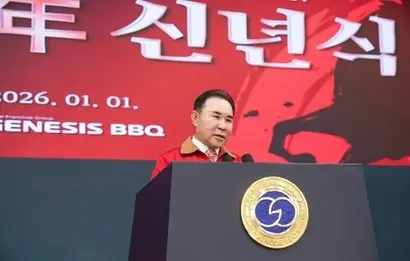
Companies Still Do This? 'New Year's Hiking' in the Freezing Cold of January 1st
Genesis BBQ, considered a representative chicken franchise, is often called the "BBQ Army" within the industry. This is because a distinct military-style organizational culture is deeply embedded throughout the company. This culture is linked to the background of founder and Chairman Yoon Hong-geun. As a member of the first class of the Army Academic Officers program, Chairman Yoon is seen as having integrated the top-down management style and hierarchy-centered leadership he experienced during his military service into his overall corporate management.
Chairman Yoon’s attachment to military-style management is widely known both inside and outside the industry. In fact, BBQ is considered a company that actively hires military veterans and has been selected as an "Excellent Company for Veteran Employment" multiple times, resulting in a large number of former military officers within the organization. This has led to the analysis that a vertical decision-making structure and military-style chain of command have naturally solidified into the corporate culture.
This "military DNA" also leads to unique management practices. A prime example is the "New Year's Hike" held every January 1st. It is reported that every year on New Year's Day, Chairman Yoon and all employees hold a kick-off ceremony at the company's educational institution, "Chicken University," in Icheon, Gyeonggi-do, followed by a joint hike up the nearby Mt. Seolbong. The event involves the Chairman and employees climbing the mountain to watch the first sunrise of the year together.
In the past, many companies used hiking as part of their management activities to emphasize organizational cohesion and unity while symbolically demonstrating the will and mental strength of the staff. However, as times changed, corporate culture shifted rapidly. With the spread of a social atmosphere that values horizontal communication and individual life, such group activities began to be perceived as outdated, "boomer culture." Consequently, many companies abolished large-scale hikes and replaced them with online New Year messages or town hall meetings to improve their organizational culture.
Conversely, BBQ is known to continue its New Year's hiking tradition. This year, the hike took place on January 1st, alongside the New Year's ceremony. Despite the freezing cold, with morning temperatures dropping to around minus 10 degrees Celsius, Chairman Yoon and his employees climbed the mountain together.
The practice of "chanting slogans," where all employees gather to shout management goals before starting work, also continues. A former BBQ employee remarked, "We used to shout slogans together in the office before starting work. Many people are very surprised to hear that companies like this still exist these days."
Employee complaints about the rigid corporate culture are pouring out on corporate review platforms as well. Criticisms include, "It feels like a communist, North Korean-style organizational culture rather than just military-style," "I don't understand why all employees have to gather for a hike on January 1st. Shouldn't we spend that time with our families?" and "A culture that forces us to memorize the owner's beliefs and even mandates reading his autobiography is too burdensome in this day and age."

Over 10 CEOs Replaced in 17 Years: "Organizational Culture Must Change"
Many acknowledge that BBQ's military-style culture was a key driver of its past growth. Driven by strong leadership, BBQ rose to become the domestic leader in a short period and achieved results in expanding into overseas markets. However, as times change, this rigid culture is increasingly pointed out as a source of "human risk."
According to Wanted Insight, which analyzes employment insurance and national pension subscriber statistics, the turnover rate at BBQ in 2024 was 83.7%. This is a significant difference compared to competitors like bhc (12%) and Kyochon F&B (17.7%). The trend of talent loss continued last year. In February 2025, 78 people were hired but 71 resigned, and in March, 91 were hired while 64 left. In just two months, 135 people departed.
BBQ explained that the high turnover rate reflects statistical anomalies due to the company's characteristics. A BBQ official stated, "We have more direct-managed stores nationwide than our competitors. Each store employs about 20 to 30 people, and even if they work as part-timers, they are covered by the four major social insurance plans if they work for more than a month. When these employees leave for reasons like returning to school, they are all counted as turnover, which makes the rate appear high."
However, this explanation does not cover everything. Not only are entry-level staff leaving, but the professional executives leading the company are also resigning one after another without completing their terms. Since introducing a professional management system in 2009, BBQ has replaced more than 10 CEOs over 17 years.
Former CEO Lee Sung-rak, who took office in 2017, submitted his resignation after just 21 days, and former CEO Jung Seung-in, hired in 2021, stepped down after three months. Former CEO Lee Seung-jae, appointed in January 2022, left after seven months, and former CEO Jung Seung-wook resigned after five months. A former CEO from CJ CheilJedang, who took office in July last year, also resigned in December before serving half a year. BBQ recently appointed Park Ji-man, who previously worked at Korean Air, GS Caltex, and managed planning and strategy at KT, as the new CEO. However, the industry's focus is less on his potential achievements and more on "how long he will last this time."
Industry observers analyze that the frequent turnover of executives and high staff turnover are linked to BBQ's vertical organizational culture and, further, its owner-centric, autocratic management style. One distribution industry official pointed out, "It is difficult to explain the successive departures of professional executives by anything other than the owner-centered management style, or 'owner abuse of power.' A structure is being repeated where Chairman Yoon hires professional CEOs but cannot trust them."
Concerns about the military-style culture within BBQ are also being raised. Seo Yong-gu, a professor of business administration at Sookmyung Women's University, pointed out, "The core of the current workforce is the MZ generation, and if a company persists in a culture that is not friendly to them, it cannot retain top talent. The current rigid corporate culture must change."
BBQ stated, "The resignation of CEOs has nothing to do with corporate culture. Since they do not disclose specific reasons for their resignations, the company does not know the exact reasons either." Regarding employee complaints about the rigid culture, they said, "It is an internal company matter, so it is difficult to answer."