

[비즈한국] One of the most famous landmarks in the winter night sky is the Pleiades star cluster. Near the constellation Taurus, you can see several exceptionally blue stars clustered together rather than just one. For a long time, the Pleiades has been called the 'Seven Sisters' because seven bright stars are visible to the naked eye. However, it was recently discovered that the Pleiades has thousands of hidden relatives. In fact, the stars that make up the Pleiades stretch across the entire sky as extensively as the Milky Way itself.
The Pleiades was merely considered an open cluster placed at a relatively close distance. While about seven bright stars are visible to the naked eye, it was thought to be a loose gathering of about 1,000 young stars within a narrow area of about 15 light-years. However, this recent discovery has completely overturned our understanding of the Pleiades. There are at least 3,000 more stars that make up the Pleiades. Moreover, the size of the Pleiades is at least 20 times larger than we previously knew!
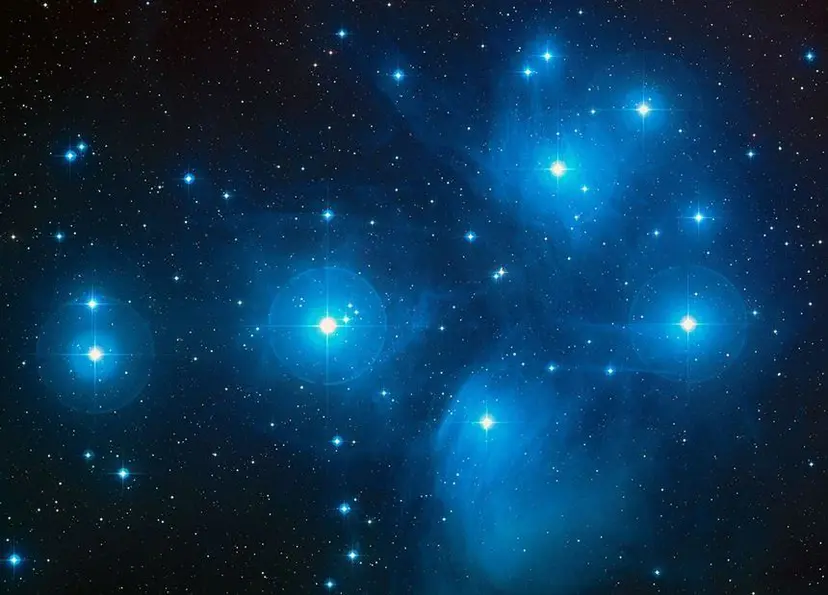
Stars in our galaxy are born within giant molecular gas clouds. As gas clouds undergo gravitational contraction, young protostars are born one by one. As the giant cloud goes through a fragmentation process, splitting into several smaller pieces, multiple new stars are born at once throughout a single giant molecular cloud. After time passes and the gas clears, what remains is an open cluster where only newly born, blue, hot young stars are sparsely gathered. The Pleiades is also one of the open clusters born in this way.
Young stars of the same age living in an open cluster cannot stay together forever. As they orbit the galaxy while held by the Milky Way's gravity, the gravitational forces of the entire galaxy can disrupt the shape of the open cluster, causing some stars to leak out. Just like Hansel and Gretel in the fairy tale leaving breadcrumbs behind them, disintegrating clusters slowly shed stars that fall away along their trajectory. The Pleiades likely went through this process, shedding its original members into the space of our Milky Way.
Astronomers used the TESS (Transiting Exoplanet Survey Satellite) and Gaia space telescopes to search for the Pleiades' relatives by examining every corner of the night sky over about a month. Gaia is an excellent telescope for precisely measuring the distances of countless stars in our galaxy. Throughout its mission from 2014 to 2025, Gaia mapped the precise 3D positions and movements of 880 million stars shining along the Milky Way. An interesting point is that TESS was originally launched to find exoplanets orbiting other stars. Like the Kepler Space Telescope before it, it utilizes the 'transit' phenomenon, where starlight periodically dims due to an exoplanet passing in front of the star.
However, the periodic dimming of starlight can also occur for reasons other than exoplanets. A prime example is 'starspots,' dark blemishes that appear on a star's surface. As a star with starspots rotates, if we view it from the side with the spots, the star temporarily appears dimmer. By measuring how often the starlight dims, we can determine how fast the star is rotating—and therefore how often it reveals its spotted side—which gives us the rotation period. A space telescope built to see the silhouettes of exoplanets unexpectedly discovered a new type of information: the rotation periods of stars!
A star's rotation period is very important. Usually, stars get tired as they age, and their rotation slows down. Measuring how fast or slow a star is rotating can serve as an indirect benchmark to determine the star's age. Astronomers utilized this principle to find the Pleiades' lost relatives!
The stars in the Pleiades were born about 100 million years ago. If relatives born around the same time are hiding somewhere, they should not only have a similar chemical composition to the current members of the Pleiades but also be around 100 million years old. They must also move along an orbit very similar to that of the Pleiades.
Astronomers scoured the stars in the Milky Way with Gaia and TESS. They identified candidate stars that moved at similar speeds along trajectories nearly identical to the Pleiades. Then, they compared their chemical compositions. Finally, based on the rotation periods determined by TESS starspot observations, they selected stars that appeared to have slowed down just enough since being born 100 million years ago. They selected only those stars where all three factors—orbital path, chemical composition, and age determined by rotation period changes—matched perfectly! The probability of all these elements aligning perfectly by pure coincidence is extremely low. If all factors match, there is a very high probability that these stars share the same origin as the Pleiades.
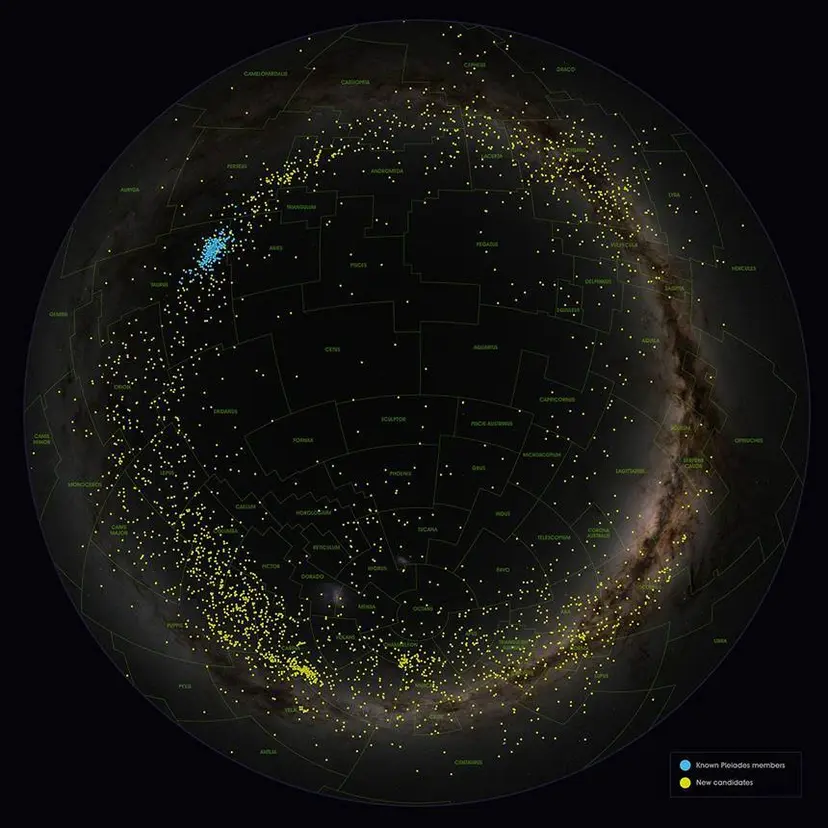
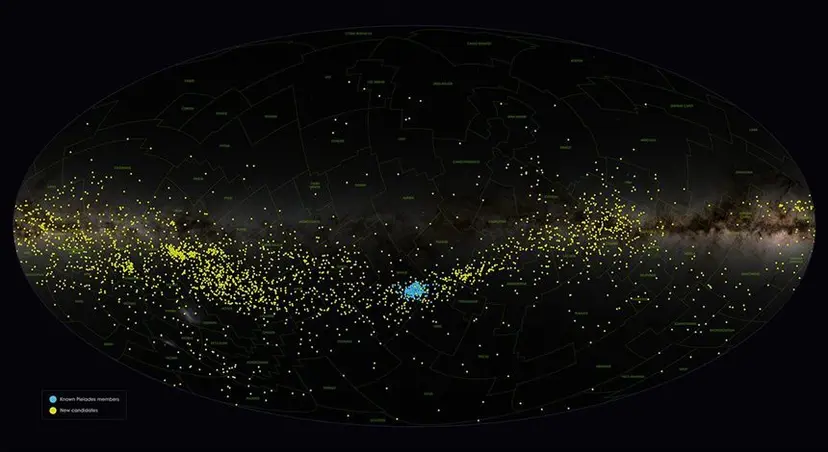
There are a whopping 3,000 such newly discovered stars! Moreover, these stars extend far beyond the area of the Pleiades we are familiar with, drawing a massive band across the night sky along the Milky Way.
The Pleiades must have been born about 100 million years ago, with stars clustered together much more densely than they are now, much like the stars currently forming the Orion Nebula. However, as time passed, stars that finished their evolution early met their end in supernova explosions, and in the aftermath, many stars were scattered outside the cluster. Furthermore, over the past 100 million years, as the cluster as a whole traveled rapidly through the Milky Way, it underwent a process of stretching and disintegration due to the gravitational and tidal forces of the entire galaxy. The stars it shed were left behind in long trails along the path the Pleiades traveled. It was simply that their presence went unnoticed for so long because they were buried within other stars and the Milky Way.
This discovery also provides an important clue as to why it was so difficult to accurately measure the distance to the Pleiades. Despite its fame, the Pleiades is a celestial object for which the exact distance is unexpectedly unknown. Early measurements estimated the distance at about 430 light-years, but a controversy began when the Hipparcos space telescope calculated a much shorter distance of 390 light-years. However, this may be a misunderstanding caused by the fact that the Pleiades star cluster itself is currently stretching out and disintegrating. As it happens, the direction in which the distribution of stars in the cluster has stretched is parallel to our line of sight from Earth. At first glance, the stars appear to be well-clustered within a small area, but viewed from the side, they might look very elongated. In other words, the distance to the cluster can vary depending on which star is used as the reference point when calculating the distance.
This discovery demonstrates that a star's age, determined by its rotation period, can also be utilized in various ways to map the stars in the Milky Way and identify their origins. In fact, discussions about stellar streams winding around our galaxy have previously focused only on older globular clusters and dwarf galaxies. This is because older stars have much more easily distinguishable chemical compositions, and the orbits of globular clusters are more distinctly separated from other young stars in the Milky Way's disk. It is difficult to distinguish which young stars born in the Milky Way's disk belong where or were born where, because they all orbit in the disk. On the other hand, globular clusters wander through the galactic halo, exiting the galactic disk and drawing clearly different orbits. Therefore, when discussing the long tails or traces of stars left behind by disintegrating clusters or dwarf galaxies, astronomers usually focused on old globular clusters.
However, this discovery shows that it is possible to determine the ages of relatively young stars and stars that make up open clusters and identify their origins by using their rotation periods. Furthermore, it is incredibly inventive that data from a space telescope originally launched to hunt for exoplanets was utilized to lead to a unique discovery outside of its original intent. A method once used to understand the long, old history and ancient times of our galaxy can now be used as a tool to understand the much more recent, 'modern' history of the Milky Way.
Tonight, let us look at the blue-glowing Pleiades in the winter sky once more. And let us think about the other members of the Pleiades that are invisible but stretched out long before and behind it. Imagine the tails of numerous stars that the Pleiades left behind as it disintegrated, following the gaze as it slowly shifts from one horizon to the other. You will be able to feel the clear river of the Milky Way above our heads flowing along with the stream left by the Pleiades.
References
https://iopscience.iop.org/article/10.3847/1538-4357/ae0724#sidr-main
https://science.nasa.gov/missions/tess/nasas-tess-spacecraft-triples-size-of-pleiades-star-cluster/
About the author Ji Ung-bae? He loves cats and the universe. After watching 'Galaxy Express 999' as a child, he dreamed of spreading the beauty of the universe. Currently, he is an assistant professor in the Faculty of Liberal Arts at Sejong University, engaged in various science communication activities including lectures and writing. He has authored books such as 'A Piece of the Universe Every Day,' 'Scientists of the Starry Universe,' 'Can't Go But Can Know,' and 'Strange Questions That Come to Mind When Looking at the Universe,' and translated books including 'The Hitchhiker's Guide to the Real Universe,' 'How I Killed Pluto,' 'Quantum Life,' and 'Cosmigraphics.'