

[비즈한국] The South Korean shipbuilding industry hit an record-breaking order jackpot as 2026 began. The three major shipbuilders—Samsung Heavy Industries010140, Hanwha Ocean042660, and HD Korea Shipbuilding & Offshore Engineering009540—have successfully secured orders for Liquefied Natural Gas (LNG) carriers worth approximately 5 trillion won since last December. This order boom is attributed to the global spotlight on LNG as a bridge for the energy transition, as well as the reshuffling of the global energy supply chain, driven by the full-scale operation of large-scale LNG production facilities, primarily in the United States and Qatar.
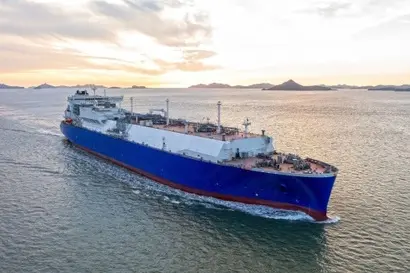
Hanwha Ocean, Samsung Heavy Industries, and HD Korea Shipbuilding & Offshore Engineering Win Consecutive Orders
Hanwha Ocean announced on December 18 of last year that it had signed a contract with a European shipowner for seven LNG carriers. It is a large-scale contract totaling 2.5891 trillion won. Subsequently, on December 31, Samsung Heavy Industries also won a contract to build two LNG carriers for a shipping company in the Oceania region, valued at 721.1 billion won.
News of LNG carrier contracts continued into this year. HD Korea Shipbuilding & Offshore Engineering announced on the 6th that it had signed a contract with a North American shipping company to build four ultra-large LNG carriers. The total contract value is 1.4993 trillion won. The Korea Chamber of Commerce and Industry projected that in 2026, the shipbuilding industry's exports, bolstered by LNG carrier orders, would reach $33.92 billion (50 trillion won), an 8.6% increase compared to the previous year.
The reason behind the global concentration of demand for LNG carriers lies in the 'energy transition.' In the process of moving toward carbon neutrality, the value of LNG as a 'bridge energy' is gaining attention. As LNG emits less carbon than coal or oil, it has become a realistic alternative until a full transition to renewable energy is achieved. Furthermore, due to International Maritime Organization (IMO) regulations on ship emissions, shipping companies are increasingly opting for LNG-powered vessels instead of traditional bunker C oil, significantly boosting demand for ship fuel.
In particular, demand for gas-based power generation has risen to meet the surging power needs caused by the recent expansion of AI data centers. For data centers where a stable, 24-hour power supply is essential, LNG power generation has emerged as a savior, standing between weather-dependent renewable energy and nuclear power, which requires long construction periods.
Widening the Technology Gap with China is the Challenge
Another reason for the increased demand for LNG carriers is that LNG supply is set to expand significantly. Since the shale gas revolution, the U.S. has been accelerating the construction of export terminals. From 2026, many new liquefaction facilities, such as the 'Golden Pass' project, are expected to be completed, likely increasing export volumes by more than 10% compared to current levels.
Qatar, one of the world's largest gas producers, is also beginning to substantially expand its production capacity from 77 million tons to 126 million tons annually starting in 2026 through its 'North Field' expansion project. In the second half of the year, Australia's 'Pluto Project' is also set to begin its first LNG production.
Consequently, Europe's efforts to replace Russian pipeline gas (PNG) continue. Since the Russia-Ukraine war, Europe has significantly expanded its LNG import terminals for sea-borne delivery to reduce its reliance on Russian gas. As the supply chain expands, demand for carriers is naturally increasing.
Of course, it is not without competition. Just as they did in the container ship market, where they leveraged massive capital and price competitiveness to seize an over 80% market share, Chinese shipbuilders are pressuring our shipbuilding industry in the LNG carrier market as well.
However, LNG carrier technology, which involves safely maintaining and transporting gas at the cryogenic temperature of minus 163 degrees Celsius, requires extreme precision. South Korean shipbuilders are still evaluated as having the highest level of reliability in the world in this technology. Experts agree that to maintain market leadership in LNG carriers amid the growth in global LNG demand, the task at hand is to widen the technological gap with China.