

[비즈한국] The Korea Art Support Project, which began with the sole purpose of supporting artists, has been running for 10 years. Keeping true to our initial intentions, we have supported around 230 artists. It was a unique endeavor, unprecedented by any media outlet, cultural organization, or government institution in Korea. We take pride in the fact that this decade of persistence has become a value embedded in the 21st-century Korean art scene. Consequently, the 10-year history of the Korea Art Support Project is recognized as a perspective through which to observe the flow of contemporary Korean art. Now, in Season 11, we aim to pave another path for Korean art.
In painting, there are two ways to express an artist's thoughts: descriptive expression and poetic expression. Descriptive expression is a way of kindly explaining the content, leading to a clear narrative. It is a style frequently used by artists who make their intended message their primary artistic goal.
In painting, this has often involved themes such as mythology, religious stories, the achievements of kings or nobles, or political ideologies. Therefore, descriptive expression prioritizes a documentary nature, aiming to preserve content for future generations.
In contrast, poetic expression lacks clear content that could be woven into a story. While the narrative is not explicit, the meaning embedded in the image is rich. This is because the method of conveying content is different.
The art form that best utilizes poetic expression is music. Music does not convey or explain specific stories. Exceptionally, music referred to as program music does have a clear narrative. However, most music uses a poetic mode of expression. That is why we visualize certain images while listening to music. If the music is connected to one's own unique experiences or memories, it can even evoke concrete images or events.
In "Landscape in the Mist," director Theo Angelopoulos depicts the painful journey of young siblings searching for their runaway father as a metaphor for the fear and wandering of humanity in our godless era. This film is famous for its lyrical 'Adagio' melody. Played on the oboe, this music creates a dreamlike sensation, as if one is truly wandering through a fog.
The anxiety regarding an opaque future, symbolized by the fog, matches perfectly with the timbre of the oboe. Here, the oboe's melody does not narrate the film's content, but thanks to this music, the audience can easily read the director's inner heart. And the image planted by the oboe's melody remains in our hearts for a long time. This is the strength of poetic expression. It is a way of touching the emotions through images rather than stimulating reason through stories.

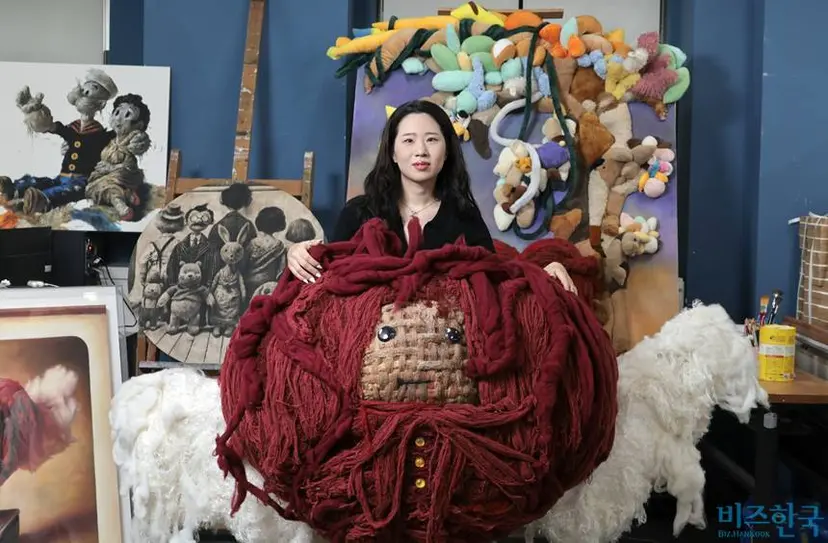
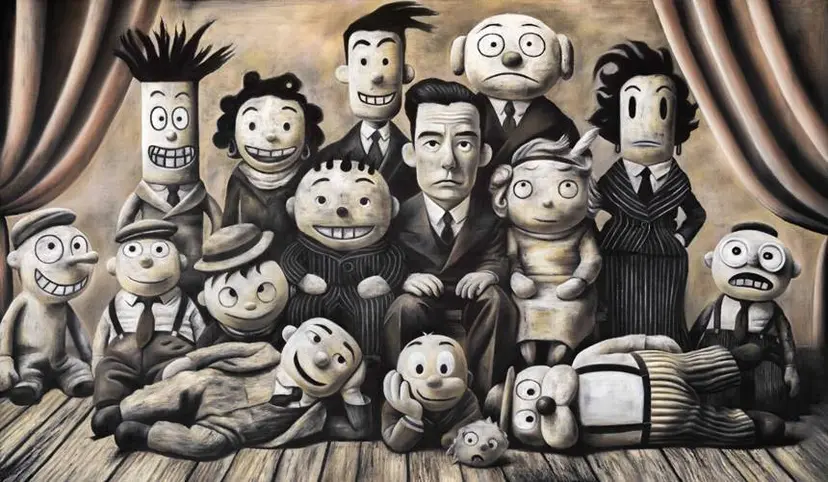
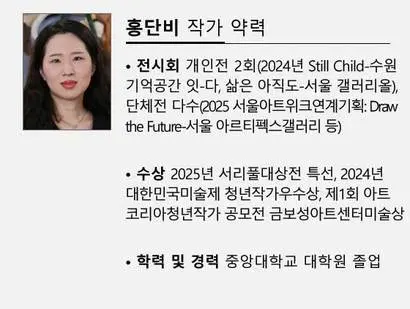
Hong Dan-bi's working method also follows poetic expression. She shows the effect of poetic expression by turning objects that everyone loved at least once in their childhood into images. She creates artwork out of objects commonly known as 'attachment dolls' to express her thoughts. What are those thoughts?
She aims to summon precious memories that fade with the passage of time. The artist says this is because these memories act as energy for us to live our lives.
Her character-like attachment dolls lack the vibrancy of Pop Art. Instead, they have a faint, nostalgic atmosphere that reveals the weight of time. To achieve this, the artist works with oil pastels. By leveraging the characteristics of the medium, she powerfully presents images of memory. This is the charm of Hong Dan-bi's work.