

[비즈한국] Before it is an 'investment', housing is an 'infrastructure for survival'. And infrastructure always quietly, yet surely, forces people's choices. This is the current state of the Korean housing market. It is not about so-called premium areas like the three districts of Gangnam (Gangnam, Seocho, Songpa), Magok-Yongsan-Seongdong (Mapo, Yongsan, Seongdong), or Dongjak, Gangdong, and Yangcheon. Now, the more fundamental question has become, "Can you secure your own home?" rather than "Can you afford a premium area?" As jeonse prices soar, monthly rent skyrockets, and the supply of new move-in homes decreases, the expectation that "it will stabilize someday if I wait" is increasingly losing its basis. Whether it's the outskirts of Seoul, the semi-core of the metropolitan area, or core regions in the provinces, now is the time to seriously consider purchasing a home.
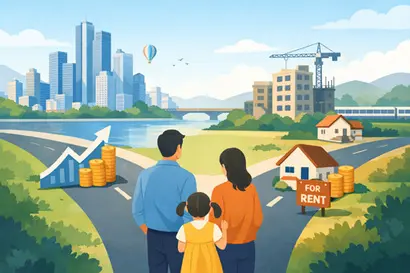
The point of this column is not mere fear-mongering. Nor is it a slogan saying "buy no matter what." It is simply an acknowledgement that the housing market has entered a structure different from the past. When the structure changes, the criteria for judgment must also change. The past expectation of "price declines" cannot compensate for current "rising housing costs" and "loss of residential stability." Now, one must look beyond just the sale price and consider the long-term direction of housing costs driven by changes in jeonse, monthly rent, supply, finance, and household structures.
First, jeonse is becoming a 'scarce commodity' rather than 'affordable housing'.
Jeonse was a uniquely Korean system, and many households used it as a ladder for housing. However, the current jeonse market has begun to take on the character of a "tug-of-war" rather than a "waiting room." As landlords' loan burdens grow and the tendency to avoid leasing risks strengthens, the supply of jeonse decreases. When supply drops, the deposit rises. If the deposit rises, loans are needed again, and when loans become difficult, people are pushed into monthly rent. This flow is closer to a structural path than a temporary phenomenon.
Jeonse was originally a 'buffer zone' before moving to ownership. But that buffer zone is thinning. When jeonse becomes unstable, people don't "wait it out with jeonse" but rather struggle to "secure jeonse," and in that process, prices climb even higher. Even if the sales market slows down when the jeonse market falters, the rental market never becomes friendly. One shouldn't be happy that jeonse prices fall; one should be wary of jeonse disappearing. Where jeonse disappears, monthly rent takes its place. Monthly rent directly eats into a household's cash flow. Once housing costs go up, they do not easily come down.
Second, the era of monthly rent is not an 'era of income' but an 'era of expenditure'.
A society where monthly rent increases may look like "flexible living" on the surface. But for most households, monthly rent is not flexibility; it is pressure. Monthly rent robs time for asset accumulation. Even with the same income, as the proportion of monthly rent increases, the capacity for savings and investment decreases. As a result, the wealth gap widens. Housing becomes a device for fixing social classes rather than a springboard for mobility.
The problem is specifically that monthly rent does not rise 'gradually.' When the market shifts rapidly from jeonse to monthly rent, the process of price discovery is rough and fast. Demand flocks while supply is limited, weakening the tenant's bargaining power. In a phase where monthly rent is spreading, "it will go down next year" doesn't work. Monthly rent is a monthly pain, and that pain immediately lowers one's standard of living. It encroaches on other essential expenses such as children's education, healthcare, and retirement planning.
When housing costs rise, people only think of "house prices," but what is actually scarier is that the very cost structure of life is being reorganized. During this period of reorganization, the choice to buy a home acts as a means of cost control rather than an investment. In that my own home is not exposed to fluctuating rent, it becomes a stabilizer for household finances in the long term.
Third, the decrease in move-in supply is 'physics', not 'psychology'.
The most powerful variable in the housing market is 'physical supply.' When supply is sufficient, prices stabilize, and rent also stabilizes. But when supply shrinks, the result cannot be solved by psychology. The saying "if people are scared and don't buy, it will stabilize" may apply to short-term speculative markets, but it is difficult to apply to the residential market. People need to live, households need homes, and local jobs and educational environments do not suddenly relocate.
In periods where move-in volume decreases, the scarcity of new and semi-new homes increases. At the same time, it drags even older homes up as 'substitutes.' The longer the choice to "wait because I can't buy in a premium area" lasts, the cost of that waiting is paid in jeonse or monthly rent. In a phase of declining supply, rent develops strong downward rigidity, and the sales market eventually follows the rent. Time is not on the side of the buyer, but on the side of a supply-constrained market.
Fourth, we must abandon the frame that 'if it's not a premium area, it's a failure'.
The reason many people hesitate to buy a home is only one: the question, "It's not Gangnam or a premium area anyway, so is it right to buy now?" This question is natural because the asset market has moved around 'premium areas' until now. However, frames lose their effectiveness when the situation changes.
The question needed now is this:
"Can I secure residential stability and future liquidity within a range I can handle?"
A premium area might be the 'right answer,' but it cannot be everyone's answer. Rather, the more one is trapped in the premium area frame, the more households end up facing rent increases without having made any decision at all. The decision to buy a house is not about choosing the 'highest-priced region,' but about securing the 'most reasonable base within my radius of life.'
Whether it's the outskirts of Seoul, a semi-core of the capital area, or a core region in the provinces, three things ultimately support house prices: jobs (demand), transportation (accessibility), and living infrastructure (residency). Add school districts and product quality to this. Places equipped with these conditions survive even if they aren't premium areas. And as the burden of jeonse and monthly rent grows as it is now, the real demand for these 'base regions' becomes even firmer.
Fifth, the provinces are no exception. 'Core regions in the provinces' are even more important now.
When talking about the provinces, we often divide into extremes. We repeat arguments between "the provinces are finished" and "the provinces are also rising." But reality is more nuanced. The provinces are not a single market. The core residential areas of metropolitan cities, residential areas supporting industrial complexes, transportation hubs, and centers where universities, hospitals, and government offices are concentrated have different economies within the provinces. The core regions of the provinces are maintained not because "the population is increasing," but because "demand remains."
There are two reasons why buying a home in a core provincial region is important.
First, if jeonse decreases, the transition to monthly rent proceeds quickly in the provinces as well. It is not just a problem for the metropolitan area. If anything, the more limited the supply of new homes is in a region, the faster new rental prices can spike. Second, in the provinces, once the burden of housing costs increases, 'moving to an alternative site' is not easy. This is because many households have fixed living spheres due to jobs, education, or caring for parents. While one can move to the next neighborhood in Seoul, in the provinces, moving itself can lead to the collapse of one's lifestyle.
Core provincial regions should be approached from the perspective of 'defending the cost of living' rather than 'investment profit.' If the goal of buying a home is not only 'capital gains,' then the reasonable purchase of a home in a core provincial region is actually more persuasive.
That doesn't mean you should just buy blindly: what is needed now is the 'technique of choice.' Saying that now is the time to consider buying a home does not mean you can buy any house. Rather, it is the opposite. In a period where the housing market is structurally changing, 'what you buy' becomes more important.
Finally, I would like to answer the question, "Wouldn't I be able to buy it cheaper if I wait a little longer?"
This question is always valid. However, the premise of the question has changed. In the past, the cost of waiting was relatively low. Jeonse was plentiful, the burden of monthly rent was not as high as it is now, and move-in volume buffered the market. But waiting now is not 'free.' While waiting, the jeonse deposit goes up, monthly rent goes up, moving costs are incurred, and the child's educational environment is shaken. In other words, waiting itself can be a loss.
Of course, prices rise and fall. There may be short-term adjustments. However, if the purpose of housing is 'living today' rather than 'selling tomorrow,' the criteria for judgment must change. If you can protect your residential stability and living sphere within a range you can afford, making an 'appropriate choice' is more important than hitting the perfect bottom.
Housing is the foundation of life, and if the foundation shakes, everything shakes. In a market like this, the advice to "wait a little longer" often becomes irresponsible. While waiting, housing costs rise, opportunities shrink, and life becomes exhausting. Conversely, those who have secured their own home can make plans even amidst uncertainty. They can decide on their child's school, calculate job transfers, and design their retirement. This is the power that residential stability gives.
It doesn't have to be Gangnam. It doesn't have to be a premium area. The important thing is to secure a place where "demand remains" within "a range I can handle" with a "structure I can endure." Now is a phase where the price of delaying that judgment is increasing. If the housing market has changed, our way of choosing must also change. It is time to return to the essence of housing costs and stability, not house prices.
Kim Hak-ryeol, head of the Smart Tube Real Estate Research Institute, known by his pen name Pashong, previously served as the team leader of the Real Estate Research Division at Gallup Korea. He operates and hosts the Naver blog "Pashong's World Expedition" and the YouTube channel "Stew TV." His books include "Re-writing the Republic of Korea Real Estate User Manual (2025)," "The Power of Gyeonggi Real Estate (2024)," "Absolute Principles of Seoul Real Estate (2023)," "The Future of Incheon Real Estate (2022)," "Kim Hak-ryeol's Absolute Principles of Real Estate Investment (2022)," "Republic of Korea Real Estate Future Map (2021)," and "From Now On, Only Places That Rise Will Rise (2020)."