

[비즈한국] Real estate fractional investment firm Lucent Block has raised suspicions of technology theft and unfair screening ahead of the announcement of the preliminary licensing results for the Token Securities (STO) over-the-counter (OTC) exchange. On January 12, Lucent Block announced that it had reported the consortiums involving the Korea Exchange (KRX) and Nextrade to the Korea Fair Trade Commission (KFTC). The KRX and Nextrade participated in the preliminary licensing process by forming partnerships with various securities firms and are reportedly the likely candidates for approval. As Lucent Block, which has sustained the market ahead of the institutional integration of fractional investment, faces the risk of being forced out due to a potential license rejection, attention is focused on their appeal.
Founded in 2018, Lucent Block is the company that operates the real estate fractional investment platform 'Sou'. It has been conducting its real estate fractional investment business since 2021 after being designated as an Innovative Financial Service (Financial Regulatory Sandbox) by the Financial Services Commission (FSC). On Sou, high-value commercial real estate is securitized into beneficiary certificates, allowing users to invest small amounts by purchasing shares, much like stocks. Investors receive monthly dividends based on their holdings or earn capital gains when the building is sold. Through Sou, Lucent Block has conducted public offerings for 11 properties, including Downtowner in Anguk, Seoul, and News Museum in Haenggung, Suwon.
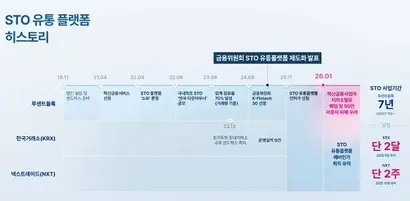
Lucent Block began its bid to acquire an investment brokerage license related to the distribution of trust beneficiary certificates in September 2025. This followed the FSC's announcement of a 'new licensing plan for the operation of fractional investment OTC exchanges (distribution platforms).' This was a plan to integrate existing fractional investment services that had been operating under the regulatory sandbox into the institutional system. At the time, the FSC stated that, considering the dispersal of liquidity, it would allow a maximum of only two companies to be licensed.
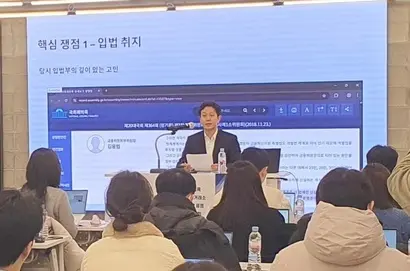
However, just ahead of the preliminary license announcement (January 14), Lucent Block held an emergency press conference on the 12th, raising allegations of △preferential treatment for vested interests, △unfair licensing procedures, and △technology theft. Heo Se-young, CEO of Lucent Block, claimed, "The administrative processing and the restructuring of the market around vested interests occurring during the institutionalization process completely contradict the purpose of the bill, and it appears they are attempting to oust Lucent Block from the market."
On the 7th, some media outlets reported that the FSC's Securities and Futures Commission had selected the Korea Exchange (KDX) and Nextrade (NXT Consortium) as the targets for the preliminary licensing of the fractional investment distribution platform. Lucent Block protested, stating that competition between public-natured institutions and startups is impossible. Nextrade is Korea's first alternative trading system (ATS) established through investments by 34 securities firms, financial holding companies, and IT firms. However, regarding the reports on the preliminary licensing results, the FSC stated, "Nothing has been confirmed regarding matters related to the licensing of the fractional investment OTC exchange."
Three entities applied for the fractional investment distribution platform preliminary license: △KDX, △NXT Consortium, and △Lucent Block. KDX is a consortium with the participation of the Korea Exchange and Koscom, and its largest shareholders are financial firms including Kiwoom Securities039490, Kyobo Life Insurance, and Kakao Pay Securities. The NXT Consortium is led by Nextrade and includes Musicow, Shinhan Securities, INF Consulting, Eugene Investment & Securities001200, Hana Securities, and Hanyang Securities001750. Lucent Block formed a consortium with entities including Korea South Pole Venture Investment Fund No. 3 and Hana Beyond Finance.
Lucent Block also raised allegations of technology theft by Nextrade. The core of the allegation is that last year, ahead of the license application, Nextrade obtained sensitive internal information from Lucent Block—such as financial data, shareholder registers, business plans, and core technical materials—under the pretext of considering investment and participation in the consortium, but then did not participate. At the time, Nextrade countered, "There was no content considered confidential. The information about the business status was merely general data meant to help understand the company's overview."
The controversy surrounding the license applications of the Korea Exchange and Nextrade was also mentioned during the parliamentary audit. At the October 2025 audit of the National Assembly's National Policy Committee, Democratic Party lawmaker Park Beom-kye pointed out, "It is unfair for Nextrade, which has a public nature, to emerge as a competitor based on the ideas and data of a startup," and added, "For the Korea Exchange to form a separate consortium to obtain a license is like the team owner playing as a player themselves. The reality of public-natured institutions entering the startup market and taking over the lead is a serious problem."
Lucent Block stated, "(The authorities) have not provided a clear explanation as to how they reflected that incident in the preliminary screening process," and added, "Financial authorities promised at the parliamentary audit to review the matter thoroughly, but we have not had a single communication since then."
At the press conference held on the 12th, Lucent Block announced that it had reported the KDX and NXT consortiums to the Korea Fair Trade Commission on charges of obstructing business activities and violating the obligation to report business combinations. CEO Heo Se-young said, "Consortiums involving large-scale corporations are supposed to undergo a preliminary review of whether business combinations are permissible before applying for a license, but I understand that KDX and NXT did not do so," adding, "If this issue is not resolved before the preliminary licensing, I consider it preferential treatment."
They also pointed out problems with the evaluation criteria. The Lucent Block side argued, "Despite operating the platform without any accidents for four years, the Korea Exchange and Nextrade, which have no actual business performance, received higher evaluations in the areas of technology and stability," claiming, "It is suspected that the evaluation criteria prioritized institutional status and formal requirements rather than empirical data."
They emphasized that the exclusion from licensing also goes against the purpose of the Special Act on Support for Financial Innovation. CEO Heo stated, "This case is about the institutionalization process of a business that a startup was already doing, resulting in the startup being ousted and vested interests taking over," adding, "Please consider protection measures such as exclusive operation rights for business operators who have attempted innovation, as intended by the bill." Exclusive operation rights refer to a system that provides priority to innovative financial service providers when they apply for official licenses to transition into full-fledged business operators, in order to help them settle into the market. When the FSC announced its licensing plan last year, it explicitly stated, "We plan to prioritize the license review of innovative financial service providers by considering exclusive operation rights under the Financial Innovation Act."
As the survival of its business depends on the results of this licensing, Lucent Block is pinning its life on a re-evaluation. CEO Heo Se-young appealed, "We are not asking for preferential treatment. We are asking to be evaluated according to the principles of the Financial Innovation Act," and added, "If we do not receive the license, the interests of our 500,000 users and shareholders will be infringed upon. I will begin a one-person protest in front of the Government Complex Seoul starting on the night of the 13th to make the unfairness and the contradictions of the system known."