

[비즈한국] Samsung Electronics005930 is once again at the center of the market. In the securities industry, the phrase “Samsung is back” is being used without hesitation regarding Samsung Electronics' recent fourth-quarter performance. An operating profit of 20 trillion won holds significance beyond just the numbers. This rebound is interpreted not as a one-time event, but as a signal that the profit structure of the semiconductor industry is fundamentally changing.
The core of this performance is undoubtedly semiconductors, and specifically, memory. It is estimated that DRAM prices surged by approximately 40% and NAND by over 20% in the fourth quarter compared to the previous quarter. The fact that price increases, rather than shipment volume growth, drove earnings demonstrates that the memory supply and demand environment has shifted entirely to a supplier-oriented market. Hana Securities described this as “violent memory pricing,” meaning that server customers have entered a phase where they prioritize securing supply over price negotiations.
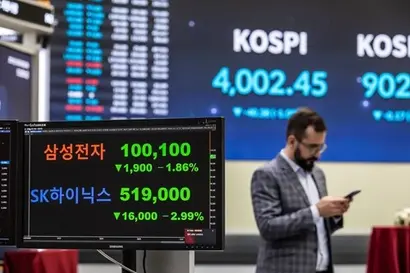
This trend is expected to become even more pronounced this year. Major securities firms are competitively upwardly adjusting their operating profit forecasts for Samsung Electronics this year. Daishin Securities projected an operating profit of 150 trillion won and raised its target price to 180,000 won, while KB Securities forecasted 145 trillion won and raised its target price to 200,000 won. This is well over double the operating profit of approximately 59 trillion won seen in 2018, which was considered the peak of the semiconductor supercycle. This is why analysts say we have entered a phase where the earnings potential itself is on a different level, rather than just a simple market recovery.
What makes this cycle decisively different from the past is Artificial Intelligence (AI). Samsung Securities analyzes that “the center of AI infrastructure has shifted to memory.” As generative AI and inference services proliferate, data processing efficiency has become as important as computational power, and in that process, demand for DRAM and High Bandwidth Memory (HBM) is growing explosively.
Perspectives on HBM competitiveness, which had been a source of market concern, are also shifting. iM Securities evaluated that technical competitiveness has effectively entered a recovery phase, stating, “There is a high possibility that Samsung Electronics’ HBM4 will be shipped starting at the end of the first quarter of this year.”
Also noteworthy is the fact that major hyperscalers are requesting long-term supply contracts of up to 3 years. This suggests that the extreme price volatility that plagued the memory industry in the past could be structurally mitigated.
However, not all business divisions are smiling. The surge in memory prices is acting as a “double-edged sword” even within Samsung Electronics. The SET division, including smartphones and home appliances, is facing rapidly increasing component cost burdens.
According to iM Securities and Heungkuk Securities, DRAM currently accounts for approximately 9.9% of the cost of PCs and smartphones, significantly higher than the historical average of 5.4%. In fact, the profitability of the MX (Mobile Experience) division in the fourth quarter fell below market expectations. It is a structure where the profits earned by the memory division are partially offset by the SET division.
Nevertheless, the market's view remains positive. This is because the profit leverage of the memory division has grown to a scale incomparable to the past.
Samsung Electronics' current stock price remains at a Price-to-Book Ratio (PBR) of 1.5–1.8 times based on this year's expected performance. Compared to global memory competitors like SK Hynix or Micron, which are receiving valuations of 3–5 times, it is still considered to be in a discounted range.
KB Securities evaluated Samsung Electronics as “the most attractive option among global DRAM companies.” While the possibility of a correction due to the sharp rise cannot be ruled out in the short term, the larger trend of structural demand expansion led by AI and the reorganization of the profit structure centered on memory does not seem easily broken.
There is talk that even people who were not interested in stocks have started buying Samsung Electronics. Jokes are even emerging that one should be cautious now. However, if the forecast for an operating profit of 150 trillion won this year becomes a reality, the current 130,000 won price range is more likely to be remembered later as a “range where one could buy cheaply enough” rather than a price that was “too expensive to buy.” Samsung Electronics is entering a phase where it is proving itself through numbers once again.