

[비즈한국] The conversion of the POSCO labor union into an enterprise-level union, following its withdrawal from the Korean Metal Workers' Union (KMWU), has been finalized. The Supreme Court's ruling, which found no procedural issues, marks the end of a legal dispute that lasted approximately two years and seven months. As the paradigm of labor movements undergoes recent shifts, observers suggest this ruling could encourage further departures from the metal workers' union at other workplaces.
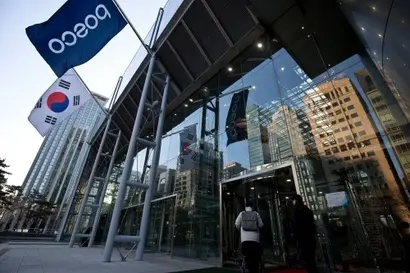
On the 8th, the Supreme Court dismissed the appeal filed by the plaintiff, the Korean Metal Workers' Union (KMWU), against the defendant, the POSCO Independent Labor Union, in a lawsuit seeking to invalidate the resolution to change the union's organizational form, thereby confirming the lower court's ruling in favor of the defendant.
Previously, in June 2023, the POSCO labor union held a delegate assembly to pass a resolution changing its organizational form to an enterprise-level union and registered the establishment of the POSCO Independent Labor Union. Although the Pohang branch of the Ministry of Employment and Labor accepted the registration, the KMWU attempted to block the move by disciplining the POSCO union officials who spearheaded the initiative and filing a lawsuit to invalidate the resolution.
Industry experts believe this ruling not only solidifies POSCO's labor union's "going it alone" status but will also serve as a guideline for other individual enterprise-level unions looking to break away from industrial unions in the future.
The KMWU had argued that "the local chapter is not an independent union and therefore lacks the authority to withdraw" and that "a resolution by the delegate assembly rather than a general meeting of all members is invalid." They claimed the POSCO union failed to meet the procedural and substantive requirements for changing organizational forms as stipulated by the Trade Union and Labor Relations Adjustment Act (Trade Union Act).
However, the appellate court ruled that at the time of the resolution, the POSCO chapter possessed its own bylaws (POSCO Chapter Rules), regulations for delegate elections, member management, and accounting management, effectively functioning as an independent entity similar to a labor union. The court recognized that as an unincorporated association, it could be a party capable of changing its organizational form under the Trade Union Act.
In particular, the broad recognition of the delegate assembly's resolution—the biggest point of contention—is expected to spark further departures from industrial unions. For large workplaces with thousands or tens of thousands of members, convening a general assembly to poll every opinion presents significant physical and procedural burdens. This ruling now paves a path for union leadership, through mechanisms like delegate assemblies, to decide on withdrawing from industrial unions.
The court ruled that while matters regarding changes in union organizational structure should generally go through a general meeting, if the bylaws specify that a delegate assembly can substitute for a general meeting, the assembly can make such a decision. The court also rejected the KMWU's claim that the quorum was not met because only four delegates were present, noting that with five of the nine total delegates having resigned, the attendance of four delegates and the approval by three did not violate the Trade Union Act or the POSCO Chapter Rules.
The weakening influence of industrial unions is accelerating as the MZ generation becomes the mainstream force in labor sites. These workers are more interested in direct benefits and workplace-specific advantages than the "labor liberation" or "political agendas" promoted by traditional industrial unions. A trend is also emerging where unions that have left the KCTU or FKTU are joining or aligning with the "Refresh Labor Council."
The POSCO chapter had been paying 48% of the 20,000 won earmarked for general accounting from each member's monthly dues of 30,000 won to the KMWU as an allotment. Now that the POSCO union can fully utilize the funds previously sent to the KMWU, it has gained more capacity for employee welfare and strike funds. Industry sources report that unions at financial and public institutions like the Bank of Korea and the Financial Supervisory Service have already left the KCTU, and large unions in other sectors such as manufacturing and construction are increasingly likely to join the exodus.
The KMWU issued a statement criticizing the Supreme Court's ruling. In a statement on the 12th, the KMWU declared, "A labor union is only truly democratic when it operates based on the collective will of its members, not just a few leaders," adding, "We strongly condemn the Supreme Court for accepting a change in organizational form that failed to properly reflect the members' will and did not comply with relevant regulations."