

[비즈한국] The government is set to impose sanctions on 'dark patterns' (online deceptive practices) related to the sale of non-face-to-face financial products. The Financial Services Commission (FSC) recently established guidelines categorizing types of dark patterns related to online financial products. The guidelines are scheduled to go into effect in April. As non-face-to-face financial product sign-ups become commonplace and financial companies increasingly use light, simple expressions or participatory marketing in their apps, there is keen interest in whether the implementation of these guidelines will put a brake on such practices.
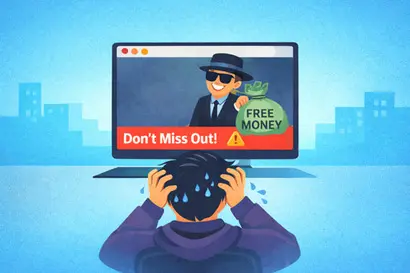
Financial authorities recently announced guidelines on dark patterns related to the sale of online financial products. The core of these guidelines is the classification of dark patterns specific to financial products into 4 categories and 15 sub-types. The guidelines apply to businesses governed by the 'Financial Consumer Protection Act (FCPA),' including financial product sellers, advisory firms, and fintech companies designated as innovative financial service providers.
According to the newly established guidelines, dark pattern types for financial products sold online are broadly divided into four categories: misleading, obstructive, pressurizing, and exploitation-inducing, with 15 sub-types in total. 'Misleading' refers to methods that induce mistakes or misconceptions by consumers through intentional screen layouts or phrasing, such as trick questions or pre-selecting specific options. 'Obstructive' refers to making it difficult for users to make decisions, causing them to give up on making rational choices, such as hiding information or inducing multiple clicks.
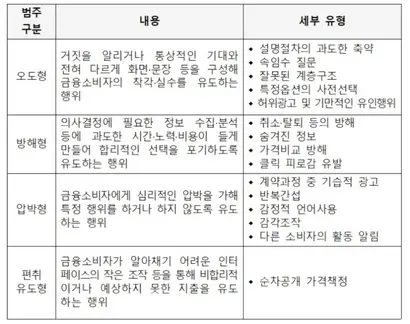
'Pressurizing' means applying psychological pressure on consumers, such as unexpectedly popping up advertisements for irrelevant products during the sign-up process or using emotionally charged language. 'Exploitation-inducing' refers to inducing irrational spending by consumers; one sub-type is 'drip pricing,' where hidden costs are gradually revealed during the sign-up process.
These financial product dark pattern guidelines will be applicable from April 2026. The FSC explained, "The guidelines will be implemented after a preparation period of about three months for financial companies to develop IT systems and update internal regulations. We will encourage active compliance through self-inspections by companies, but will provide guidance and supervision through the Financial Supervisory Service when necessary." They also hinted at the possibility of legislation, stating, "We plan to review the need for codification through amendments to the Financial Consumer Protection Act based on the industry's adherence to the guidelines."
It is not as if there were no regulations on online financial product sales before. The Financial Consumer Protection Act applies regulations such as the prohibition of unfair business practices and the prohibition of improper solicitation to non-face-to-face sales, just as it does to in-person sales. However, unlike general products governed by the E-Commerce Act, it has been pointed out that financial products were in a blind spot for dark patterns because there were no specific criteria.
Jung Soo-min, a research fellow at the Korea Capital Market Institute, pointed out in her paper, 'Trends in Domestic and International Dark Pattern Regulation and the Necessity of Guidelines for the Financial Sector,' that "The Financial Consumer Protection Act sets business conduct rules for in-person sales, making its application to online financial transactions unclear and difficult to assess for compliance." She noted, "Various dark patterns that hinder rational judgment by consumers are observed in financial apps. Representative examples include complex explanations that make it difficult to choose what is advantageous for the user, excessive requests for personal information, and cumbersome cancellation or change procedures."
In fact, as more financial companies use easy and simple expressions to lure customers into signing up for high-risk products or providing personal information, attention is being focused on whether these phenomena will disappear. For instance, at the end of last year, Toss Securities faced controversy over dark patterns ahead of launching its overseas stock options (the right to buy or sell assets at a set price at a specific future point). It was criticized for encouraging high-risk investments by highlighting potential returns in simulated investments for some consumers. Since then, there has been a debate over marketing strategies that lower the barrier to entry for high-risk investment products.
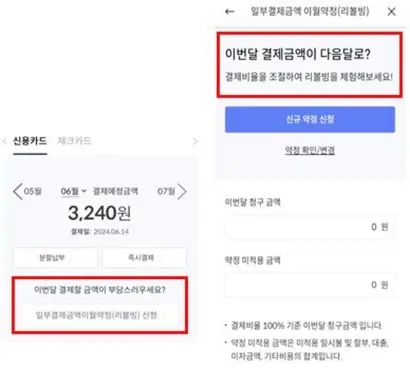
The new guidelines include 'use of emotional language' as a sub-type of dark pattern, which refers to inducing acts of manipulation that influence a user to select an option desired by the business. An example provided in the guidelines is a credit card company using the phrase "Experience it" for a revolving credit service in its app. Revolving service allows for carrying over a portion of payment amounts, but it comes with high interest rates (average 17.45% in 2024), which can easily lead to a cycle of credit delinquency. Financial authorities pointed out that using the light expression "experience" to induce the use of revolving credit is a dark pattern.
An official from the FSC explained, "Regulation will depend on the specific circumstances. Using emotional expressions in financial marketing is not prohibited in itself. We regulate when such expressions prevent the consumer from understanding, or when they are combined with other dark pattern practices." A limitation is that the guidelines are intended for voluntary compliance and lack legal binding force. The official added, "We are currently regulating through the Financial Consumer Protection Act, the E-Commerce Act, and the Labeling and Advertising Act. These guidelines were created to first encourage voluntary industry participation."
The industry is also preparing for the guidelines. Among the three internet-only banks (K-Bank, Kakao Bank 323410, and Toss Bank), Kakao Bank stated, "We are reviewing the intent and content of the guidelines and are proceeding with necessary procedures such as internal standard updates and process inspections. We will actively respond to institutional changes from the perspective of customer protection."
There are also opinions that in the long term, legislation beyond the level of guidelines is necessary to protect consumers. Kang Hyung-goo, Vice President of the Korea Finance Consumer Federation, pointed out, "The sales process for financial products is supplier-centered, not consumer-centered. Many financial terms themselves are difficult for the general public to understand, and problems easily arise because information is not sufficiently explained in the non-face-to-face sign-up process. Once a consumer agrees to the manual, the financial company is often exempt from liability, making it a structure where consumers easily suffer damages. It is necessary to make sales regulations tighter through legislation."