

[비즈한국] Since the 2020s, the government's job budget has shown an average annual growth rate of 6%, but as the increase has been concentrated on direct job creation budgets for the elderly, such as senior employment programs, the proportion of budgets for vocational training and startup support for the youth has continued to decline.
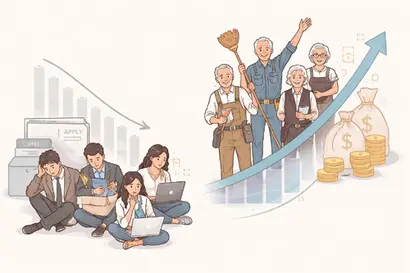
As the share of the job budget for the elderly has increased in this manner, it is expected that the employment rate of the elderly aged 60 and over will exceed that of the youth (aged 15–29) for the first time in history last year. As President Lee Jae-myung’s national task of 'extending the legal retirement age to 65' begins in earnest this year, it is clear that the impact on youth jobs will grow, leading to calls for an urgent expansion of the budget for the youth.
President Lee Jae-myung announced labor pledges including the extension of the retirement age on Facebook on May 1, 2025, during his time as a presidential candidate. At the time, President Lee emphasized, "The gap between the legal retirement age and the receipt of the national pension is a cliff of livelihood," adding, "To respond to a low-birthrate and aged society, we must create a society where people can continue to work. We must improve the reality where retirees are driven into poverty due to unprepared retirement."
Following this, in September of the same year after President Lee took office, the Ministry of Employment and Labor finalized a labor policy reform plan including retirement age extension as a national task and reported a draft of the basic law to the National Assembly to extend the retirement age to 65. The ruling Democratic Party of Korea intended to process the relevant bill in 2025, but it was pushed back by major pending issues such as the Coupang data breach. Accordingly, the Democratic Party plans to enter full-scale legislative discussions regarding retirement age extension in the first half of this year.
As signs of full-scale discussions on the retirement age extension emerge, concerns about a backlash in the form of reduced youth jobs are also growing. In fact, experts point out that although the government has increased the job budget every year, the proportion of the budget for the elderly has increased while that for the youth has decreased, which has not helped in creating youth jobs.
According to the Ministry of Employment and Labor and other sources, the government's fiscal support job project budget, which was 21.2374 trillion won in 2019, increased significantly to 25.4998 trillion won in 2020 and has since maintained around 30 trillion won every year. Last year, the fiscal support job project budget reached 30.7089 trillion won. Consequently, the average annual growth rate of the fiscal support job project budget since the 2020s has shown a significant upward trend of 6.17%.
Among these, the budget for direct job creation, such as the operation of senior job programs for the elderly, recorded an average annual growth rate of 10.01%, from 2.0779 trillion won in 2019 to 3.6824 trillion won in 2025, significantly exceeding the growth rate of the total fiscal support job project budget.
In contrast, the budget for vocational training, startup support, and employment services for the youth grew from 7.5354 trillion won in 2019 to 10.5290 trillion won last year, with an average annual growth rate of 5.73%. This means the growth rate of the job budget for the youth was only half that of the job budget for the elderly.
Due to this difference in growth rates, the trend in the proportion of job budgets for the elderly and the youth within the total fiscal support job project budget has shown contrasting results. The direct job creation budget, which accounted for 9.78% of the fiscal support job project budget in 2019, increased its share every year to reach 12.11% last year.
Conversely, the proportion of the budget for the youth (vocational training, startup support, and employment services), which was 35.48% of the fiscal support job project budget in 2019, fell to 34.62% last year. As the benefits of the government's annually increasing job budget are concentrated on the elderly rather than the youth, the youth employment crisis is worsening, with it becoming certain that employment rates will reverse for the first time in history.
According to the National Statistics Portal of the National Data Agency, the employment rate for youth aged 15–29 was 45.1% from January to November last year, while the employment rate for the elderly aged 60 and over was 47.3%. It is the first time the youth employment rate has fallen below the elderly employment rate. Until 2017, the youth employment rate was in the 40% range, while the elderly employment rate was 30%.
However, as the government focused on creating jobs for the elderly, the elderly employment rate rose to the 40% range in 2018 and has continued to increase since. In 2024, the youth employment rate was 46.1% and the elderly employment rate was 45.9%, narrowing the gap to 0.7 percentage points. Subsequently, it became certain that the elderly employment rate would overtake the youth employment rate in 2025.