

[비즈한국] If the 'game changer' that has shaken the landscape of modern warfare in recent years was the Unmanned Aerial Vehicle (UAV/drone) that dominates the skies, the new battlefield drawing attention from military authorities worldwide as of 2026 is the 'ground'. The key players are military robots roaming the battlefield, namely Unmanned Ground Vehicles (UGVs).
In fact, the history of UGVs is deeper than that of drones. The 'Goliath,' a tracked remote-controlled demolition vehicle developed by Nazi Germany during World War II, can be considered its precursor. However, due to the technical limitations of the time, it had to adopt a wire-guided system, and failed to achieve significant utility on the battlefield due to difficulties in securing a line of sight and slow speed. Since then, hundreds of military robots have appeared, but they were only deployed for limited missions such as Explosive Ordnance Disposal (EOD). Unlike the flat aerial environment, ground environments with numerous obstacles are much more difficult for autonomous driving and maintaining communication.
However, the maturation of 4th Industrial Revolution technologies has completely reversed this trend. Rapid advancements in autonomous driving, Artificial Intelligence (AI), and high-density battery technology have elevated the UGV from a mere auxiliary tool to a leading player in combat.
An interesting point is that the country leading this cutting-edge industry is not the United States or China, but Estonia, a small but strong nation in Northern Europe. 'THeMIS,' developed by Milrem Robotics, is currently considered the most successful multi-purpose UGV. Exported to over 16 countries since its first unveiling in 2015, THeMIS proved its worth in the Ukraine war. It significantly increased soldiers' survivability by performing tasks such as ammunition and food transport, medical evacuation, and surveillance and reconnaissance missions. The Russian military even issued a 'public bounty' equivalent to approximately 23 million KRW for the capture of a THeMIS unit.
Some have questioned whether UGVs would be effective in areas with frequent communication disruptions and rugged terrain, unlike the open plains of Ukraine. However, the border conflict between Thailand and Cambodia that occurred last year served as a decisive moment to dispel these concerns.
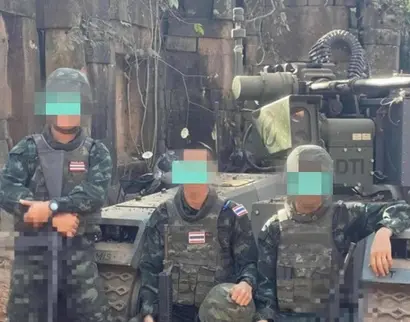
Already back in May, the Thai military, which had conducted a show of force by deploying the South Korean-made frigate 'Bhumibol Adulyadej' during a maritime border dispute, boldly operated unmanned assets in the subsequent ground border conflict as well. The Royal Thai Army deployed the 'D-Iron' combat robot into actual combat, which was modified domestically by combining the Estonian THeMIS chassis with a U.S.-made machine gun and Australian components.
On July 24, early in the engagement, the Thai military's combat robots used their 30mm machine guns to precisely strike Cambodian forward observation posts and armored vehicles. By putting unmanned robots at the forefront before deploying troops, the Thai military achieved the goal of capturing key positions without any friendly casualties. Even after the ceasefire, the Thai military continues to use these robots for high-risk border patrol missions, simultaneously solving the problems of declining troop resources and soldier safety. This is a proven case demonstrating that UGVs can be fully effective not only on plains but also in mountainous and jungle terrain.
South Korea is also joining this trend rapidly. Our military is making the application of manned-unmanned teaming (MUM-T) and AI technology a core tenet of defense innovation to respond to troop shortages caused by the demographic cliff and to minimize casualties.
Hanwha Aerospace012450 signed a Memorandum of Understanding (MOU) with Milrem Robotics in February 2025 and unveiled the Korean model 'THeMIS-K' at the 'Seoul International Aerospace & Defense Exhibition (ADEX 2025)' held in October. This model combines the verified THeMIS chassis with a Remote Controlled Weapon Station (RCWS) independently developed by Hanwha and a Korean sensor and communication system, making it a variant optimized for the mountainous terrain and operational environment of Korea.
Just as the AI revolution in the civilian industry is leading to a robot revolution, the 'unmanned' trend in the defense sector is an irresistible wave. Although the start was somewhat late, the potential of the Korean defense industry, which possesses world-class manufacturing capabilities and IT technology, is sufficient. We look forward to seeing domestic military robots patrolling the DMZ fence lines instead of soldiers in the near future, subduing enemies in emergencies and protecting the lives of our troops.