

[비즈한국] Samsung Electronics005930 has recorded its highest quarterly performance in 7 years, bolstered by a recovery in artificial intelligence (AI) demand and increased sales of High Bandwidth Memory (HBM). Moving past the stagnation that followed the 2018 memory supercycle, this achievement is significant as it shows AI server-focused high-value products are now driving performance. Market observers suggest that Samsung Electronics has gone beyond a mere industry rebound, effectively elevating its semiconductor business structure to the next level.
208% Increase Year-on-Year, Equivalent to 3% of the National Budget
In a preliminary disclosure on the 8th, Samsung Electronics announced that it achieved 93 trillion won in revenue and 20 trillion won in operating profit for the fourth quarter of last year. Operating profit surged by 208.2% compared to the same period last year, easily surpassing its previous all-time high of 17.57 trillion won set in the third quarter of 2018. This amounts to an average daily profit of approximately 217.4 billion won, an astonishing figure where a single quarter's earnings generated cash equivalent to about 3% of South Korea's annual national budget.
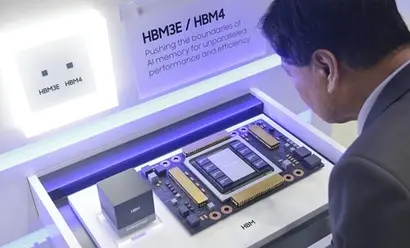
The core of this performance lies in the quality of the profit. While past booms were driven by quantitative expansion through PC and smartphone distribution, this achievement was propelled by high-performance products essential for AI servers. In particular, the Semiconductor (DS) division is estimated to have earned 16 to 17 trillion won, accounting for over 80% of the total profit. This is the result of a combination of skyrocketing prices for next-generation memory, such as HBM3E, and improved profitability of general-purpose DRAM.
Industry attention is focused on the recovery of Samsung Electronics' HBM market dominance. While SK Hynix000660 had been running ahead by securing the Nvidia supply chain, Samsung's successful supply of its 5th-generation HBM3E product and subsequent rapid gain in market share became the catalyst for this earnings explosion.
Samsung is now employing bold strategies to reclaim its position as the leader. To counter the coalition strategy of SK Hynix, which has partnered with the world's No. 1 foundry, TSMC, Samsung is responding with a 'turn-key' strategy that handles everything from design to foundry and memory production in one go. As customized designs for clients become crucial starting from the 6th-generation HBM4 market, observers suggest that Samsung, with its vertically integrated processes, will hold an advantage in terms of lead times and cost reduction.
Expectations for 2.5 Trillion Won Stock Buyback… Overcoming the 'Semiconductor Paradox' Remains a Task
Along with the record-breaking performance, Samsung Electronics announced a large-scale stock buyback plan worth 2.5 trillion won the previous day, further heightening market expectations. This share acquisition will be conducted via open-market purchases over the next three months starting from the 8th.
While the stated purpose is to secure resources for employee performance incentives, the market interprets this as a strong signal of stock price support and responsible management. In particular, the newly introduced Performance Share Unit (PSU) system directly links stock price returns to employee compensation. This is interpreted as a manifestation of the company's will to have management and employees share the goal of enhancing corporate value with shareholders, focusing firm-wide capabilities on long-term stock appreciation rather than short-term results.
This report card also contains the challenge known as the 'Semiconductor Paradox.' While the steep rise in semiconductor prices brought record profits to the DS division, it acted as a direct hit of increased costs for the smartphone (MX) and home appliance (DX) divisions that use them as components. Indeed, the profitability of the set business units appeared stagnant compared to semiconductors, with rumors of potential losses in TV and home appliances. To dispel concerns about being a 'semiconductor-only' company, recovery in set division profitability through the sale of on-device AI devices is critical.
Additionally, the intensifying U.S.-China conflict remains a variable. With the tightening of U.S. restrictions on semiconductor exports to China, the operation of Samsung Electronics' Xi'an plant and its global supply chain management will be key links in determining the sustainability of future performance.
Growth will likely hinge on this year. Based on the massive cash reserves secured, Samsung Electronics plans to focus its investments on dedicated HBM production lines. Experts predict that Samsung's overwhelming production capacity will lead to pricing power, and the market landscape will shift once more starting with the mass production of HBM4 in the first half of next year.
Samsung Electronics plans to release its confirmed earnings on the 29th, along with detailed performance by business division and future shareholder return policies. Market attention is focused on whether Samsung Electronics, which has perfectly ridden the new wave of the AI era, can surpass the 2018 supercycle and open an era of 100 trillion won in annual operating profit.