

[비즈한국] The conflict between the government and the medical community, which was triggered in 2024 and has remained unresolved for about two years, shows signs of reigniting. After the government released estimation results based on a premise of a doctor shortage, the medical community immediately protested, calling them forced results lacking scientific basis.
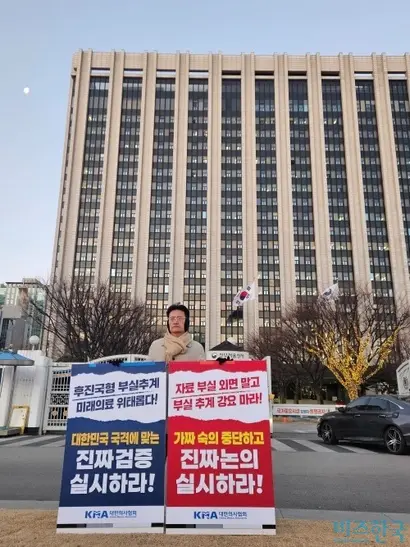
On the morning of the 8th at 7:40 AM, the Korean Medical Association (KMA) began a one-person protest in front of the Government Complex Seoul in Jongno-gu, Seoul, regarding the announcement of the doctor supply-demand estimation results. KMA Vice President Jwa Hoon-jeong kicked off the protest that day. This demonstration was staged in opposition to the revised doctor supply-demand estimation results recently reported to the first Health and Medical Policy Deliberation Committee (HMPDC) by the Doctor Manpower Supply-Demand Estimation Committee.
According to the results calculated by the Estimation Committee on the 6th, the demand for doctors as of 2040 is projected to be between 144,688 and 149,273, while the supply is projected to be between 138,137 and 139,673, indicating a shortfall of 5,015 to 11,136. Considering that the initial supply upper limit was 138,984, the lower limit of the shortfall has decreased by 689. However, since the conclusion remains that thousands of doctors are needed, the trend of increasing medical school admissions can be seen as remaining intact.
Regarding this, Vice President Jwa pointed out the lack of scientific evidence in the announced results. He noted, "Like the previous government, where the answer was already fixed and you just had to go along with it, it is difficult to accept claims that we must simply increase numbers because there is a shortage." He added, "The government concluded there is a shortage by reflecting only 6% of the medical workforce replacement rate due to AI technology development in this estimate, but according to OECD research methods, 12-30% of AI variables are reflected when estimating medical personnel." He emphasized, "If that were the case, the number of medical personnel shortages would be significantly lower than the announced estimate, leading to the conclusion that a reduction might actually be necessary."
The KMA also plans to engage in public opinion campaigns through data verification. They plan to introduce scientific estimation methods at a symposium on the 13th titled 'Problems and Alternatives of Government Doctor Manpower Supply-Demand Estimates.' Vice President Jwa stated, "We will explain to the public what is truly scientific."
Depending on future announcements by the HMPDC, there is a possibility that the 'hard-line' conflict between the government and the medical community could resurface. Vice President Jwa warned, "If we cannot accept the results announced by the HMPDC, we will decide on a response policy by putting our heads together with the KMA, residents, and medical students," adding, "We hope that the HMPDC will conduct more scientific and rational discussions to reach a conclusion that the medical community can accept, and the relay one-person protests will continue until the HMPDC announcement."
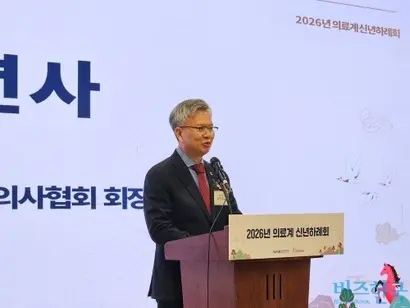
KMA President Kim Taek-woo delivered sharp criticism to the government at the 2026 Medical Community New Year's Reception held at the KMA building in Yongsan-gu, Seoul, that day. President Kim criticized, "In foreign countries, doctor supply and demand plans are promoted over two years and results are announced over six years, but in Korea, there is great concern because the conclusion was reached hastily within a short period of five months," adding, "I believe that if the supply of doctors increases, it could affect health insurance finances, which is a part that should be considered together."