

[비즈한국] One of the biggest topics in cancer treatment is overcoming drug resistance. No matter how effective an anticancer drug may be, cancer cells eventually evolve and develop resistance after a certain period. Consequently, patients are forced to rely on more toxic chemotherapy drugs, enduring severe side effects. Once resistance to these subsequent treatments also occurs, patients often run out of treatment options and are forced to stop therapy.
Oscotec is focusing on this issue and taking on the challenge of developing 'anti-resistance anticancer drugs.' These drugs play a role in prolonging the efficacy of existing anticancer drugs used in combination by blocking the root cause of cancer cell resistance and inhibiting recurrence. As anti-resistance anticancer drugs are currently only discussed conceptually, Oscotec’s challenge is the world's first attempt to apply this to new drug development.
Oscotec currently holds four anti-resistance anticancer drug candidates. In May and November of last year, it received approval for Phase 1 clinical trial plans for 'OCT-598' in the U.S. and South Korea, respectively, and has already begun administering it to patients. Oscotec is seeing encouraging results in mouse lung cancer models, where the combination of OCT-598 and standard treatments maintained a state close to complete remission (where all tumors disappear) until the end of the study.
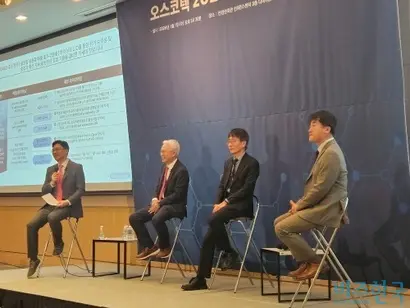
At the Investor Day held at the FKI Tower in Yeouido, Seoul, on the 7th, Oscotec CEO Yoon Tae-young stated, "Unlike tasks where we follow what others have already done, entirely new 'first-in-class' targets allow for early technology transfers." He added, "Because they can command higher valuations, our goal is to transfer the technology for at least two anti-resistance anticancer candidates by 2030.”
Oscotec is targeting cancers where drug efficacy typically lasts less than 20 months, including bladder, head and neck, liver, stomach, lung, colorectal, kidney, and ovarian cancers. The potential market size is estimated to reach $95 billion (approximately 137.655 trillion KRW) annually. Oscotec aims to build an anti-resistance anticancer drug platform by precisely tracking cells that develop resistance and conducting integrated screenings. Based on this platform, the company plans to streamline the drug development process, increase target suitability, and expand its pipeline.
However, anti-resistance anticancer drugs do not completely block all resistance. Since resistance arises through various pathways, it is scientifically difficult to eliminate the possibility of resistance by 100%. CEO Yoon explained, "Our research direction will be to identify the primary factors causing resistance in specific cancers, rather than attempting to capture the entire mechanism of resistance all at once.”
After the event, CEO Yoon told reporters, "For an anti-resistance anticancer drug to be clinically significant, I believe it should extend the Progression-Free Survival (PFS) of standard treatments by 1.5 to 2 times." He hinted, "Currently, the PFS for docetaxel, the anticancer drug used in combination with OCT-598 in our Phase 1 trials, is about 3 months. If we can extend that to around 6 months, it would be highly significant.”
Beyond anti-resistance anticancer drugs, Oscotec is also tackling resistance through its U.S. subsidiary, Genosco, by developing DAC (Degrader-Antibody Conjugate) therapies. DAC therapy fuses ADC (Antibody-Drug Conjugate) and TPD (Targeted Protein Degradation) technologies to fundamentally degrade the target proteins that trigger resistance. It is garnering attention for its potential to overcome the limitations of ADC therapies, such as side effects like ocular toxicity and interstitial lung disease, as well as maximum dosage constraints. According to market research firm EvaluatePharma, the global DAC therapy market is expected to reach $40 billion (approximately 58.008 trillion KRW) by 2032.
Oscotec is developing next-generation payloads that demonstrate superior efficacy against cancer cells showing resistance to topoisomerase inhibitors, which account for 70% of current ADC therapy payloads. In particular, the company holds payloads that show strong activity against triple-negative breast cancer (TNBC) cell lines. Kwak Young-shin, Head of Research and Vice President, expressed confidence, stating, "We believe we can solve both the safety and resistance issues.”