

[비즈한국] Cracks are appearing in the 'domestic car fortress' that has long stood firm in the South Korean automotive market. With the share of imported cars exceeding 20% of all new vehicle registrations, and the internal combustion engine system—centered on diesel—rapidly collapsing while a new competitive landscape dominated by electric vehicles (EVs) and autonomous driving takes hold, market leadership is being reshuffled at a rapid pace.
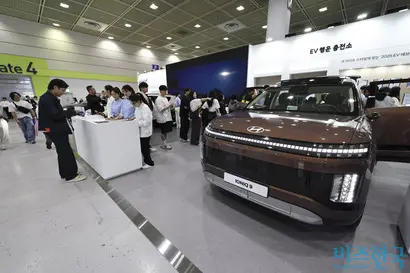
EVs Fill the Diesel Void, Driving the Growth of Imported Car Market Share
Recently released statistics clearly illustrate this structural shift. According to the '2025 Annual New Imported Passenger Car Registration' data released by the Korea Automobile Importers & Distributors Association (KAIDA) on the 6th, a total of 307,377 imported passenger cars were registered in Korea in 2025, a 16.7% surge compared to the previous year. This marks the first time the industry has hit the 300,000-unit annual sales milestone since tracking began in 1987. The share of imported cars in total new vehicle sales is expected to surpass 20% for the first time in history, having recorded an average of 20.2% through November 2025.
The backdrop to this increase in imported cars is the radical reorganization of a powertrain structure that was once centered on internal combustion engines. According to data released by the CarIsYou Data Research Institute on the 7th, annual diesel car sales in 2025 were 97,671 units, falling below 100,000 for the first time ever. Diesel cars, which boasted a 52.5% market share in 2015 with 960,000 units sold, have now shriveled to 5.8%. The void left by diesel has been quickly filled by hybrids (452,714 units) and EVs (220,897 units), with electrified vehicles now accounting for about 40% of all new car registrations.
Domestic Cars Put to the Test in the Race for Autonomous Driving and EVs
The concerning aspect is not merely that the share of imported cars has increased, but that domestic cars are lagging behind global leaders in the core technologies of future mobility: electric vehicles and autonomous driving. In the era of internal combustion engines, hardware competitiveness—namely engines, transmissions, and production efficiency—directly translated to market share. However, as we move into the era of EVs and autonomous driving, the focus of competition is shifting toward battery efficiency, software maturity, and user experience.
The primary driver of the imported car market expansion is undoubtedly electric vehicles. The share of EVs and hybrids within the imported car market has reached a staggering 86%. When looking at the EV market alone, the presence of imported cars is even more overwhelming. Tesla's Model Y, which took the top spot in sales for imported passenger car models, saw its sales surge by over 169% compared to the previous year, leading a tectonic shift in the domestic imported car market.
Following the recent abolition of EV subsidies in the United States, Tesla has been implementing aggressive price-cutting policies in Korea. On top of this, it is emphasizing software competitiveness beyond being a simple EV by showcasing its recently introduced 'Full Self-Driving (FSD)' technology. Chinese EV giant BYD has also officially entered the Korean market with low-cost models. The domestic auto industry finds itself in a 'sandwich' position, squeezed by Tesla in the premium segment and Chinese cars in terms of price competitiveness.
Meanwhile, the Hyundai Motor Group has recently encountered obstacles in its autonomous driving and software strategy. With the sudden resignation of Song Chang-hyeon, CEO of 42dot, who has been leading Hyundai's software-centric strategy, concerns are rising that the roadmap for Software-Defined Vehicles (SDVs) and autonomous driving could face setbacks. This is interpreted as more than just a personnel change; it suggests that Hyundai's software transition strategy is being put to the test as global automakers accelerate their competition in autonomous driving and AI.
Competitiveness Must Come Before Subsidy Effects
The government's policy direction is also pushing hard for a transition from internal combustion engines to electric vehicles. According to the '2026 EV Subsidy Reform Plan' announced by the Ministry of Climate, Energy and Environment, an additional 'transition subsidy' of up to 1 million won will be provided if an existing internal combustion engine vehicle is scrapped and an EV is purchased. The plan aims to accelerate decarbonization in the transport sector by expanding subsidy eligibility to small passenger vans and medium-to-large cargo trucks.
However, it remains to be seen whether the government's support will lead to a recovery in domestic car market share. Currently, the standing of domestic cars in the Korean EV market is significantly lower than it was in the era of internal combustion engines. While domestic brands used to command an 80-90% share in the internal combustion market, that share drops to around 50% for EVs. One cannot rule out the possibility that the subsidy policy may ultimately serve to lower the barrier for imported EVs to enter the domestic market.
Ultimately, the warning that the position of domestic cars in the Korean automotive market will shrink as the transition to decarbonization accelerates is becoming reality. Analysts argue that for domestic brands like Hyundai Motor and Kia000270 to overcome this crisis, they must secure software competitiveness that transcends their hardware manufacturing prowess amidst the trends of electrification and autonomous driving. It is pointed out that they are now at a crossroads: whether to adopt a Tesla-style software-centric strategy, respond with cost structure innovation like Chinese firms, or buy time through hybrid technology and platform diversification.