

[비즈한국] Recent sales of Hyundai Motor Company005380 in the Japanese market have increased. This is interpreted as a result of Hyundai Motor's active efforts in the Japanese market. However, compared to its total sales, the proportion of the Japanese market remains small. Given the uncertainties in the U.S. market, there are assessments that the proportion of the Japanese market should be further increased.
Hyundai Motor entered the Japanese market in 2001 but withdrew in 2009. This was because it failed to achieve the expected results. According to its business report, Hyundai Motor Japan (HMJ), the company's Japanese subsidiary, recorded a net loss of approximately 8.6 billion KRW in 2008.
The company later re-entered the Japanese market in 2022. Chang Jae-hoon, then-President of Hyundai Motor (currently Vice Chairman of Hyundai Motor Group), explained the reason for the re-entry at a local press conference in Japan in February 2022, stating, "Hyundai Motor has been pursuing sustainable mobility since the vision of 'Progress for Humanity,'" and "The Japanese market is a place to learn from as well as a place to challenge ourselves."
However, Hyundai Motor's recent export performance is on a downward trend. Hyundai Motor's total vehicle sales decreased from 4,141,959 units in 2024 to 4,138,180 units in 2025. While domestic sales increased from 705,010 to 712,954 units, overseas sales decreased from 3,436,949 to 3,425,226 units.
For Hyundai Motor, failure to improve export performance affects its overall performance. As the U.S. market has high uncertainty due to the tariff policies of U.S. President Donald Trump, analysts suggest that the proportion of the Japanese market should be increased.
According to the Japan Automobile Importers Association (JAIA), Hyundai Motor's sales in Japan were: 526 in 2022, 492 in 2023, 618 in 2024, and 992 from January to November 2025. Although sales have recently been increasing, it is difficult to consider them satisfactory. The proportion remains small compared to Hyundai Motor's total sales.
Last December, Hyundai Motor placed an advertisement in major Japanese daily newspapers congratulating Toyota Gazoo Racing World Rally Team on winning the '2025 FIA World Rally Championship (WRC)' triple crown. Hyundai Motor stated in the ad, "Because there was a great rival, the Hyundai World Rally Team was also able to do its best and grow to the next level."
Various interpretations emerged in the automotive industry regarding this. Hyundai Motor, Japan's Toyota, and Germany's BMW began collaborations by establishing the Hydrogen Transport Forum (HTF) last May. Analysts suggest this advertisement is also an attempt to strengthen cooperation between Hyundai Motor and Toyota. On the other hand, some interpret it as a move by Hyundai Motor to increase its presence and expand the market in Japan.
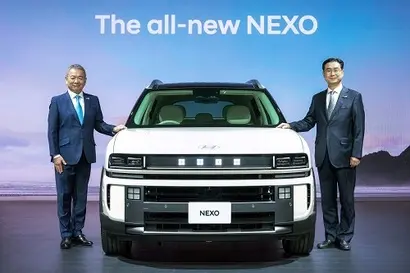
Hyundai Motor is targeting the Japanese market centered on the Casper and Nexo. In the Japanese market, the Casper is sold under the name 'Inster.' Hyundai Motor participated in the 'Japan Mobility Show 2025' held in Tokyo last October, where it unveiled the 'All-New Nexo' and is putting effort into marketing the Nexo. Last year was the first time Hyundai Motor participated in the Japan Mobility Show.
Jung Yoo-seok, Executive Vice President of Hyundai Motor, stated at the time, "We will introduce high-quality and customer-centric product lineups to the Japanese market, and we plan to actively join the electrification trend by launching the hydrogen car, the All-New Nexo, in the first half of next year (2026)," and added, "We will continue to listen to customer voices through customer community activities such as the Hyundai Motor Club Japan, and establish ourselves as a sincere brand by expanding exchanges between Korean and Japanese owners."
However, Japan recently announced it would reduce subsidies for hydrogen cars. It plans to lower the cap on hydrogen car subsidies from the current 2.55 million yen (approx. 23.46 million KRW) to 1.5 million yen (approx. 13.8 million KRW) this coming April. This is expected to have a negative impact on the sales of the hydrogen car, the Nexo.
An official from the automotive industry evaluated, "Since Japan has a high proportion of compact cars, the strategy to expand sales centered on the Inster and Nexo is not bad," but added, "Because domestic car brands are highly popular in Japan, it will not be easy for Hyundai Motor to gain an advantage in competition with them."
There is another reason why the automotive industry is paying attention to the success of Hyundai Motor in the Japanese market. It is because Chung Chang-chul, the eldest son of Hyundai Motor Group Chairman Chung Eui-sun, joined Hyundai Mobility Japan (HMJ) as a regular employee early last year and has been working at the Yokohama headquarters. Born in 1998, it is still too early for him to be at the forefront of management, but industry interest is focused on this as his first management training experience.