

[비즈한국] The government has launched the 'Everyone's Card,' effectively an 'unlimited flat-rate pass,' by significantly expanding and restructuring the existing K-Pass, which previously refunded a certain percentage of public transportation costs. It features a groundbreaking structure where users are fully reimbursed for any amount spent exceeding a set threshold. While the Ministry of Land, Infrastructure and Transport (MOLIT) self-assessed the 'Everyone's Card' as "irreplaceable national transportation welfare," concerns are emerging from some quarters. This is because the combined annual refund budget from central and local government funds exceeds 1 trillion won.

Seoul City's Climate Companion Card vs. MOLIT's Everyone's Card
The 'Everyone's Card' introduced by the government is a policy that drastically scales up the benefits of the existing K-Pass. The previous K-Pass refunded a fixed percentage of transit costs. When users utilized public transport 15 or more times a month, they received a refund for up to 60 trips per month at a rate of 20% for the general public, 30% for young adults and seniors, and 53% for low-income households.
The 'Everyone's Card,' newly launched by the Ministry of Land, Infrastructure and Transport in January this year, provides a full refund for any amount spent over the limit. Refund benefits apply to public transit nationwide, including city buses, village buses, subways, the Shinbundang Line, and the GTX. It is divided into two types: General and Plus. The General type applies when a single fare is under 3,000 won, while the Plus type applies refunds to all modes of transportation.
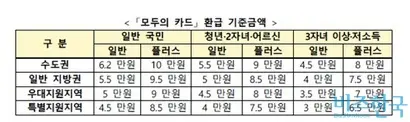
In the Seoul metropolitan area, amounts exceeding 62,000 won for the General type and 100,000 won for the Plus type are fully refunded. Existing K-Pass users can continue using their current cards without needing a new issuance. The system automatically calculates and applies the more favorable benefit between the K-Pass and the Everyone's Card (General/Plus) for the user after the fact.
The number of participating local governments has also increased. Starting in 2026, 8 basic local governments, including Goseong in Gangwon Province and Gangjin in South Jeolla Province, have newly joined, expanding the total to 218 local governments nationwide.
As it essentially overlaps with the benefits of the 'Climate Companion Card' previously applied only to Seoul and parts of the metropolitan area, some point out that the government may be implementing aggressive transportation policies to keep Seoul's policy in check. In fact, analysis suggested that the Climate Companion Card faced a 'crisis of existence' following the launch of the Everyone's Card. The Everyone's Card General type is priced at 62,000 won, which is the same as the 30-day Climate Companion Card general pass (excluding bike rentals).
The Seoul Climate Companion Card was implemented in January 2024, and the MOLIT K-Pass in May 2024. While regions like Gyeonggi and Incheon introduced additional discount policies based on the K-Pass, Seoul proceeded with the Climate Companion Card as an independent project, unconnected to the K-Pass.
This trend appears likely to continue this year, even with the government's launch of the Everyone's Card. A MOLIT official stated that there have been no discussions regarding linking the K-Pass and the Climate Companion Card.
Refunds: 230 Billion Won Last Year, Over 1 Trillion Won This Year
The problem is the massive budget. The 'Thrifty Transportation Card,' the predecessor to the K-Pass, experienced refund delays in 2023 due to budget issues. The following year, the refund amount was even reduced. The 2024 K-Pass also saw reduced refunds due to budget constraints because the number of users exceeded expectations.
The national budget for the 2025 K-Pass project was 237.5 billion won, but it surged more than twofold to 558 billion won this year. The K-Pass structure requires the central and local governments to split the costs equally. According to Bizhankook's reporting, the 2026 K-Pass refund budget, combining both national and local funds, exceeds 1 trillion won. A MOLIT official confirmed, "Local government funding is also 558 billion won, and refunds are being processed by combining central and local funds."
The Ministry of Land, Infrastructure and Transport is confident that there will be no 'refund crisis' this year, as the budget has been significantly increased compared to last year. However, as it is an unlimited refund structure without a cap, fiscal volatility has increased. As the number of users on high-cost transit like the GTX grows, the scale of the burden on the central and local governments will increase. Securing a budget of over 1 trillion won annually is a necessity. Especially since the burden on local budgets is growing, the financial capacity of local governments is also critical.
Whether the Everyone's Card will increase public transport ridership is also a key question. Kim Sang-chul, a research fellow at the Nara Institute for Fiscal Studies, pointed out, "In terms of boosting public transportation, I don't see an annual investment of 1 trillion won as overly large. The problem is that since more than 80% of existing K-Pass users were in the metropolitan area, the benefits of introducing the Everyone's Card are not significant for non-metropolitan areas where transport infrastructure is lacking. For non-metropolitan regions, it is necessary to lower the flat-rate thresholds significantly. If the Everyone's Card, intended for the whole country, is set at the same amount as the Climate Companion Card, there are concerns that the policy effect will be ambiguous. It could even end up being a factor that makes non-metropolitan areas feel a sense of 'transportation disparity'."