

[비즈한국] Earth will eventually meet its end one day. In 2008, the most unexpected and shocking doomsday scenario for Earth was presented in the journal 'Nature'. It claimed that a so-called 'Death Star' was aiming at Earth. The suspect identified as the potential cause of Earth's end was a star located a staggering 8,400 light-years away. It’s not an asteroid passing near Earth, nor is it our violently fluctuating sun right in front of us; it’s a distant star far outside our solar system that could potentially destroy the Earth!
The reason for this is that the suspect, WR 104, appeared to be a candidate for a potential gamma-ray burst (GRB) celestial object that emits massive amounts of energy and could explode at any moment. The appearance of WR 104 in the images is far from ordinary. It does not look like a mere point of light; it shows a distinct spiral pattern.
For a long time, astronomers assumed this was a binary system consisting of one star emitting powerful stellar winds and a companion star. In particular, they believed the central star was in its final evolutionary stage—a Wolf-Rayet star—standing on the verge of a supernova explosion. If this star were to die, it would release a powerful flash of gamma-ray radiation, and if the axis of this binary system were pointed directly at Earth, there is a possibility that Earth could suffer the full impact.
If that were the case, we could suddenly vanish from the universe due to the death of a star 8,400 light-years away. As described in 'Nature' in 2008, it could truly become something like the Death Star from the movie Star Wars.
Such star destruction, characterized by these spiral patterns, happens throughout the universe. Recently, the James Webb Space Telescope (JWST) revealed surprising facts after observing another such site, WR 70–16. Astronomers originally thought this, like WR 104, was a Wolf-Rayet star system formed by a common dying star and a companion orbiting each other. However, they discovered traces of another star that had been hidden for a long time. This site was a 'three-body' scene, where three stars were entangled together.
The star WR 70–16 is a Wolf-Rayet star nearing its end, dancing a dance of death in a spiral. It looks as if two snakes are biting each other, which is why it is nicknamed 'Apep' after the Egyptian god of snakes and chaos. Wolf-Rayet stars shed their material into space in a very violent and intense manner. This powerful stellar wind is so fast that it shoots out almost perpendicular to the star's surface. Because it orbits with a companion, the material from the straight-shooting stellar wind spreads out in a spiral, much like water from a sprinkler.
For a long time, this was considered a binary system composed of a single dying star and a relatively calm companion. However, in 2018, astronomers discovered a third star. A third star was hidden, orbiting the other two from a greater distance. This is not a binary system, but a triple-star system. The two innermost stars orbit each other with a period of 100 years. The third star discovered is located 1,700 AU away from them, with an orbital period reaching 10,000 years.
Because it moves so slowly, it was initially suspected that this star might not be a member of WR 70–16, but merely a wanderer passing by. However, JWST observations confirmed that this star is clearly dancing together in the spectacular spiral of WR 70–16. The infrared images taken by JWST revealed a much larger structure that had previously been hidden. It captured traces of dust clouds pushed out by stellar winds, spreading much further than the small central spiral known previously.
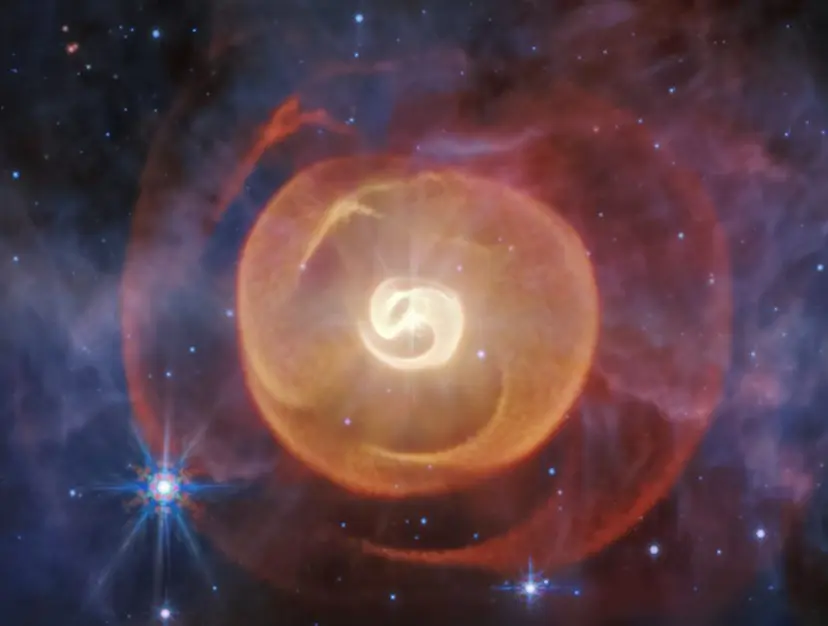
In this photo, the relationship between the two stars performing their dance of death at the center of WR 70–16 is quite different from what we knew. Astronomers previously thought only one of them was a dying Wolf-Rayet star, while the other was a relatively ordinary companion, and that the dying star was blowing a much more powerful stellar wind. In reality, that is not the case. Both stars are blowing out fierce stellar winds of similar magnitude. It wasn't just one that was nearing its end; it was a binary system composed entirely of Wolf-Rayet stars!
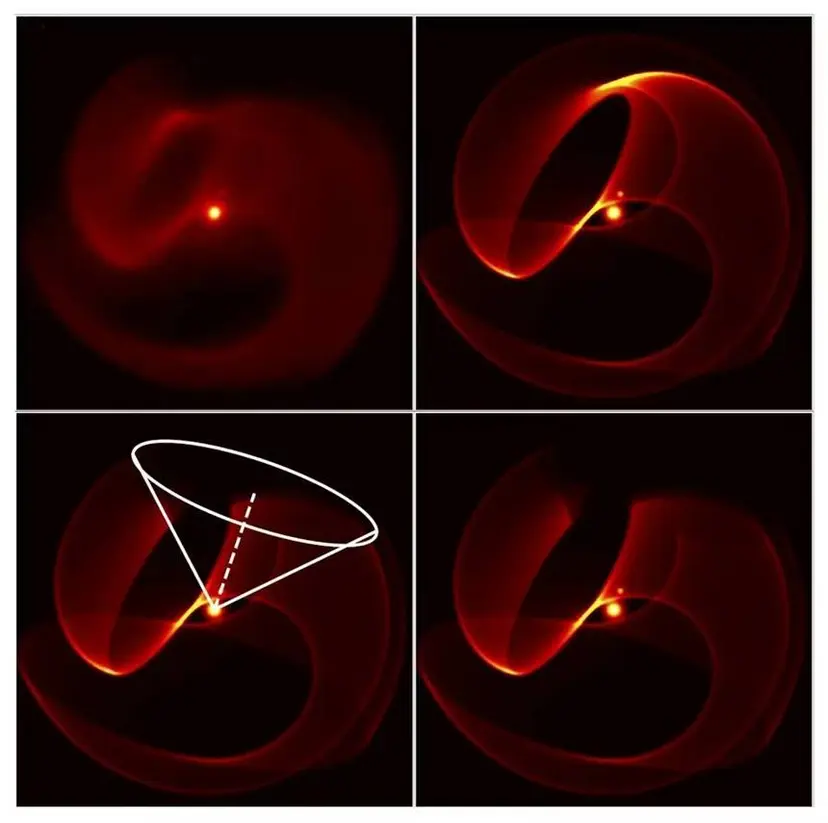
JWST observations show another surprising trace. Some of the stellar wind trails spiraling out in the photo appear empty, as if they had a large bite taken out of them. The third star is located in that very empty region. The third star was no pushover, either. It also blows powerful stellar winds, clearing away surrounding dust clouds, making parts of it look empty. The stellar wind from the third star is interacting with the complex winds generated by the two central stars. As shown in this study, the beautiful and complex patterns of the observed dust clouds can only be reproduced if the third star and its wind effects are included in the simulation. This proves that the third star is not just a background star passing by, but another member that has been influencing the others for a long time.
The small inner spiral known previously is a structure created within the last 100 years. However, the larger, more massive spiral newly revealed by JWST is an older structure created at least 700 years ago. And all dust spiral shell structures are expanding rapidly in all directions every year. According to recent observations, there is a possibility that WR 70–16 is slightly further away than previously thought. WR 70–16 might be a much brighter star. As such, it is spewing out stellar winds more violently, and its end may arrive more brightly and brilliantly. This means its end could pose a greater threat to our Earth.
Ultimately, this star will face a core collapse and a dazzling supernova explosion. As confirmed by this observation, if there is not just one but two dying stars at the center, that death will be even more violent. In the process of a typical star explosion, most of the energy is emitted in both directions along the star's central rotation axis. If the rotation axis of this star also happens to aim directly at our Earth, the high-energy cosmic rays emitted at the final moment could have a significant impact on Earth. Let us hope that this star does not turn into a real 'god of destruction' that brings ruin to our Earth.
References
https://www.nature.com/articles/news.2008.653
https://ui.adsabs.harvard.edu/abs/2025arXiv250714610W/abstract
https://ui.adsabs.harvard.edu/abs/2025arXiv250714498H/abstract
https://www.nature.com/articles/s41550-018-0617-7
About the author: Ji Ung-bae loves cats and the universe. After watching 'Galaxy Express 999' as a child, he dreamt of sharing the beauty of the universe. Currently, he is an assistant professor in the Division of Liberal Arts at Sejong University and is active in scientific communication through lectures and writing. He has authored books such as 'A Piece of the Universe Every Day', 'Scientists of the Starry Universe', 'Things You Can Know Though You Cannot Go', and 'Strange Questions That Come to Mind When Looking at the Universe', and translated books including 'The Hitchhiker's Guide to the Galaxy', 'How I Killed Pluto', 'Quantum Life', and 'Cosmigraphics'.