

[비즈한국] Following President Lee Jae-myung's state visit to China, business leaders from Korea and China gathered in large numbers for the first time in nine years. Held on the 5th (local time) at the Diaoyutai State Guesthouse in Beijing, the 'Korea-China Business Forum' is viewed as more than just an economic exchange event; it is seen as the first official signal to gauge the potential easing or lifting of the 'Hallyu Ban' (limitations on Korean culture) that has been in place since 2016. In particular, with heads of cultural content industries such as entertainment and gaming prominently featured, expectations are rapidly rising that the frozen Korea-China cultural and content markets may reopen.
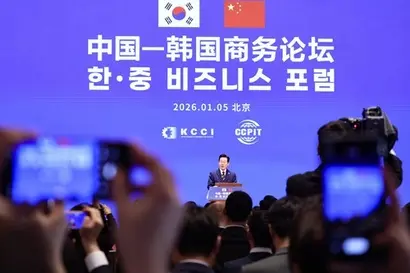
Heads of Entertainment and Gaming Companies Take Center Stage… Aiming to Ease the Hallyu Ban
From the Korean side, led by the Korea Chamber of Commerce and Industry, an economic delegation of 416 people from 161 companies participated, including the heads of the four major conglomerates: Samsung Electronics Chairman Lee Jae-yong005930, SK Group Chairman Chey Tae-won, Hyundai Motor Group Chairman Euisun Chung005380, and LG Group Chairman Koo Kwang-mo.
The Chinese side also attended in force, with about 600 people including Vice Premier for Economic Affairs He Lifeng and China Council for the Promotion of International Trade (CCPIT) Chairman Ren Hongbin, along with 200 other business leaders. Key figures from the IT and high-tech industries with deep cooperative ties with Korea, such as CATL Chairman Robin Zeng, Tencent Vice President Liu Yong, and TCL Chairman Li Dongsheng, also attended in large numbers to discuss practical business cooperation measures.
The most notable aspect of this forum is the change in the composition of the economic delegation. Moving away from traditional manufacturing, the list included heads of the entertainment and gaming industries, such as SM Entertainment CEO Jang Cheol-hyuk041510 and Krafton CEO Kim Chang-han259960. Analysis suggests this is a strategic move aimed at the practical lifting of the Hallyu Ban and the reopening of the cultural and content markets that have persisted since 2016.
In his keynote speech, President Lee also stated, "We must infuse color and narrative—services and content—on top of the solid foundation of manufacturing," defining the cultural and content industries such as film, music, gaming, and sports as a 'new breakthrough' for Korea-China economic cooperation.
President Lee presented the 'spirit of Byeoklando,' an international trading port during the Goryeo Dynasty, as a future model for Korea-China cooperation. Citing the example of ancestors who never stopped exchanges even during diplomatic conflicts, he unveiled a vision to fully restore civilian-level economic exchanges.
Furthermore, he emphasized that artificial intelligence (AI) technology will be a key tool to deepen cooperation across both manufacturing and services, ordering that the mutual complementarity between the competitive industries possessed by both countries be maximized.
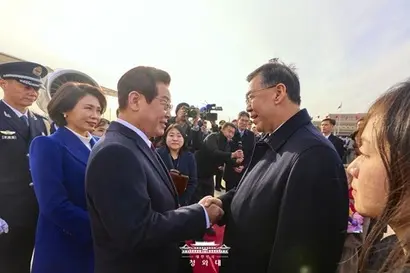
"Inseparable Neighbors": Over 10 MOUs Including Supply Chains and Tourism Expected to be Signed
Heads of major conglomerates also expressed expectations for a recovery in the business environment following improved Korea-China relations. Hyundai Motor Group Chairman Euisun Chung told reporters, "Although sales and production in China have decreased significantly, we plan to increase production and sales again with a humble attitude," adding, "If relations improve following this summit, it will be a great help to Hyundai Motor.">
In his opening remarks, SK Group Chairman Chey Tae-won emphasized the spirit of 'Qiutong Cunyi' (seeking common ground while shelving differences), expressing his hope that the forum would serve as an opportunity for business people from both countries to seek practical solutions for growth together.
The Chinese side responded in kind. Vice Premier He Lifeng emphasized, "China and Korea are inseparable neighbors," and added, "Joint efforts are needed to develop economic and trade cooperation to a higher level." He expressed hope that the summit would lead to a relationship of trust and development, and projected that 400 Chinese companies would discover new cooperative possibilities through this forum.
The government plans to link this forum with the Korea-China summit to achieve tangible economic results. National Security Office Director Wi Sung-lac explained in a briefing on the 2nd that they are preparing over 10 Memorandums of Understanding (MOUs) in areas directly related to the livelihoods of both countries, including supply chain investment, the digital economy, ventures and startups, environment and climate change, and human and tourism exchanges. Most importantly, attention is focused on the final results of the upcoming summit to see if this large-scale gathering of business leaders in Beijing, which resumed after nine years, can lead to substantial economic restoration and market opening.