

[비즈한국] At some point, we started prefixing words with 'Jjin' (meaning real/genuine). Words like 'Jjin-matjib' (a truly great restaurant), 'Jjin-buja' (a truly wealthy person), and 'Jjin-nammae' (true siblings) come to mind. The word 'Jjin' itself serves to emphasize someone's claim. Moreover, saying "It's the real deal" (Jjin-iya) puts an end to any debate. Yes, 'Jjin' is a very effective term that makes 'real' feel even more real and sound more authentic.
In golf, there is also something called a 'Jjin-score' (real score). If a golfer records a 'PR' (Personal Record) or a score close to one, they snap a photo of their scorecard and brag to others. Potential playing partners in the group chat offer congratulations and express surprise. At this point, the golfer who hit their PR adds, "This is a 'real score'. No 'il-pa-man-pa' (giving a par to everyone on the first hole) and no mulligans either."
By then, someone in that chat has likely already suspiciously scanned the first hole score to see if it was indeed a case of 'il-pa-man-pa'. Someone else might be doubting that score, even attempting a subtle verification by saying, "Show us that skill sometime." Golf is a sport of manners. The first virtue of those manners is 'trust'. It is the belief that you won't do what you aren't supposed to do. Yet, we sometimes find it hard to trust a score reported by someone else until we see it with our own eyes.
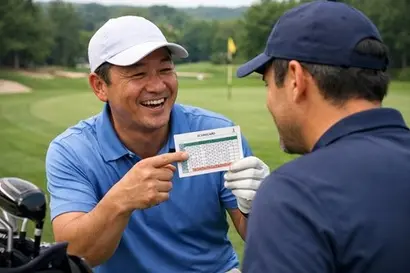
That is because 'fake scores' exist. As the opposite of a 'real score', one might call them 'fake scores' or 'inflated scores'. This is what is known as 'score massaging'. One caddie remarked, "I can easily shave 10 strokes off a customer's score." There are opportunities for a caddie to shave strokes all over the round. It starts right from the first hole. After finishing the first hole, the question a caddie often asks golfers is, "Should I record the score properly?" Does not recording it 'properly' mean recording it however we want?
"The first hole score is already recorded as 'all-par'." This is a phrase all too familiar to golfers, and we often rely on it, secretly hoping for a par on the first hole. Some caddies even say, "I don't record anything worse than a double bogey." Perhaps that is why I once met a caddie who, back in the days when scorecards were handwritten, was particularly talented at writing a stylish '2' for a double bogey. If you hit a quadruple bogey or a snowman (eight) on a par 4 and it gets recorded as a double, you’ve already shaved two strokes off in one hole.
Isn't the 'snowman' (double par) just a 'maximum score rule' determined among weekend golfers anyway? Even Tiger Woods hit a 10, seven over par, on the par-3 12th hole at the Masters, and the legendary golfer Tommy Armour, whose name is used for a golf club brand, once hit a 23 on a par 5, eighteen over par. The only reason weekend golfers' scores can stop at 144 no matter how badly they play is because of this 'snowman rule'. Or rather, thanks to it. Nevertheless, we forget to be grateful for this 'snowman' rule and are very reluctant to record an actual 'snowman' on our scorecard. In the end, the score gets reduced with a simple, "Caddie, please take good care of my score this hole."
One reason I feel a slight sense of guilt regarding whether my score today is a 'real' score is the 'mulligan'. "I played well today, shot this many strokes." The statement that follows, like a footnote in a thesis, is, "I did use one mulligan..." Of course, in South Korea, mulligans depend on the 'mercy of the caddie'. Caddies at golf courses under pressure to keep the pace moving are often stingy with mulligans. At this point, the caddie is less of a 'round caddie' and more of a 'score caddie'.
Gimmes are also handed out liberally for distances that would make you question if they would actually succeed without them. The score gets reduced further by touching the ball, moving it, placing it in a better spot, and generally bending the rules. Of course, in a round among weekend golfers, especially when the goal is 'cheerful golf', such things happen naturally. However, let’s not forget that this score is not my 'real' score. When we look at images created by AI repeatedly, we get confused about what is real. Sometimes, the fake looks more real than the real thing.
Could it be that for golfers, too, a fake score sometimes looks more real? Real golf is not on the scorecard, but in the 'real score' deep inside my heart.
Who is author Kang Chan-wook? He is an advertiser and writer. Starting as a copywriter at Cheil Worldwide, he currently serves as the CEO of the video production company 'Sidae-ui Siseon'. A golf enthusiast, he obtained a USGTF teaching professional certification and, out of his love for writing, published books on golf such as 'The Joy of Golf', 'Bad Golf', 'Sincere Golf', and 'Golf Thoughts, Thinking Golf'. He runs the YouTube channel 'Bad Golf', sharing various stories and thoughts surrounding golf with readers and viewers.