

[비즈한국] Last year, the domestic pharmaceutical and biotech industry proved its growth potential once again by recording its largest-ever scale of technology exports. As we approach 2026, the reorganization of global supply chains following the implementation of the U.S. Biosecure Act is fueling expectations for new opportunities centered on domestic CDMOs. However, concerns are simultaneously being raised that the government's signaled cuts to generic drug prices could shake the foundation of the domestic market. As 2026 approaches, a year where global market expansion intersects with domestic regulatory risks, we examine the key variables facing the Korean pharmaceutical and biotech industry.
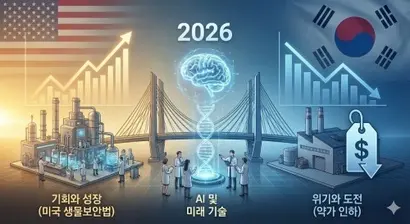
U.S. Biosecure Act: Opportunities and Threats for K-CDMOs Targeting Clients Leaving China
The U.S. Biosecure Act is considered the most significant external variable for the domestic pharmaceutical and biotech industry in 2026. Following U.S. President Donald Trump's signing of the National Defense Authorization Act, which includes the Biosecure Act, last month, it is expected that Chinese biotech firms will face much greater difficulty entering the U.S. market. New contracts are prohibited, and existing contracts can only be maintained until January 1, 2032. Given the significant role Chinese CDMO (Contract Development and Manufacturing Organization) firms have played in global pharmaceutical production, a major shift in the supply chain is expected to become reality.
Domestic CDMO firms are anticipating a 'trickle-down effect' in attracting clients moving away from Chinese CDMOs like WuXi Biologics and WuXi AppTec. Samsung Biologics207940 is leveraging its world-leading biopharmaceutical production capacity of 785,000 liters to absorb global big pharma as clients. Seventeen of the top 20 global pharmaceutical companies are clients of Samsung Biologics. With the acquisition of GSK's Rockville facility in the U.S. confirmed last month, Samsung Biologics is also expected to avoid the impact of U.S. tariffs.
Celltrion068270 plans to expand its CDMO business in earnest by acquiring Eli Lilly's U.S. plant to boost profitability. Given its extensive experience in biosimilar production, it is expected to stabilize facility operations early on. Lotte Biologics is also challenging the CDMO market through the acquisition of the Syracuse plant in the U.S., which produces ADCs (Antibody-Drug Conjugates), and the construction of three large-scale antibody drug production facilities in Songdo, Incheon. Prestige Biologics, Binex053030, and others are also going all-out as mid-sized CDMO firms to attract clients leaving Chinese companies. ST Pharm237690 holds an overwhelming presence in the CDMO market for oligonucleotides, which are the APIs (Active Pharmaceutical Ingredients) for RNA-based therapies.
However, the outlook is not entirely rosy. Indian CDMO firms are using low labor costs and manufacturing expenses as weapons, while Japanese companies, including Fujifilm, are expanding their influence in the global CDMO market by possessing high-level technological capabilities and capital in fields such as ADCs and advanced regenerative medicine.
Generic Drug Price Cuts: Fears of a Domino Effect on the Industrial Ecosystem
The drug price reduction policy announced by the government at the end of last year is emerging as the biggest risk threatening the pharmaceutical and biotech industry ecosystem. Aimed at improving the financial health of the national health insurance and encouraging new drug development, the policy's core is to lower the ceiling for generic drug price calculation from the current 53.55% of the original drug's price to 40%. Given that generic profits are the main revenue source for domestic pharmaceutical companies, this price cut is highly likely to lead to deteriorating profitability. For small and mid-sized pharmaceutical companies in particular, generics account for 80-90% of total revenue.
The pharmaceutical industry fears that reduced generic profits could lead to a decline in R&D and facility investment by pharmaceutical companies. According to a survey conducted by the Emergency Committee for the Reorganization of the Drug Pricing System for the Development of the Pharmaceutical and Biotech Industry, the estimated annual revenue loss for 59 pharmaceutical companies upon the implementation of the price cuts would reach 1.2144 trillion KRW, with operating profit declining by approximately 51.8%.
Co-chair of the Emergency Committee, Roh Yeon-hong (Chairman of the Korea Pharmaceutical and Bio-Pharma Manufacturers Association), argued at a press conference on the 22nd of last month: "Despite the difficulties of ten rounds of drug price cuts since the introduction of the actual transaction price system in 1999, the industry has managed to achieve significant results through hard work. We are on the verge of major breakthroughs in the coming years; further price cuts would kick away the ladder that allows us to rise from generics and improved new drugs to truly novel drugs.".
Concerns are also rising that this could act as a threat to the biotech ecosystem, leading to a domino collapse of the industry. It is pointed out that if pharmaceutical companies have less capital to invest due to reduced generic profits, the flow of funds to promising biotech companies will inevitably decrease. Cho Yong-jun, Vice Chair of the Emergency Committee (Chairman of the Korea Pharmaceutical Cooperative and Chairman of Dong-A ST), stated, "While there are FIs (Financial Investors) involved in the growth process of bio-ventures, pharmaceutical companies also participate as SIs (Strategic Investors) using their operating profits to help during difficult early stages.".
AI Drive and Rising Next-Generation Modalities: 'TPD, RPT, DAC'
The 'AI Transformation' strongly promoted since the launch of the Lee Jae-myung administration last June is expected to accelerate a major shift in the pharmaceutical and biotech industry. To maximize the efficiency of new drug development, the government has made AI utilization a national priority and is strengthening data construction and platform support.
The Ministry of Health and Welfare (MOHW) and the Ministry of Science and ICT (MSIT) are expanding support for AI drug development through large-scale national projects to ensure the birth of AI-developed drugs in Korea. In November last year, the MOHW selected the Korea Pharmaceutical and Bio-Pharma Manufacturers Association as the lead agency for the 'K-AI New Drug Development Preclinical/Clinical Model Development Project.' Pharmaceutical companies and biotech firms, including Hanmi Pharmaceutical128940, Daewoong Pharmaceutical, and Samjin Pharmaceutical, have agreed to participate, with approximately 37.1 billion KRW to be invested over 4 years and 3 months. The MOHW plans to establish an AI-based clinical trial design and support platform and create a full-cycle AI drug development ecosystem by linking preclinical and clinical stages.
In October last year, the MSIT selected a consortium led by Lunit and another led by KAIST as project teams for the 'AI-Specialized Foundation Model.' The goal is to develop a 'next-generation bio-foundation model' that accurately predicts core molecular structures of life phenomena and a multi-scale medical science-specialized foundation for innovation in full-cycle medical science.
AI is also set to be utilized in building an ecosystem that can lead the market by accelerating process development and scaling beyond just research and design. AI is playing an increasingly important role in 'autonomous laboratories' that decide and learn conditions for compound synthesis and future experiments to discover optimal candidates, as well as in 'bio-foundries' that create reproducible process development data by rapidly processing and integrating large amounts of data generated from automated experiments.
At the end of last year, the AI New Drug Research Institute under the Korea Pharmaceutical and Bio-Pharma Manufacturers Association established an AI drug development autonomous laboratory that operates 24/7 without human intervention, with plans to foster talent to operate the labs and use them as testbeds for companies. The MSIT and the Ministry of Trade, Industry and Energy plan to invest 126.3 billion KRW over the next 5 years to build bio-foundries driven by AI and robots.
There are also noteworthy new modalities (therapeutic techniques). TPD (Targeted Protein Degradation), which breaks down proteins that cause diseases at the source; RPT (Radiopharmaceuticals), which precisely target cancer cells by binding medical radioisotopes to target materials; and DAC (Degrader-Antibody Conjugates), which fuses ADCs and TPDs, are expected to lead the R&D trends in new drug development this year.
In Korea, SK Biopharmaceuticals is highlighting TPD and RPT as the next-generation growth engine modalities to follow its epilepsy drug 'cenobamate (U.S. product name: Xcopri).' Furthermore, Yuhan Corporation, Carna Therapeutics, and Voronoi are expected to stand out in the TPD sector; FutureChem, Selion, and DuChemBio in the RPT sector; and Orum Therapeutics and Ubix Therapeutics in the DAC sector.