

[비즈한국] As the Lee Jae-myung administration successfully launched in 2025 and opened the era of KOSPI 4000, it is now drafting a blueprint to achieve KOSPI 5000 in 2026. Accordingly, capital market management agencies are actively supporting companies and the market, while supervisory authorities have launched crackdowns to strengthen market fairness. With the domestic stock market surpassing 4300 points at the turn of the new year, we examined what changes the financial authorities have announced for capital market improvement.
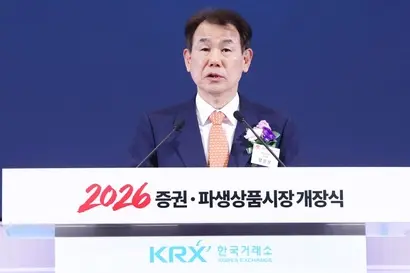
On January 2, the '2026 Securities and Derivatives Market Opening Ceremony' was held at the Korea Exchange in Yeongdeungpo-gu, Seoul. The event was attended by key figures from financial authorities, including Financial Services Commission Chairman Lee Eok-won, Financial Supervisory Service Governor Lee Chan-jin, and Korea Exchange Chairman Jeong Eun-bo, as well as heads of financial institutions such as Korea Financial Investment Association Chairman Hwang Sung-yeop, Korea Listed Companies Association Chairman Kim Young-jae, and Nextrade CEO Kim Hak-soo.
The main topic of the opening ceremony was the achievement of KOSPI 5000. January 2, the day of the event, was also the day the KOSPI surpassed 4300 points for the first time in history. Chairman Jeong Eun-bo stated, "In 2025, our capital market set a new milestone of 4000 points for the first time in history despite uncertain internal and external conditions," and added, "Now we must move beyond the 'Korea Discount' and toward a 'Korea Premium'."
Chairman Jeong presented three tasks for the Exchange to pursue the KOSPI 5000 era: establishing a fair and trusted market, providing productive financial support, and strengthening capital market competitiveness. To establish a fair market, the Exchange plans to build an AI-based surveillance system and eradicate unfair trading centered on a joint response team for stock manipulation. Plans were also announced to tighten exit requirements for insolvent companies to ensure market soundness.
To provide productive financial support, the Exchange will foster innovative companies by supporting customized listings for high-tech strategic industries such as AI, energy, and aerospace. It will also continuously pursue the Corporate Value-up Program to ensure companies are recognized for their fair stock prices. Changes to strengthen competitiveness in the global market were also presented. The goal is to gradually establish a 24-hour trading system by extending trading hours. To accelerate the shift to digital finance, the Exchange will expand new products such as virtual assets and ETF futures.
At the opening ceremony, Financial Services Commission Chairman Lee Eok-won expressed his determination to establish fair market order. Chairman Lee stated, "Last year, we laid the foundation for account payment suspensions and the imposition of fines through the joint response team for eradicating stock manipulation," adding, "This year, we will expand the enforcement capabilities of the response team and apply a 'one-strike-out' policy to unfair trading."
Measures to protect shareholders were also mentioned. Chairman Lee stated, "We will strengthen shareholder protection in cases of 'split-off' listings and support the principle of canceling treasury shares," adding, "We will establish a monitoring system for the implementation of the Stewardship Code (principles for institutional investors to participate in the management of invested companies) and expand its scope of application."
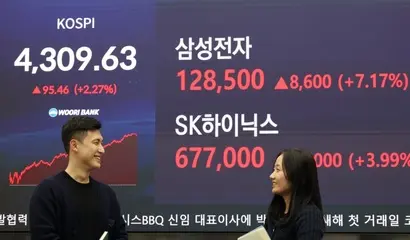
As Chairman Lee noted, financial authorities have improved various systems starting this year to strengthen capital market fairness and transparency. The five major capital market system changes taking effect in 2026 are: improvement in treasury share disclosure, strengthening of disclosure for serious disasters, enhancement of executive compensation disclosure, expansion of English-language disclosures for listed companies, and reorganization of the income statement. These improvements aim to allow shareholders to clearly understand a company's current status and management situation.
Under the previous treasury share disclosure system, listed companies holding 5% or more of total issued shares were required to disclose their holdings and handling plans once a year. The improved system expands this obligation to twice a year for those holding 1% or more. A new regulation was also established requiring companies to disclose the reasons if the actual handling of treasury shares differs by more than 30% from the previously disclosed plan.
Regarding disclosures for serious disasters, previously only penalties and administrative measures were disclosed. Starting this year, details such as the overview of the disaster, damage status, and response measures and outlook must be specifically disclosed in business and semi-annual reports. This opens a path for shareholders to verify specific information on serious issues that may affect corporate value.
Executive compensation disclosure was reorganized because the existing system was criticized for lacking a clear relationship between corporate performance and compensation, and for insufficient justification of how compensation is calculated. Now, performance metrics from the past three years, such as total shareholder return and operating profit, must be stated alongside total executive compensation. Stock-based compensation for all executives and individuals must also be disclosed.
English-language disclosure for listed companies was previously limited to large KOSPI-listed companies with assets of 10 trillion won or more, but the threshold was significantly lowered to companies with assets of 2 trillion won or more starting May 1, 2026. The scope of items for English disclosure was also strengthened from a partial list (26 items) of major management matters to the entire set (55 items).
In the case of corporate income statements, operating profit was previously limited to gains and losses related to primary business activities. After the improvement, it will be classified and displayed by source, such as operating, investing, and financing activities. While it is set to be applied to business years starting on or after January 1, 2027, early adoption is possible starting this year.