

[비즈한국] The Chinese government has released the world's first technical standards for all-solid-state battery (ASB) electric vehicles, often referred to as the 'dream battery.' There is cautious speculation that Chinese battery companies may be on the verge of commercializing these batteries. As seen in the consecutive contract cancellations faced by SK On, the South Korean battery industry is suffering due to the setbacks of Western markets, which have lagged behind in the secondary battery industry. Under these circumstances, concerns are rising that South Korea may fall behind in the race for battery leadership against China.
On December 30 of last year, the China Automotive Standardization Technical Committee announced a draft standard for all-solid-state batteries (ASB) titled 'All-solid-state batteries for electric vehicles - Part 1: Terms and definitions.' This is the first time a standard for ASBs has been established globally. The draft is set to be finalized following a period of public consultation. ASBs use solid electrolytes instead of the conventional liquid electrolytes, earning them the nickname 'dream battery' due to their low fire risk and high energy density.
The new standard applies a rigorous classification system. Depending on the ion transport method, they are classified into liquid, solid-liquid hybrid, or solid batteries, and the previously used term 'semi-solid' has been abolished. This is interpreted as an intention to strictly distinguish between hybrid batteries containing liquid electrolytes and true all-solid-state batteries.
To be recognized as an ASB, the mass loss rate under drying conditions must be 0.5% or less. This is a stricter criterion than the 1% limit announced by the China Society of Automotive Engineers (CSAE) early last year. In addition to this, the standard also includes classifications for ASBs based on criteria such as the type of solid electrolyte (sulfide, oxide, polymer, etc.), the type of transport ion (lithium, sodium, etc.), and the application (high-energy type, high-power type).
Some predict that this announcement by the Chinese government signals that Chinese battery firms are nearing mass production of ASBs. The implication is that the Chinese government has presented standards that align with the current technical development level of its domestic battery industry.
The basis for this speculation lies in a precedent involving sodium batteries. In September 2024, China announced stringent battery safety standards. These included requirements for thermal propagation tests, which effectively require preventing thermal runaway caused by electrical shorts, and bottom impact tests, which simulate scenarios where road debris or rocks strike the battery.
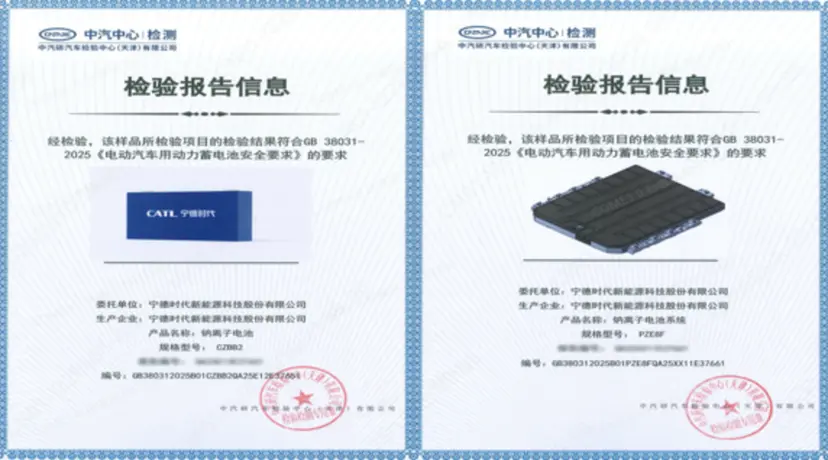
At the time, the industry felt these safety standards were nearly impossible to meet. However, CATL, China's largest battery company, shocked the industry in April last year by unveiling 'Naxtra,' a sodium battery that met these safety standards. While sodium batteries have lower energy density than lithium batteries, they are gaining attention as low-cost alternatives due to advantages in material costs, low-temperature discharge, and safety.
This follows a series of shocks that began after the South Korean battery industry focused on high-performance batteries, allowing China to effectively monopolize the lithium iron phosphate (LFP) battery market. Fears are growing that China could seize leadership in the ASB field just as it did with low-cost batteries. In South Korea, Samsung SDI006400 is targeting 2027, while LG Energy Solution373220 and SK On are aiming for 2029 for the mass production of ASBs.
However, experts still assess that South Korea's ASB technology remains ahead of China's. Shin Dong-wook, a professor of Materials Science and Engineering at Hanyang University, commented, "Chinese companies have only been properly developing related technology for about one to two years. While it remains to be seen once they actually unveil their products, I believe there is currently a significant technical gap with South Korea."
Others argue that it is too early to pinpoint a timeframe for the mass production of ASBs. An industry insider said, "Including China, ASBs are still closer to the research and development stage than to mass production. Realistically, we expect commercialization in South Korea, China, and Japan to occur around 2030."