

[비즈한국] On the first day of the New Year, a '50,000 won coupon pack' unveiled by the fashion platform Musinsa instantly captured the attention of the retail industry and consumers. It was more than just a simple New Year's promotion; it was a direct move aimed at Coupang's recent controversial '50,000 won purchase voucher compensation plan.' By mimicking the coupon amount, composition, and even Coupang's signature colors, they took a direct shot at the company.
On January 1st, Musinsa released a coupon pack worth a total of 50,000 won. The breakdown includes 20,000 won for Musinsa Store, 20,000 won for Musinsa Shoes & Player, 5,000 won for Musinsa Beauty, and 5,000 won for Musinsa Used. All coupons can be used on Musinsa's core service platforms. The key feature is the structure, which is 'difficult not to use' by focusing on categories with high usage frequency.
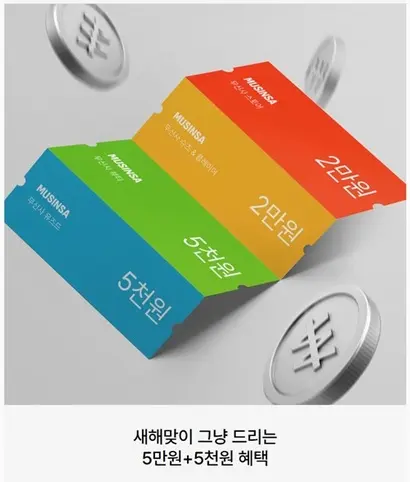
On top of this, Musinsa added an extra benefit. It is running an event where customers get 5,000 won back if they confirm a purchase of over 10,000 won after topping up their Musinsa Money. By adding the 5,000 won payback to the 50,000 won coupon pack, the total perceived benefit for consumers reaches 55,000 won. This is effectively 5,000 won more in benefits than Coupang's 50,000 won purchase voucher.
Such a composition naturally draws comparisons to the compensation plan recently announced by Coupang. Following a personal data breach, Coupang proposed 50,000 won worth of purchase vouchers, but faced controversy due to their focus on categories with low usage rates, such as travel and luxury goods, and a coupon method that lacks liquidity. Some in the legal community have even pointed out that using these coupons could negatively affect the exercise of future legal rights.
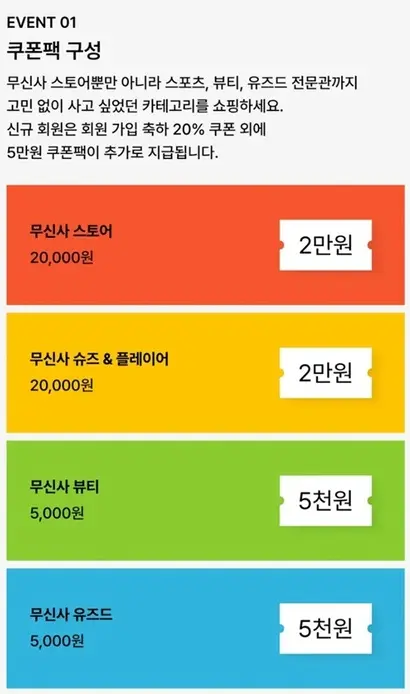
Musinsa's strategy is considered to have precisely targeted this point. Musinsa's coupon pack requires almost no explanation. It is structured to be used immediately upon opening the app. Furthermore, with the addition of a coupon design in a color similar to Coupang's logo, a comparative framework is naturally formed in the minds of consumers. Industry insiders interpret this as a "design with no hidden intentions."
An official from the retail industry stated, "Musinsa designed this in a way that exposes the weaknesses of the Coupang compensation plan as they are," adding, "The core is using the same number, 50,000 won, but making it more intuitive and tangible." They continued, "From a consumer's perspective, they have no choice but to respond to benefits they can use immediately without needing an explanation."
Meanwhile, the government and political circles are expressing their intent to respond sternly to the Coupang incident, which was sparked by a large-scale personal data breach. In particular, they stated their position to use all legally available means, including addressing the issue of overwork deaths among workers. Immediately after the joint hearing, the government-wide Task Force (TF) on the Coupang incident stated in a press release that there will be "no compromise on acts that undermine public safety, workers' lives, and fair market order." The Ministry of Science and ICT also clarified its stance on taking strong government-level action, stating that it will immediately request a police investigation regarding Coupang's violation of the data preservation order.
Criticism from the political arena is also intensifying. The Democratic Party of Korea defined this hearing as a "series of organized and complacent evasions and excuses," pointing out that Coupang avoided responsibility by citing cooperation from the National Intelligence Service instead of providing a responsible explanation in the face of an unprecedented personal data breach. In particular, the fact that the National Intelligence Service refuted their claims by mentioning the possibility of perjury, the assertion of deleting 5 months of access logs, and the attitude of disguising the failure to submit key materials as 'cooperation' have also come under heavy fire. The Democratic Party emphasized that Coupang must clearly recognize that it is not a dominant market player but stands on the judgment seat of law and principles.