

[비즈한국] As the Seoul Metropolitan Government pushes forward with the 'Nodeul Global Art Island' project in phases, it has been confirmed that the total project cost reaches 440 billion won, with the core 'Sky Art Garden' project alone requiring over 400 billion won. In October, the Seoul Metropolitan Government announced the total cost of the Nodeul Global Art Island project was 370.4 billion won; however, it was discovered that this figure excluded land compensation costs. The Seoul Metropolitan Council has previously pointed out that by splitting the project into phases, the Seoul Metropolitan Government is making the total project scale appear smaller than it actually is.
Seoul City: "The waterfront area and the sky garden have different licensing requirements and procedures, hence the split"
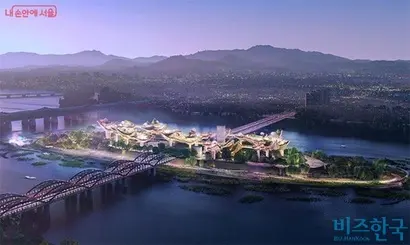
Last October, the Seoul Metropolitan Government announced that the 'Nodeul Global Art Island' project would break ground this October and be completed by 2028. Through an international design competition, the Seoul Metropolitan Government plans to build the 'SOUNDSCAPE' design by British architect Thomas Heatherwick, dividing it into the Sky Art Garden (aerial + ground) and the Waterfront Cultural Space (base + waterfront).
The total project cost announced by the Seoul Metropolitan Government was 370.4 billion won. However, an investigation by Bizhankook confirmed that the construction cost for the Sky Art Garden alone exceeds 400 billion won, and the total project cost reaches 440 billion won. The Seoul Metropolitan Government divided the Waterfront Cultural Space into a 'short-term' project, the Sky Art Garden into a 'medium-term' project, and the island expansion into a 'long-term' project. Currently, the total cost for the ongoing Waterfront Cultural Space construction is approximately 36 billion won, while the total cost for the Sky Art Garden, scheduled to break ground next January, is approximately 404 billion won.
This means over 440 billion won will be spent just on the waterfront and ground-level construction, and the scale is expected to grow even further once the long-term island expansion project is included. As a result, critics argue that the Seoul Metropolitan Government split the budget in a 'salami-slicing' tactic.
During a meeting of the Seoul Metropolitan Council's Administrative Autonomy Committee last June, Councilmember Park Soo-bin (Democratic Party) raised questions about the Nodeul Island project: "It involves aerial, ground, base, and waterfront components. It only makes sense if the design is comprehensively and organically connected, and it shouldn't be executed in a fragmented manner. Why was the management plan submitted with only the base and waterfront components separated?" She further questioned, "Isn't this an attempt to split the medium-term investment review?"
Councilmember Park pointed out, "The Nodeul Island project alone is a 350 billion won project, and if you add road accessibility improvements and other things, it will rise to about 400 billion won. I cannot shake the impression that it is being split too much in phases."
In fact, according to documents submitted by the Seoul Metropolitan Government to Councilmember Lee Min-ok (Democratic Party) regarding the Nodeul Island development project, the Waterfront Cultural Space project passed the 2024 2nd Investment Review Committee with a 'conditional approval' for a project cost of 36.173 billion won. The Nodeul Island Sky Art Garden project passed the 2024 7th Investment Review Committee with an 'appropriate' rating for 404.233 billion won. All were results from Seoul's internal investment review committee.
In response, an official from the Seoul Metropolitan Government explained, "The Waterfront Cultural Space project is near a river, so it requires relevant permits, while the Sky Art Garden project is on land and subject to urban planning facility project regulations. We split the projects because the licensing requirements and procedures are different. Since the administrative procedures are different, we are proceeding with them separately; the project was not split to fall below a certain size threshold."

Even though the medium-term project alone exceeds 400 billion won, the Seoul Metropolitan Government announced that the total project cost for the Nodeul Global Art Island is 370.4 billion won. This is because they excluded 71.9 billion won in land compensation costs for state-owned and city-owned land allocated for the medium-term project.
Previously, a Seoul Metropolitan Government official stated, "Other local governments do not disclose total project costs including land prices for projects that utilize state or public land."
Regarding this, Kim Sang-chul, a senior researcher at the Nara Institute for Economy and Finance, pointed out, "The concept of total project cost is clearly defined under current law, and even for state-owned assets, land compensation costs must be included in the total project cost. If the Seoul Metropolitan Government wanted to reduce the figure to lower social pressure, they should have used terms like 'project cost' or 'actual investment amount' rather than 'total project cost'."
Passed internal review, not subject to Ministry of the Interior and Safety review
The economic feasibility of the Nodeul Island project is also significantly low. According to the investment review request for the Nodeul Island Sky Art Garden project, the feasibility study resulted in a B/C (benefit-to-cost) ratio of 0.31 and an NPV (net present value) of –243 billion won. Usually, a project is considered economically feasible when the B/C ratio is 1 or higher and the NPV is greater than 0.
The FNPV (financial net present value), which shows cash flow, was –315.1 billion won, the PI (profitability index) was 0.21, and the FIRR (internal rate of return) was –6.40%. The investment review request stated, "Since the profitability index (PI) is less than 1, it is judged that there is no financial profitability."
The annual average operating balance was predicted to be a surplus of 3.6 billion won. The Seoul Metropolitan Government plans to charge a 5,000 won entrance fee per person for the aerial walkway.
Despite low economic feasibility, both the Nodeul Island Waterfront Cultural Space and the Sky Art Garden projects passed the Seoul Metropolitan Government's internal investment review without issue. Although they require over 400 billion won in budget, they did not undergo the Ministry of the Interior and Safety's central investment review because they are funded entirely by 'city funds'. This is because the standards were relaxed following an amendment to the relevant enforcement decree last January.
The Seoul Metropolitan Government plans to complete the Nodeul Island medium-term project, including the aerial walkway, by 2028. There is a possibility that the project cost will increase further. In particular, the total project cost for the Nodeul Island long-term project has not yet been calculated. The review report on the 2025 periodic public property management plan of the Seoul Metropolitan Government states, "The aerial walkway is a special structure for which no similar domestic cases exist, so there are limitations in reviewing the construction cost in this report. In the case of structural work and external finishing work, which account for most of the construction cost, it should be noted that there is a possibility of cost increases depending on manufacturing methods and domestic transportation costs during future detailed design."
A Seoul Metropolitan Council member criticized, "The improvement of accessibility to Hangang Bridge, which was a condition for pushing forward the Waterfront Cultural Space project, was diverted to another project, so the budget was not included in the Nodeul Island project. This is a 'trick' method of splitting a single project."
Previously, Kim Sang-chul, a senior researcher at the Nara Institute for Economy and Finance, pointed out, "The enforcement decree should have been amended based on the premise that local governments have the capability for investment review, but in reality, that is not the case. I believe it has opened the way for local governments to conduct investment projects as they please."