

[비즈한국] Every modern person lives with chronic pain in at least one part of their body. Even after visiting the hospital, it doesn't get better. Every clinic provides a different diagnosis and a different prescription. Despite using all kinds of treatments and medications, you might feel slightly better for a while, only to have the pain return. Information about pain is overflowing on TV, YouTube, and in books. But why is it so difficult to find a solution that truly frees me from pain?
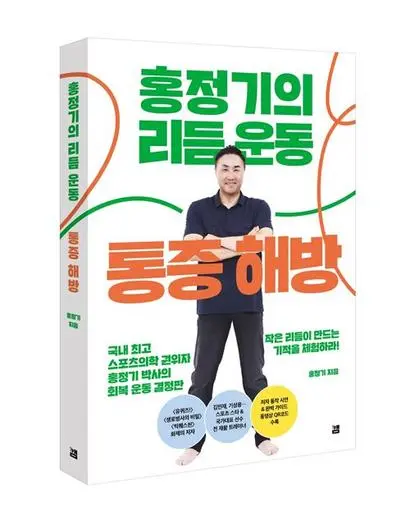
‘Hong Jung-gi's Rhythmic Exercise for Pain Relief’ is a solution for chronic pain provided by a sports medicine expert. The author, Dr. Hong Jung-gi, is a rehabilitation and conditioning expert who has been trusted by top-tier athletes performing on the world stage, such as Kim Min-jae, Ki Sung-yueng, and Yun Sung-bin. He received his doctorate in exercise science from Oregon State University, was the only Korean professor appointed at Willamette University, and received the 'Professor of the Year' award. His path to becoming a rehabilitation trainer was rooted in the frequent injuries he suffered as a teenage national weightlifting athlete. Having experienced clinical work, academia, and the field extensively, he has established a new paradigm of 'movement recovery' in the domestic sports medicine field.
The solution the author presents for chronic pain is 'rhythmic exercise.' He argues that we must move our bodies according to their natural flow—the rhythm in which our bodies rotate, connect, and release. Chronic pain is often difficult to trace to a specific cause, and in some cases, the pain persists even when there is nothing physically wrong with the body. When memories of pain during certain movements accumulate, it leads to kinesiophobia (fear of movement), and that fear causes the body to tense up excessively, recruiting muscles that don't need to be used. As a result, the rhythm of movement collapses and a 'pain circuit' becomes fixed in the brain. The author states that because chronic pain is a pain circuit fixed in the brain, strenuous exercise that stimulates it will have the opposite effect. He advises that one should unlock these closed pain circuits through small movements that the brain allows and rhythmic exercises where different parts of the body move in harmony.
Therefore, rhythmic exercise begins with small movements that reassure the brain. You should never overexert yourself or cause muscle pain. The point is to move rhythmically within a pain-free range so that the brain accepts it without resistance. Once the brain begins to feel reassured that there is no pain, the range of motion is gradually expanded.
There are four principles to rhythmic exercise. First, there should be no pain while exercising. If your body hurts while exercising, you are doing it wrong. Recovery begins only when you reset the brain's pain memory. Second, you should feel comfortable even after exercising. This is because rhythmic exercise is 're-learning,' not 'stimulation.' Third, you must move while relaxing your muscles. You need to move gently and softly enough that your body doesn't resist; this is how tension is released. Fourth, you must induce coordination of the body through connected movements. Shoulder pain often occurs because the coordination between the neck and the scapula has weakened. Rather than moving just one part, the entire connected area should move harmoniously to regain its rhythm.
The book provides detailed guidance on rhythmic exercise methods by body part: neck/shoulder, lower back, hips, knees, and ankles/soles of the feet. It also covers exercises to prevent recurrence after the pain has disappeared.