

[비즈한국] The European tech ecosystem has made remarkable leaps over the last decade. According to the ‘State of European Tech 2025’ report, published on November 25 by London-based investment firm Atomico, the scale of investment in Europe has grown more than 10-fold since 2015, the talent pool has expanded 7-fold, and the number of companies valued at over $1 billion has more than tripled.
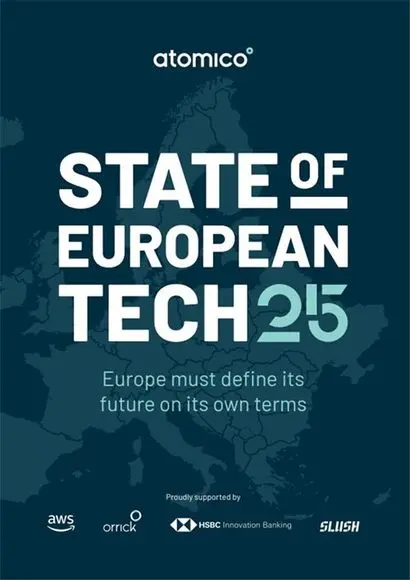
Currently, Europe is home to five ‘Centacorns’—companies with a market capitalization exceeding $100 billion (144 trillion KRW), including ASML and SAP. Given that the U.S. has over 30 Centacorns, Europe remains a market thirsty for 'growth.' The desire for transformative change toward growth is also higher than ever. Even in terms of ecosystem value alone, it has climbed from less than $1 trillion (1,442 trillion KRW) a decade ago to about $4 trillion (5,768 trillion KRW) today, demonstrating rapid momentum.
Perhaps Europe now stands at the threshold of its most transformative era. Will it restore its past glory, or slowly fall behind in history? Atomico defines the factors that will determine this as ‘speed, integration, and boldness.’ The question thus becomes simple: What will define the next 10 years of European tech, and how will Europe proactively design its 'own future'?
Looking back at the European startup scene in 2025, we examine what is becoming important in Europe and how Korean companies need to prepare for entry into the European market.
Europe Leading AI Regulation
The release of ChatGPT at the end of 2022 served as a signal flare for the acceleration of global AI trends. Now, attention is focused on how the AI trends sparked by LLMs will be specifically applied to industries. In this context, the importance of physical AI—such as robots, autonomous driving, and factory automation, which combine spatial relationships with the physical characteristics of the world—is growing.
Meanwhile, Europe has quietly been working on establishing the 'rules' for the markets where AI will be applied. A prime example is the EU AI Act. It is the world’s first comprehensive regulation of artificial intelligence technology. The EU AI Act adopts a risk-based approach, differentially regulating AI usage according to risk levels; it prohibits certain AI technologies like social scoring and real-time remote biometric identification, while requiring strict safety standards for AI in high-risk areas such as healthcare and transportation. Major regulations have been implemented in stages following their entry into force in August 2024, and because massive fines are imposed for violations, AI-related companies have been on high alert.
Furthermore, in August 2025, key provisions covering General Purpose AI (GPAI) also came into effect. With this, European AI startups faced a 'first regulatory shock,' bearing obligations for technical documentation, summaries of training data disclosure, system risk assessments, and accident reporting.
Because this law can impose fines of up to 35 million Euros (59.3 billion KRW) or 7% of global annual turnover for violations, it has begun to function as an entry barrier for early-stage startups, and as weaponized compliance for players who prepared for the regulations preemptively.
Consequently, in Europe, the issue for AI is no longer just about 'making it well,' but 'under what rules can it be sold?' 2025 was the year that question became a greater reality. Regulatory compliance for prohibited and high-risk areas has climbed to the first page of product roadmaps, and technical documentation, data governance, risk assessment, and accident response systems have become part of the product, not just an 'appendix.' For the European AI industry in 2025, regulatory compliance became the first step toward becoming a 'Unique Selling Point (USP)' rather than a cost.
In addition, in April 2025, the EU put forward the ‘AI Continent Action Plan,’ which bundles infrastructure, talent, data, and industrial application, attempting to shift regulation into an ‘industrial strategy package.’ This plan aims to accelerate the adoption of AI in actual industrial and research settings. The way Europe handles AI is different from the U.S.-style Big Tech vertical integration or the Chinese state-led approach. Europe’s characteristic—first creating a regulatable market, designing industry-specific applications meticulously atop it, and making the process itself an entry barrier—became even more distinct in 2025.
Amidst this, what moves have major European AI tech companies made? Mistral AI, the hope for European LLMs and often called 'sovereign AI,' raised 1.7 billion Euros (approx. 2.88 trillion KRW) in a Series C round in September, surpassing a corporate valuation of 14 billion dollars (20 trillion KRW).

This is one of the largest in European startup history, cementing Mistral AI’s position as Europe's powerful challenger to OpenAI and Anthropic. The most notable point here is that this investment was led by ASML, the world-class semiconductor manufacturing equipment company headquartered in the Netherlands. This is an interesting case where the discourse on European AI sovereignty is moving from political slogans to industrial alliances, a point worth watching to see if it becomes a new growth model for the European market.
The moves of Nscale are also noteworthy. Nscale is an infrastructure player founded in London in 2023, focusing on the ‘compute layer,’ such as AI-dedicated clouds and data centers. The fact that Nscale raised 1.1 billion Euros (approx. 1.86 trillion KRW) in September gives a glimpse into Europe's current interests. When Europe speaks of AI sovereignty, the bottleneck that always arises is compute capability. In other words, AI-dedicated clouds, data centers, and GPU supply chains are being redefined not as simple infrastructure, but as part of ‘sovereignty.’ Therefore, in the European market where power, regulation, and national interests are intertwined, Nscale's success story demonstrates that infrastructure investment in the market is not just equipment, but a point where policy meets industry.
Among European AI startups, the 2025 supernova was ‘Lovable.’ Lovable is an AI coding startup founded in Sweden in November 2023 that reached unicorn status within eight months of its founding by raising 174 million Euros (294.8 billion KRW) in Series A funding.

This is one of the shortest records for achieving unicorn status in European tech history, showcasing the explosive power of the AI-native app development platform market. Not only that, but by reaching an Annual Recurring Revenue (ARR) of $100 million (144.2 billion KRW) within 8 months of its 2024 launch, it proved that Silicon Valley-style ultra-fast product diffusion is possible in Europe as well. This is why Lovable emerged as another European hope this year.
Beyond that, London’s generative AI company focused on speech generation/dubbing ElevenLabs, Freiburg’s generative image model company Black Forest Labs, Paris’s software development AI company Poolside, London’s AI avatar video generation company Synthesia, and Cologne’s AI translation company DeepL have emerged as quiet powerhouses, igniting the European AI tech scene.
Deep Tech Investment Increased but Fragmented
A noteworthy element in the ‘State of European Tech 2025’ report is the significant increase in the proportion of deep tech in European VC funding. Europe has always been very strong in science-based industries such as research institutes, personnel, and public R&D. Capital has begun to pour into these areas once again. In particular, investments in quantum computing, space, and new materials have been active, and the bio-health sector saw successful cases combined with AI, while in quantum computing, funding inflows have continued, narrowing the gap between research and commercialization.
If until now Europe spoke the language of research, in 2025 in Europe, deep tech is being packaged not as ‘research for the sake of research’ but as the language of strategic industry, and the way that language connects to the capital market has become more sophisticated. While the U.S. is hyper-focusing investments into a small number of AI labs, Europe’s characteristic of dispersing investments across strategic technologies such as compute, quantum, defense, and climate has strengthened. While dispersion is a strength, it simultaneously reveals the weakness of being 'weak in scaling up' due to a lack of firepower to pour capital into winners.
Notable European startups in the deep tech sector in 2025 are as follows. First, Quantinuum, from Cambridge, UK, is a full-stack quantum company developing both quantum hardware and software stacks. In September, Quantinuum succeeded in raising a large-scale equity round of $600 million (approx. 810 billion KRW), boosting its total corporate valuation to $10 billion (approx. 13.5 trillion KRW) and proudly earning the status of a ‘Decacorn’ (a startup with a valuation over $10 billion). Korea Investment Partners also participated as a new investor, making it a hot topic in Korea as well.
With this, Quantinuum has secured funds to accelerate the development of next-generation systems like 'Helios,' allowing it to pursue R&D and scale-up simultaneously for the realization of Universal Fault-Tolerant Quantum Computing. This case holds great symbolism in that Europe has begun to create ‘corporate value’ in quantum, not just ‘research.’
The Series B funding of Multiverse Computing, a quantum AI startup based in San Sebastián, Spain, was also one of the big pieces of news. Multiverse Computing possesses technology that realizes ultra-small AI ('Chipbrain') capable of being applied in various fields such as edge devices, home appliances, and mobile by drastically reducing AI model sizes while maintaining performance through its ‘CompactifAI’ compression technology based on tensor networks inspired by quantum physics. Analysts suggest that the $215 million (290 billion KRW) investment raised in June marks its first step toward commercialization.
Furthermore, growth stories in the bio/health sector also show Europe's unique characteristics. As AI combines with the bio-health tech sector, there are two companies delivering interesting growth stories in the European market, where 'verification' is as important as 'invention.' They are London’s Isomorphic Labs and the Paris startup Owkin.
Isomorphic Labs is an AI drug discovery company that spun off from Google DeepMind, drawing attention for its approach of connecting structural biology and chemistry to drug design. Owkin is known as an ‘AI bio platform’ that supports clinical research and biomarker discovery based on medical data. Owkin has turned Europe’s strength—its hospital and research data network—into a product. This was possible because it turned the constraints unique to Europe—‘fragmented hospital systems, strong privacy protection regulations, and public medical data’—into a competitive advantage.
The cases of these two companies most clearly showed how research and clinical assets, which Europe has long held as strengths, were converted into a capital event called a ‘large investment round’ in 2025.
Defense Industry: From Taboo to Opportunity
If there was a sector hotter than the AI taking center stage, it was defense, security, and resilience tech. Especially in Europe, defense has long been at the center of ESG debates. However, in 2025, geopolitical risks turned moral debates into procurement driven by realistic necessity. European defense tech investment in 2025 surged 55% compared to the previous year. The defense sector in Europe is now no longer a taboo, but a land of opportunity for resilience.
At the center of this is Munich-based Helsing. Helsing is an AI-based defense software company that helps battlefield decision-making by combining sensor and reconnaissance data. In June, it raised 600 million Euros in Series D funding, becoming a Decacorn with a valuation of 14 billion dollars.
Beyond that, ‘dual-use’ startups that convert civilian AI and robotics technology into military technology have grown explosively. A prime example is Portugal’s Tekever joining the unicorn ranks. German startup Quantum Systems, which makes drones for intelligence and reconnaissance (ISR), also garnered attention.
Adding fuel to this fire is the European Defence Fund (EDF). The EU focused on reducing dependency on U.S. technology by pouring billions of Euros into defense technology projects focusing on AI, quantum computing, and cybersecurity.
Amidst this, there were also various frictions, such as news of the turmoil and reorganization of the NATO Innovation Fund (NIF). The NATO Innovation Fund was an unprecedented attempt, a 1 billion Euro (1.69 trillion KRW) defense and security innovation fund backed by 24 countries when announced in 2022. However, in the process of operations, founding partners departed, disputes regarding compensation arose, and there was significant noise over suspected conflicts of interest. Chairperson Fiona Murray, who joined during the reorganization, is working hard to resolve the current chaos.

In an interview with the startup media outlet Sifted, Murray stated, “The Russian threat is extremely real, and security is changing technology roadmaps,” adding that “to build long-term technological resilience, Europe will invest in the ‘Grey Zone’—such as border interference, the emergence of drones, and infrastructure threats like undersea cables—and needs a system for ‘pricing resilience.’” She particularly made it clear that “it is time to combine the speed of startups with the industrial production capacity of large corporations,” and that the European defense/security market in 2025 is entering a stage where the scale of scale-up, mass production, procurement systems, and capital needs to grow from the ‘startup boom’ phase.
Climate Tech: Beyond Discourse, Toward Profitable Industrial Infrastructure
Europe, which has emphasized ‘sustainability’ and ‘climate’ with the loudest voice in the world, has begun to talk about KPIs again. If until now, climate political correctness, carbon credits, and ESG rhetoric aligned with sustainability took priority, this year, investors’ focus gathered more than ever on whether climate business will ‘make money.’ In other words, ‘on-site problems’ such as electrification, grids, process efficiency, and distributed energy became the center.
Looking at startups that attracted major investments, one can understand the flow. First, Munich-based Proxima Fusion is a German-based fusion startup aiming for the commercialization of fusion power. In 2025 alone, it raised 130 million Euros (190 billion KRW) in Series A funding, breaking the European private investment record in the fusion sector. Total investment has reached 200 million Euros (290 billion KRW) after expansion, and it is actively receiving funding. Based on the Max Planck Institute’s stellarator technology (a magnetic field device that stably traps plasma for fusion reactions), it aims to commercialize fusion power plants in the 2030s.

Hamburg startup 1KOMMA5° is growing into a platform that integrates and operates home electrification (solar, batteries, heat pumps, etc.) and energy management. As 1KOMMA5° has become a representative unicorn in Germany, it has shown that climate tech is not just a choice for climate political correctness, but that it generates profit as an electrification operation business.
Furthermore, Hamburg-based startup Rabot Energy is drawing attention as an ‘energy fintech’ company that solves electricity rate optimization and power trading with software, and Karlsruhe-based INERATEC is targeting industrial decarbonization with synthetic fuel (e-fuels) production technology, turning policy goals into actual processes (plants). Also, Dresden’s Sunfire is mentioned as a representative example of European industrial decarbonization with its solid oxide electrolysis cell (SOEC)-based water electrolysis and e-fuel value chain technology. As the climate tech sector grows in connection with the energy industry, the cases of German startups growing in this field are particularly noteworthy.
The End of the Fintech Warring States Period, Only the 'True Experts' Survived
For the past five years, fintech...