

[비즈한국] 2025 is already coming to an end. A quarter of the 21st century has passed! This year saw an incredible number of astronomical discoveries and stories. What will unfold in space in 2026? Let’s get a sneak peek at next year.
Sending Humans Back to the Moon! The Artemis II Mission
If we are to pick the most important space mission of next year, it is undoubtedly Artemis II, which will send humans back into the vicinity of the Moon for the first time in nearly half a century. NASA is currently conducting the Artemis program with the goal of restoring the glory of the Apollo era and maintaining a competitive edge over other nations that are quickly catching up.
To achieve this, NASA developed the SLS rocket, which is more powerful than the Saturn V of the past. Despite significant time and effort, the development of the SLS was sluggish, casting uncertainty over the Artemis mission for some time, but they ultimately succeeded in creating a new rocket. They also built the new Orion spacecraft for the Artemis mission.
On November 16, 2022, Artemis I successfully completed its historic maiden launch. At the time, the launch was a performance test for the SLS rocket and the Orion spacecraft and did not carry a crew. The first unmanned test was successful. The Orion spacecraft reached the Moon, orbited it, and returned to Earth.
Although no humans were on board, it carried three mannequin dummies. These mannequins were named "Moonikin Campos." "Moonikin" is a portmanteau of "Moon" and "mannequin." The name "Campos" was added in honor of Arturo Campos, a NASA mission manager who helped save the lives of the astronauts during the Apollo 13 oxygen tank explosion.
While it was an uncrewed test flight, the success of the first attempt gave NASA the confidence that they could return humans to the Moon and leave footprints after half a century. And finally, the next mission to carry actual people, Artemis II, is scheduled soon.
Although technical issues caused slight delays, NASA is currently aiming to launch the rocket between February and April 2026. This mission does not yet involve a human landing on the lunar surface. The goal is for a spacecraft carrying real humans, not mannequins, to approach the Moon, orbit it, and return to Earth as a practice run. If this test succeeds, the subsequent Artemis III mission will allow us to see, in high-definition live video, astronauts planting a flag and leaving footprints on the lunar surface.
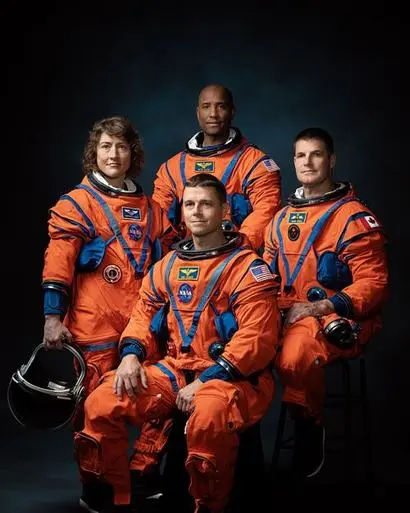
The astronauts for the Artemis II mission have also been selected. There are four protagonists who will view the Moon from the closest distance of anyone in history through this mission: Commander Reid Wiseman, Pilot Victor Glover, and Mission Specialists Christina Koch and Jeremy Hansen. Hansen is from Canada; if the mission is successful, he will be the first non-American in history to approach the Moon. Unlike the Apollo missions, which carried a maximum of three astronauts, this mission has room for one more. It is also a notable change that the crew is more diverse compared to the Apollo missions, which took place during the height of the Cold War.
Various technical tests will also be conducted. The entire mission is expected to take about 10 days, from leaving Earth to orbiting the Moon and returning to Earth's oceans. At its closest point, the craft will be just 7,400 km away from the lunar surface. This mission will test optical space communication technology, verifying whether high-speed wireless communication is possible between lunar orbit and ground stations in California and New Mexico. The goal is to receive data at speeds of up to 260 Mbps.
NASA ultimately intends to hand over the operation of the International Space Station, currently orbiting Earth, to the private sector and aims to build a new space station around the Moon. This new station, known as the Lunar Gateway, will serve as a new space outpost where astronauts can reside near the Moon and descend to the surface to work whenever needed. The most important first step toward that future—the moment a spacecraft carrying living humans circles the Moon and returns to Earth after such a long time—is about to become reality.
Voyager 1 to Break the 1 Light-Day Distance from Earth
2026 will see amazing events not only for the Moon on Earth's doorstep, but also in deep space far beyond our solar system. Voyager 1, which has been flying farther than any other object in human history, will finally pass the 1 light-day distance from Earth on November 15, 2026! This means it will have traveled a distance that takes light a full day to cover. It is a moment where a new milestone in human space exploration is set.
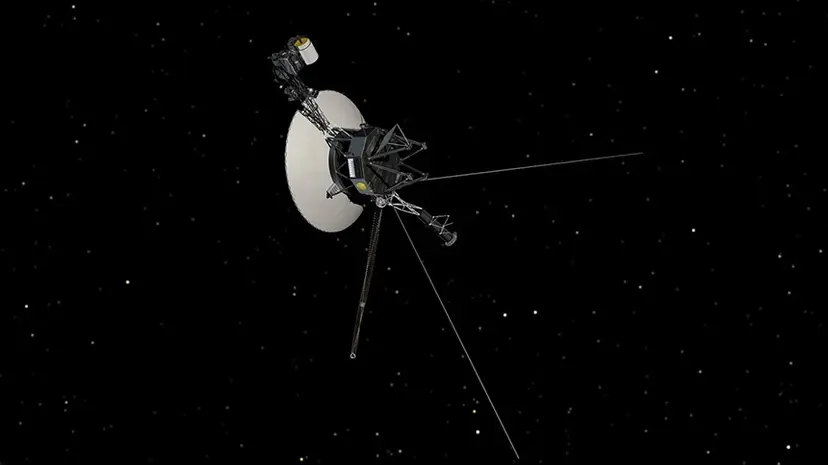
Voyager 1, which left Earth in 1977, has been traveling through space for nearly 50 years. You might think it is moving too slowly, considering it has been flying for 50 years and is only 1 light-day away, not even a light-year. However, strictly speaking, Voyager is leaving us quite rapidly. Thanks to the strong gravitational assist from Jupiter and Saturn, it has already surpassed the minimum escape velocity needed to leave the Sun's gravity from that distance. Voyager 1 is currently cruising through space at about 17.7 km per second. On average, it has added 3.5 AU of distance every year. That means it moves a distance 3.5 times the gap between the Earth and the Sun every single year! It is truly an immense speed. Even while struggling away at such speed, the fact that it is only 1 light-day away makes us realize once again just how vast the universe truly is.
On August 25, 2012, Voyager 1 left the influence of the solar wind and entered the harsher interstellar space, filled with high-energy galactic radiation. Its electronic equipment must have been deteriorating faster. In fact, small and large failures have occurred frequently on Voyager. Most recently, there was concern that the probe had completely broken down because it was flooding back meaningless, repetitive data of only "0s." However, thanks to tenacious engineers who managed to remotely repair the Voyager as it left the edge of the solar system, it is sending survival signals again. Astronomers are still receiving the faint signals of the slowly fading Voyager 1!
If the probe can hold on just a little longer, astronomers plan to receive signals from Voyager 1 again on November 15, 2026, to commemorate it crossing the 1 light-day mark. However, it seems the death of Voyager is truly not far off. If we are unlucky, the signals could disappear completely before it reaches the 1 light-day mark. Even if it manages to endure, it seems all remaining power will be exhausted before 2030. I hope Voyager can hold on at least until the moment it crosses the 1 light-day distance. On that day, if we look at the sky in the direction where Voyager is traveling, we will be seeing the "Voyager of yesterday" in every moment.
Hera Probe's Additional Verification of Asteroid Didymos
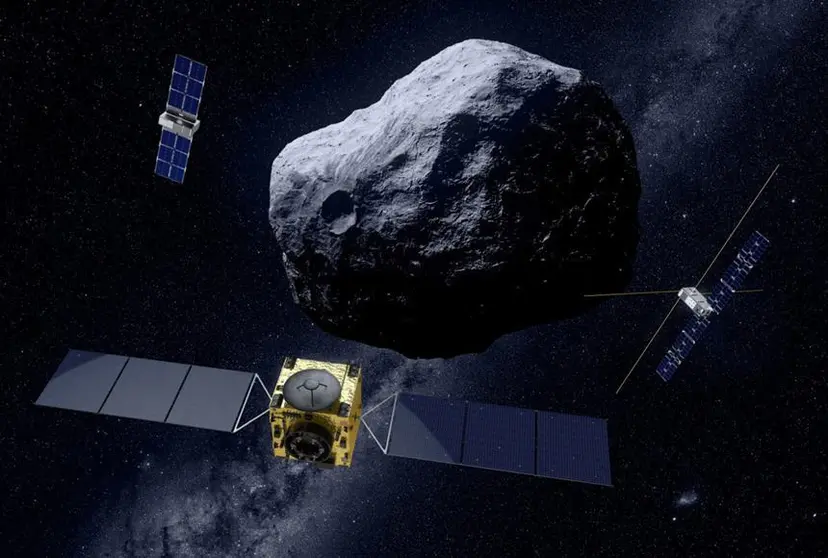
Another historic exploration is scheduled for November 2026. To understand this, we must first recall the event that took place on November 26, 2022. Astronomers are always keeping in mind the possibility of a massive asteroid threatening Earth. If such a thing were to happen, instead of accepting our fate and giving up, we could try active measures to save the Earth. One of the most realistic strategies pondered by planetary defense astronomers is to discover asteroids as early as possible and crash a probe into them at high speed to deflect their orbits as much as possible. The DART mission, a historic attempt to test if this method can defend Earth, took place in 2022.
The target for this planetary defense rehearsal was a binary asteroid system consisting of two asteroids, Didymos and Dimorphos, circling each other. It is a scene where a smaller Dimorphos circles the larger Didymos like a moon. The probe flew at high speed and collided with Dimorphos. A huge dust cloud erupted at that moment, and Dimorphos' speed slowed slightly, with its orbit becoming smaller. Dimorphos, which originally orbited with an 11-hour and 55-minute period, saw its period reduced to 11 hours and 23 minutes after the collision! Just by crashing a small probe into a 160m-diameter space rock, we were able to cause a sufficiently significant orbital change!
However, at the moment of the DART mission's impact, the probe that struck Dimorphos was destroyed and vanished. Although we observed the scene from afar using CubeSats that separated before impact and the remaining orbiter, it all happened in an instant, so there isn't enough data yet. We still need to accurately determine how large a crater was created on the asteroid's surface, the precise gravity and mass of the asteroid, and how much dust cloud was ejected.
In particular, this dust cloud is surprisingly a very important and sensitive aspect because, unlike calculations during the DART mission that considered only the speed and momentum of the probe, additional orbital changes were detected after the actual collision. Astronomers presume that the dust plume ejected at the moment of impact created an effect similar to firing retro-rockets, leading to unexpected additional orbital changes.
If we are to design actual defense strategies by crashing probes into asteroids headed toward Earth in the future, we need to accurately analyze how much damage we can deal to the asteroid and what kind of effects it produces. After all, our lives are at stake! Is there any other astronomical task more practical than this?
Following the DART mission, the reinforcement probe Hera is set to arrive to more accurately grasp the changes that occurred to Didymos. Hera was launched on October 7, 2024, and safely completed a Mars flyby in March 2025. If it stays on schedule, it will reach its destination, Didymos, around November 2026. There, it will release two CubeSats and observe the "bruise" left by humanity on the asteroid's surface at a resolution of 10 cm, creating detailed photos and maps. It will also analyze the asteroid's composition and rock condition, providing valuable data for the future practice of planetary defense.
In 2025, many things happened in space, and astronomers also lived busy lives on Earth. In 2026, many things will continue to happen in space, and astronomers will continue to tell us more surprising and fascinating stories.
About the author, Ji Ung-bae: He loves cats and the universe. As a child, he watched "Galaxy Express 999" and dreamed of sharing the beauty of the universe. Currently, he is an assistant professor at the Sejong University College of Liberal Arts, where he engages in various science communication activities including lectures and writing. He has authored books such as "A Piece of the Universe Every Day," "Scientists of the Starry Universe," "Unknown but Knowable," and "Strange Questions That Come to Mind When Looking at the Universe," and translated books including "The Hitchhiker's Guide to the Real Universe," "How I Killed Pluto," "Quantum Life," and "Cosmographic."