

[비즈한국] It has been confirmed that the combined urban renewal project order volume for Korea's top 10 construction firms has increased by over 20 trillion KRW this year compared to last year. Eight of the top 10 builders saw their order totals rise simultaneously, with the two industry giants, Samsung C&T028260 and Hyundai E&C000720, showing particularly strong performance. Hyundai E&C became the first in the industry to surpass 10 trillion KRW in annual orders, maintaining its top position in the sector for seven consecutive years.
Orders increased for 8 out of 10 major builders
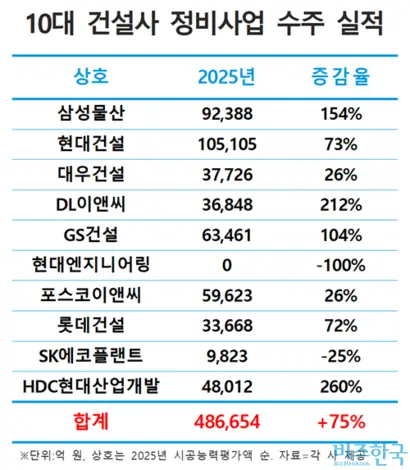
According to the construction industry, the cumulative order volume for urban renewal projects among the top 10 construction firms by construction capability reached 48.6654 trillion KRW this year, an increase of 20.7953 trillion KRW (75%) year-on-year. The number of projects won (including overlapping counts for joint ventures) rose from 63 to 74, an increase of 11 (17%). This means the average scale per project for the top 10 builders grew from 442.3 billion KRW last year to 657.6 billion KRW this year, an increase of about 215.3 billion KRW (49%). With the exception of SK Ecoplant (-25%) and Hyundai Engineering (-100%), all other firms in the top 10 saw their order volumes increase.
The builder with the highest order volume this year is Hyundai E&C. Starting with the Yeonsan District 5 reconstruction in Yeonje-gu, Busan, in March, and ending with the Jangwi District 15 redevelopment in Seongbuk-gu, Seoul, last month, the company secured a total of 10.5105 trillion KRW (11 projects), marking its seventh consecutive year at the top. This is the first time a construction firm has exceeded 10 trillion KRW in annual urban renewal orders. Hyundai E&C won three projects worth over 1 trillion KRW each, including the Apgujeong District 2 reconstruction in September (2.7489 trillion KRW), the Sutaek-dong redevelopment in Guri, Gyeonggi-do, in June (1.9648 trillion KRW), and the Gaepo Jugong 6 & 7 reconstruction in May (1.5138 trillion KRW).
Samsung C&T also recorded its highest-ever urban renewal performance. Its cumulative orders reached 9.2388 trillion KRW this year, an increase of 5.599 trillion KRW (154%) from the previous year, marking the largest increase among the top 10. Samsung C&T won 14 projects this year, starting with the Hannam District 4 redevelopment in Yongsan-gu, Seoul, in January, and ending with the Jeungsan District 4 urban housing complex project in Eunpyeong-gu, Seoul, in December. It also secured three projects worth over 1 trillion KRW: Hannam District 4 (1.5695 trillion KRW) in January, Jangwi District 8 (1.1945 trillion KRW) in April, and Sinbanpo 4th (1.031 trillion KRW) in March.
The cumulative order volumes for other firms are as follows: GS E&C006360 with 6.3461 trillion KRW (10 projects), POSCO E&C with 5.9623 trillion KRW (7 projects), HDC Hyundai Development Company294870 with 4.8012 trillion KRW (9 projects), Daewoo E&C047040 with 3.7726 trillion KRW (9 projects), DL E&C with 3.6848 trillion KRW (4 projects), Lotte E&C with 3.3668 trillion KRW (7 projects), and SK Ecoplant with 982.3 billion KRW (3 projects). Hyundai Engineering, ranked 6th in construction capability, had 1.5794 trillion KRW in orders last year but did not secure a single project this year. The two giants, Samsung C&T and Hyundai E&C, accounted for 41% of the total orders for the top 10 builders.
Mostly private contracts, with a growing trend of consortiums
The urban renewal projects won by the top 10 builders this year were also concentrated in the Seoul metropolitan area, accounting for 58 out of 74 total projects (78%). By region, the distribution (order amount) was: Seoul 49 projects (33.2418 trillion KRW), Gyeonggi 8 projects (6.6386 trillion KRW), Busan 10 projects (5.0461 trillion KRW), Jeonbuk 2 projects (733.1 billion KRW), Daejeon 1 project (960.2 billion KRW), Ulsan 1 project (698.2 billion KRW), Incheon 1 project (636.1 billion KRW), Gangwon 1 project (436.9 billion KRW), and Gyeongnam 1 project (274.3 billion KRW). Projects in Gangnam, Seocho, and Songpa—collectively known as the "Gangnam 3-gu"—accounted for 11 projects (10.0736 trillion KRW).
Out of the 74 urban renewal projects won by the top 10 firms, 70 (95%) were private contracts. The only projects that saw competitive bidding for the contractor selection were the Hannam District 4 redevelopment (1.5695 trillion KRW) and Gaepo Woosung 7th reconstruction (675.7 billion KRW) won by Samsung C&T, the Eunhaeng Jugong reconstruction in Seongnam, Gyeonggi-do (1.2972 trillion KRW) won by POSCO E&C, and the Jeongbichang Front District 1 redevelopment (924.4 billion KRW) won by HDC Hyundai Development Company. While competitive bidding is the principle for selecting a contractor, private contracts are permitted if bids are repeatedly voided.
There were 23 consortium cases (31%, overlapping by builder), which is an increase compared to the 14 cases (22%) seen last year. While the average size of a project won by a top 10 builder alone was 707.9 billion KRW, the average size of a consortium-led project was 1.0824 trillion KRW. As the projects have grown in scale, risks have been shared. In the case of Hyundai E&C, the top-ranked firm, about 42% of its total order volume (4.4252 trillion KRW, 7 projects) was secured through consortiums.
A representative from a major construction firm analyzed, "This year, the concentration of urban renewal orders among top-tier builders has been significant," adding, "The rise in construction costs due to inflation also influenced the increase in the size of the orders." Another official added, "In the field of urban renewal, while selecting a contractor is important, management after selection is equally crucial. We need to watch how these firms manage the sites after such a significant increase in their order volume.".