

[비즈한국] The labor union of IBK (Industrial Bank of Korea)024110 (the IBK branch of the Federation of Korean Financial Industry Trade Unions) has announced its second solitary general strike in one year. IBK and the union have been locked in conflict over the payment of overtime wages and profit-sharing, leading to difficulties in this year's wage negotiations. Against this backdrop, all eyes are on whether the 'total labor cost system,' the root cause of the labor-management conflict, will be improved after President Lee Jae-myung ordered IBK to resolve the issue during a work briefing with the Financial Services Commission (FSC) on December 19.
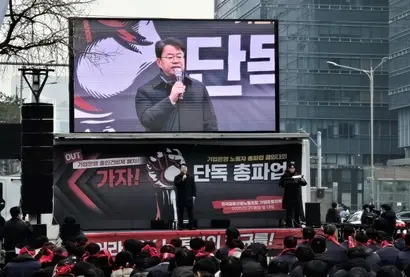
The IBK labor union held a general strike resolution rally for all members in front of the bank's headquarters in Jung-gu, Seoul, on December 29. The union conducted a vote on industrial action among its members on the 23rd, and the general strike was passed with 91% approval. The timing of the general strike is scheduled for January 2026, after the new bank president takes office. This marks the second strike crisis for IBK in just one year, following the first-ever solitary general strike on December 27, 2024.
The union is demanding the payment of unpaid wages and the distribution of excess profits. At the heart of the conflict between IBK management and the union is the total labor cost system. The total labor cost system is a mechanism where the Ministry of Economy and Finance (MOEF) sets the total labor budget for public institutions, and the institutions must then manage salaries and allowances within that limit. The Financial Services Commission applies this total labor cost system to IBK, which is classified as an "other public institution," in accordance with MOEF guidelines. When overtime pay exceeds the labor cost limit, it is compensated with leave; however, since employees have been unable to use all of their accrued leave, it has effectively resulted in unpaid wages. Furthermore, even when the bank generates excess profits, it has been unable to distribute profits or pay bonuses due to the labor cost cap.
The labor-management conflict at IBK entered a new phase following the work briefing of the Financial Services Commission and the Fair Trade Commission held by President Lee Jae-myung on December 19, where the President ordered the bank to come up with practical solutions. When President Lee asked about solutions for the unpaid wage issue during the briefing, IBK CEO Kim Sung-tae replied, "There are self-rescue measures such as reducing overtime work, but their effectiveness is limited, so we are currently discussing this with the labor union and the government."
In response, President Lee noted, "It seems there are public institutions that cannot pay even when they have the funds due to the MOEF's total labor cost system," adding, "It seems the government is effectively forcing them to operate in violation of the law. The Policy Office needs to take care of this." Given that President Lee had expressed his will to improve the total labor cost system even during his time as the leader of the opposition party, the labor union's expectations have grown.
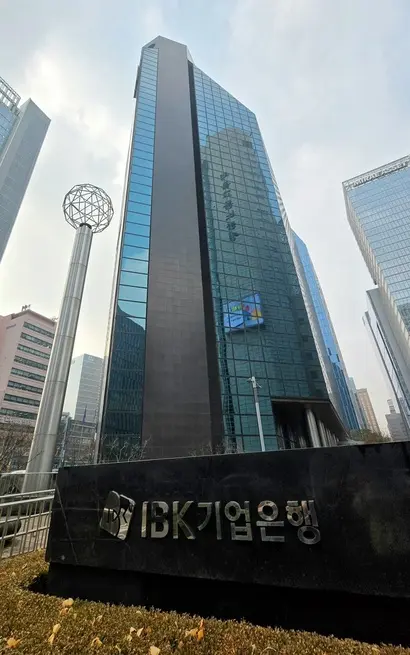
The IBK labor union is raising its voice toward the Financial Services Commission. The union has been holding a tent protest in front of the FSC since the 24th. At the general strike resolution rally on the 29th, Ryu Jang-hee, head of the IBK labor union, asserted, "Even after the President's work briefing, neither the bank nor the authorities are accelerating follow-up measures. We are urging the implementation of the President's instructions while protesting in tents, but the FSC remains silent," adding, "The total labor cost system must be abolished and the compensation structure must be changed."
Representative Park Hong-bae of the Democratic Party of Korea also attended the rally that day, stating, "It has been ten days since the President's instruction, yet I do not know what Bank President Kim Sung-tae and Financial Services Commission Chairman Lee Bok-hyun are doing." He added, "The current conduct of the FSC is no different from that of Coupang Inc. Chairman Kim Bom-suk, who avoids responsibility while holding decision-making power. They must hold a Management Budget Deliberation Committee and exclude the overdue overtime pay from the total labor cost."
IBK and the union are also experiencing setbacks in their wage and collective agreement negotiations due to the total labor cost system issue. Although working-level meetings and mediation by the National Labor Relations Commission (NLRC) have been held since mid-November, the third NLRC mediation meeting on December 17 ended in failure, further deepening the conflict. As improving the total labor cost system could have implications for other public institutions, reaching an agreement remains difficult.
On the day the NLRC mediation failed, the union filed a complaint against IBK and the Financial Services Commission with the Organization for Economic Cooperation and Development (OECD). The reason cited was that the FSC violated the OECD Guidelines for Multinational Enterprises on Responsible Business Conduct (RBC) by controlling wage and collective negotiations. The following day, the 18th, they staged a sit-in at the bank president's office. It is reported that no agreement was reached during the sit-in, as CEO Kim Sung-tae maintained the position that he "has no choice but to follow the FSC's decision."
As the possibility grows that CEO Kim Sung-tae will not be able to conclude negotiations during his term, attention is turning to the appointment of the next bank president. CEO Kim's term ends on January 2, with less than a week remaining. As a state-run bank, the president of IBK is appointed by the President upon the recommendation of the Financial Services Commission Chairman. Although a new president is usually recommended for appointment at the end of December, the next president has not yet been announced. It is reported that an internal candidate is likely to succeed CEO Kim. If the labor-management confrontation continues, the new president will face a general strike crisis immediately upon taking office. The IBK labor union stated, "Neither the Financial Services Commission nor the Presidential Office has released an official statement regarding the appointment of the new IBK bank president."