

[비즈한국] Military experts are showing intense interest in the '8,700-ton strategic nuclear submarine' that North Korea abruptly unveiled on December 25th. Based on Chairman Kim Jong Un's remarks during the 8th Party Congress in 2021 that "research on nuclear submarine construction design is complete" and the hull structure revealed in March of this year, I have predicted several times this year that North Korea would unveil a strategic nuclear submarine.
The intention behind North Korea unveiling a strategic nuclear submarine with a completed hull—rather than one still under construction—is clear. It is meant to keep in check the discussions regarding South Korea's introduction of nuclear-powered submarines, which have recently gained momentum. Unlike South Korea, which is in the 'design and negotiation stage,' North Korea is making a strategic move to maximize fear regarding its nuclear capabilities by flaunting that it possesses a 'completed entity.'
However, the North Korean strategic nuclear submarine unveiled this time is in a deformed shape that defies the common sense of existing submarine engineering, raising 'doubts about its feasibility' rather than maximizing fear. The problem that experts noticed most in the strategic nuclear submarine unveiled by North Korea is, by far, the 'abnormally massive sail.'
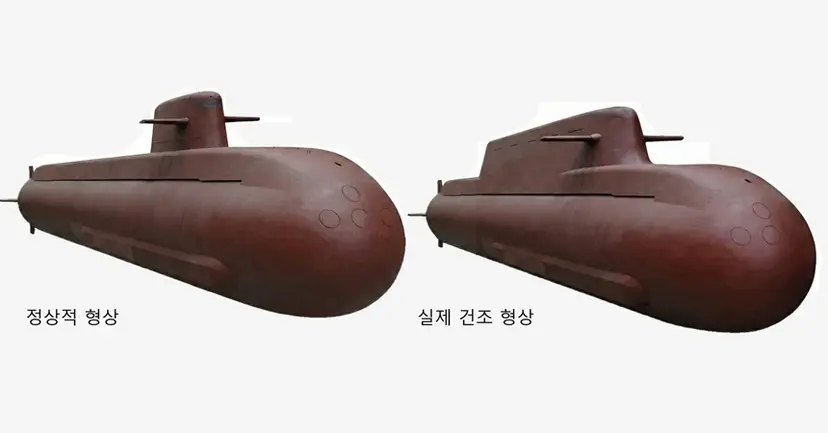
The massive, long sail, which spans nearly half the length of the hull, is a form rarely seen in the history of global submarine construction. This is reminiscent of the 'Hero Kim Gun Ok' submarine, where a Romeo-class submarine was modified to force missile launch tubes into it. However, the new nuclear submarine raises questions because it still adheres to a deformed sail design, even though its hull width has been expanded to approximately 12m, much wider than the Hero Kim Gun Ok.
Why did North Korea choose a 'top-heavy design' that lethally degrades navigational stability and underwater maneuverability? In conclusion, this is a 'desperate measure (苦肉之策)' to overcome technological limitations and strike major U.S. mainland cities with just one vessel.
Analysis results suggest that this submarine is equipped with 10 long-axis SLBMs reaching as much as 20m. This is longer than any SLBM from military powers such as the U.S., Russia, or China. Considering that the SLBMs operated by the U.S. and Russia (Bulava, Trident) are in the 10-13m range, it appears that North Korea went to the extreme of increasing the missile size even while making the risky design choice of enlarging the sail disproportionately and arranging the missiles at an angle.
While SLBMs from other countries have secured ranges of over 10,000 km even at lengths of 10-13m, North Korea's solid-fuel rocket technology could not achieve this. Therefore, they secured long range by modifying land-launched intercontinental ballistic missiles (ICBMs) like the Hwasong-18 to be mounted on a submarine.
By mounting ICBM-modified missiles instead of the existing Pukkuksong series, calculations show that North Korean submarines could directly strike Seattle, Los Angeles, as well as Washington D.C. and New York from within North Korean territorial waters without the need for new technology development. This is also evidence that clearly demonstrates North Korea's technological limitations in failing to possess miniaturization and lightweight technology, multiple independently targetable reentry vehicle (MIRV) technology, and solid-fuel rocket technology that secures long range with a short length.
Even if North Korea's new submarine is 'deformed,' its strategic threat can never be taken lightly. The strategy of hiding in the 'bastion' of North Korean territorial waters and aiming for the U.S. mainland is bound to place a serious burden on the anti-submarine operations of the ROK-U.S. combined forces.
We can neutralize this 'trick' by building excellent nuclear-powered submarines that can break through the sanctuary of North Korean territory. If the Korean nuclear-powered submarine is built as a high-performance vessel 111.2m long, 9.8m wide, and with a displacement of 8,280 tons as designed by the Korea Research Institute of Ships and Ocean Engineering (KRISO), and operated under a manned-unmanned teaming (MUM-T) concept that actively utilizes unmanned underwater vehicles (UUVs), we can sufficiently track and destroy North Korea's 'top-heavy strategic nuclear submarine.'
If North Korea resorted to the trick of a deformed 'top-heavy submarine' to make up for their technological inferiority, we must neutralize their trick by building 'true, high-quality nuclear submarines' based on solid technical skills and the trust of the ROK-U.S. alliance. Now is the time to go beyond suspicion and controversy and concentrate national capabilities on building Korean nuclear submarines.