

[비즈한국] If 2025 was a 'time of exploration' where the market consolidated its bottom amid signals of interest rate cuts, the coming year of 2026 will be recorded as a clear year of 'selection and concentration.' The era of the liquidity tide where all ships rose together, like the past bull markets, is over. We are now entering an era of 'Super-Polarization,' where we no longer rise on the power of liquidity alone, but where only those locations with verified 'scarcity' and 'actual utility value' survive.
(Super-Polarization).
In 2026, when supply shortages have become a reality and rising construction costs have become a constant, the core thesis determining the future of South Korean real estate is simple: "A place everyone craves, but few can possess." Where are the rock-solid locations that do not waver even in a shaking market? Let's explore the flow of real estate locations to watch in 2026 through five themes.
The first place to pay attention to is, without question, the key areas known as the 'heart of Seoul.'
Proximity to work has always been at the center of the real estate invincibility myth, but in 2026, this concept will evolve into 'integration of work and residence.' In particular, Gangnam and Seocho will solidify their status as the 'reserve currency' of Korean real estate, going beyond simple residential areas. With expectations of regulatory easing, such as the lifting of land transaction permit zones, reconstruction complexes centered around Apgujeong, Banpo, and Daechi are expected to break through price ceilings once again and serve as benchmarks for the entire market.
Since these are safe assets that fall last in a bear market and rise first in a bull market, entering these areas is in itself a means of asset defense. Additionally, Yongsan, often called the 'Gangnam of 10 years from now,' is also a place not to be missed. 2026, when the outlines of the international business district development and Hannam New Town are revealed, will be the inaugural year where the future value of Yongsan is transformed into concrete reality.
The second trend is 'investing in buying time,' specifically the GTX (Great Train Express) revolution.
2026 is the period when the GTX moves beyond plan drawings to lead actual changes in life. At the forefront of this revolution, where physical distance is compressed into temporal distance, is the GTX-A line. As the opening of Samseong Station becomes tangible, the station areas of Dongtan and Unjeong will effectively be incorporated into the Seoul living sphere and receive re-evaluation. In particular, landmark complexes near Dongtan Station, which have emerged as major leaders in southern Gyeonggi, have enough growth potential to threaten the prices of existing apartments in Mapo or Seongdong-gu, Seoul.
Furthermore, for the GTX-B and C lines, which are still in the early stages of construction, a strategy of preempting major transfer hubs like Cheongnyangni and Indeogwon remains valid. The expansion of transportation networks is like unblocking the arteries of a city, and the value of the surrounding areas is bound to rise in a staircase pattern.
The third theme to keep an eye on is the 'Era of New Villes,' or the spectacular revival of the 1st generation new towns.
With the full-scale application of the Special Act on the Improvement of Old Planned Cities, Bundang, Ilsan, and Pyeongchon are being reborn from old, outdated areas into 'promising reconstruction candidates.' Among them, Bundang, which carries the moniker 'Bundang below heaven,' boasts the strongest business viability. With Gangnam accessibility, school districts, and infrastructure already fully established, it is essentially gaining wings through reconstruction.
However, not all complexes will benefit. One needs the discernment to select large-scale complexes capable of integrated reconstruction near stations and places with high land shares. 2026 will be the time when complexes designated as leading districts lead the market prices, and surrounding complexes align, leveling up their overall value.
The fourth is the intensification of the 'Eoljuksin' (meaning "I'd rather freeze to death than live anywhere but a new apartment") trend and the completion of Seoul's New Towns.
Due to the surge in raw material prices and the mandate for zero-energy construction, the rise in sale prices has become an irresistible trend. This further highlights the scarcity of existing new apartments and pre-sale rights. 2026 is the point in time when large-scale new towns in northern Seoul, such as Jangwi, Imun/Hwigyeong, and Susaek/Jeungsan, complete move-ins and their infrastructure stabilizes. They will form a 'new residential belt in northern Seoul' and set a new standard for new apartments in the city.
If you are a buyer who finds entry into Seoul burdensome, you should look at large-scale redevelopment sites in 'Seoul-adjacent' areas that touch Seoul, such as Gwangmyeong or Seongnam (Old Seongnam). Although they are technically in Gyeonggi-do, their living spheres and price trends follow the same path as Seoul.
Finally, one must pay attention to locations pointed to by changes in the demographic structure.
As we enter a super-aged society, accessibility to large hospitals, or 'Byeong-se-gwon' (hospital-adjacent area), is becoming an important barometer for housing prices. Residential areas near Gangnam Severance, Asan Medical Center, and Samsung Medical Center have very strong downside rigidity thanks to the solid demand from elderly asset holders.
On the other hand, the 'semiconductor belt' where young, high-income engineers gather is the driving force that keeps the city young. The system semiconductor clusters in Namsa/Idong, Yongin and the Godeok New Town in Pyeongtaek are places where national-level jobs are concentrated. The fundamental principle of real estate—that people gather where there are jobs, and money follows where people gather—remains valid in 2026.
In conclusion, the 2026 real estate market can be summarized as the 'disappearance of the average.' A discriminatory market will unfold where good locations become more expensive and ambiguous locations are thoroughly alienated.
If you do not own a home, rather than waiting only for housing subscriptions, you should step onto the first rung of the asset ladder by purchasing urgent sales of existing homes on the outskirts of Seoul or in core Gyeonggi areas. For those who own one home, now is the golden time to move to a higher-tier area, and those with multiple homes should reorganize their portfolios into one 'smart' property by disposing of non-core assets.
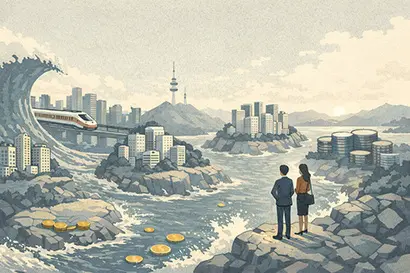
Opportunity does not lie in vague fear or expectation. It lies in cold-headed location analysis and bold execution tailored to your financial capacity. I hope 2026 will be the inaugural year for you to take a leap forward in your assets by preempting the 'rock of location' that does not waver even amidst the strong waves.
Kim Hak-ryeol, also known by his pen name 'Pashong,' head of the Smart Tube Real Estate Research Institute, served as a team leader at the Real Estate Research Division of Gallup Korea. He manages and hosts the Naver blog 'Pashong's World Exploration' and the YouTube channel 'Stew TV.' His books include 'Rewriting the South Korean Real Estate User Manual (2025),' 'The Power of Gyeonggi Real Estate (2024),' 'Absolute Principles of Seoul Real Estate (2023),' 'The Future of Incheon Real Estate (2022),' 'Kim Hak-ryeol's Absolute Principles of Real Estate Investment (2022),' 'South Korea Real Estate Future Map (2021),' and 'From Now On, Only Places That Rise Will Rise (2020).'