

[비즈한국] Samsung Electronics005930 and LG Electronics066570 will unveil their AI smart home-based technology strategies at 'CES 2026', the world's largest tech exhibition to be held in Las Vegas from January 6 to 9 (local time). Their goal is to strengthen their competitiveness in home appliances by moving beyond 'smart appliances' toward products that understand and support users in their daily lives.
Samsung Electronics plans to build an AI ecosystem within the home by introducing a wide array of new AI appliances and premium TVs. LG Electronics, having identified robotics as a key future growth engine, has teased the launch of a new home robot capable of picking up objects with five fingers. Attention is focused on the 'next move' of both companies as they seek to secure growth momentum through new technologies like AI and robotics amidst a stagnant TV and home appliance market.
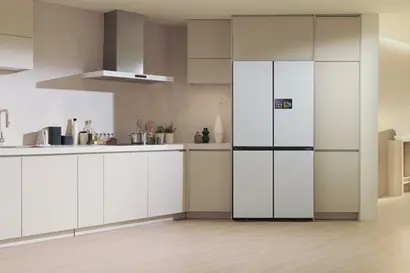
Focusing on Expanding 'Practical AI' Experience
As with last year, the core theme of this CES remains AI. A vast array of innovative products and technologies are expected to be unveiled across various industrial sectors centered around AI, including home appliances, robotics, and mobility. If last year marked the popularization of generative AI and this past January's 'CES 2025' signaled the full-scale industrial application and convergence of AI, the keyword for this event is 'practical AI.' The consensus is that only innovations capable of moving beyond labs and theories to deliver concrete results in actual industrial fields or daily life will survive.
The two major domestic home appliance firms, Samsung and LG, are also presenting AI as the driving force for innovating the overall product experience. The trend is to focus their capabilities on connectivity and the expansion of the user experience to gain hegemony in the smart home ecosystem.
Instead of the central hall of the Las Vegas Convention Center (LVCC), where it held its exhibitions annually, Samsung Electronics will set up a standalone exhibition space of approximately 1,400 pyeong at the Wynn Hotel. The strategy is to effectively allow visitors to experience the vision of an AI-based living platform and to detail their broad range of AI technologies and products.
Samsung Electronics has recently been expanding the integration of AI across all its home appliances. At this CES, the company is expected to present its direction by focusing on the 'Bespoke AI' product line and demonstrating the benefits of AI appliances. New products to be unveiled include a refrigerator that combines Google's AI 'Gemini' with the 'AI Vision' function that recognizes ingredients via internal cameras, and the 'Bespoke AI AirDresser' linked with its all-in-one washer-dryer.

LG Electronics is bringing robots into the home. In a teaser video released on its global social media accounts on the 25th, the home robot 'LG Cloide' uses its five fingers to pick up or hold household objects. It also emphasized interaction with users by showing it giving a fist bump to a person.
This is distinct from the wheeled AI companion robot 'Q9' that garnered attention at CES last January. The Q9 was conceptualized to serve as a mobile AI home hub connecting home appliances and IoT devices. An LG Electronics official stated, "Cloide has a different form factor (physical appearance and structure) from the Q9. It stems from the judgment that we need a new robot that performs tasks directly rather than just acting as an AI home hub," adding, "The Q9 project is not a discarded concept; rather, it is a further advanced form based on the technologies applied to the Q9."
Based on AI, Cloide autonomously recognizes and learns the surrounding environment and controls various AI appliances according to the user's schedule and lifestyle. It started from the concept of a new form factor that actually performs tasks, rather than just being an appliance that reduces housework. Attention is on whether the commercialization of Cloide will be mentioned at this CES. The Q9 was not sold to general customers after its reveal.
Breakthrough with RGB, First Test for AI Reorganization
With the global TV market in a slump and Chinese companies in pursuit, the TV business is challenging for both companies. However, it remains a key sector they cannot afford to lose. The TV is evaluated as the core display of the smart home ecosystem and the focal point of the in-home user experience.
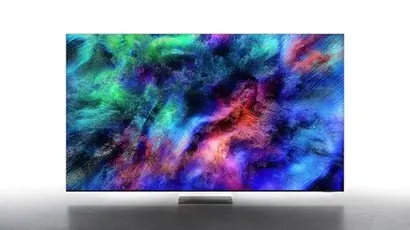
Samsung Electronics plans to unveil its new next-generation 'Micro RGB TV' at CES. Following the 115-inch TV released last August, the company is expanding the lineup to include 55, 65, 75, 85, and 100-inch models, and will include features such as '4K AI Upscaling' using a high-performance AI engine and technology that realizes optimal colors for every scene.
RGB TV, which is emerging as a battlefield for the next-generation TV market, is considered the pinnacle of LCD (Liquid Crystal Display)-based TVs. As Chinese manufacturers recently expanded the front by unveiling RGB Mini LED (Light Emitting Diode) lineups, domestic companies leading the premium market centered on OLED (Organic Light Emitting Diode) are also competing for dominance with top-tier products applying even smaller LEDs.
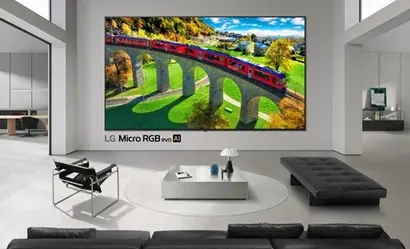
LG Electronics will also introduce its first RGB TV, the 'LG Micro RGB evo', in 75, 86, and 100-inch models at CES. According to LG Electronics, the new products are equipped with the same processor as the 2026 OLED TV lineup. They explained that the performance of the OLED-exclusive picture and sound AI processor allows for precise control of screen brightness and contrast. It is expected to target replacement demand with RGB TVs that are cheaper than cost-prohibitive OLED TVs while still sufficiently equipped with picture quality and functions.
Both companies' strategies are to find a way out of the TV market slump through AI-based image quality innovation, while simultaneously expanding their Micro RGB TV lineups, which are ultra-premium LCD series.
The AI and robot-centered technology strategies that Samsung and LG are showcasing at this CES are interpreted as long-term business directions that go beyond a temporary exhibition. They have recently reorganized their structures to establish a system that considers the competitiveness of future businesses.
Samsung Electronics has deployed AX (AI Transformation) task forces for each business unit, including mobile, home appliances, and TV, within its DX (Device Experience) division to build an AI-led system across its products, while establishing a Digital Twin Center (DT) under the DS (Semiconductor) division for the manufacturing sector.
LG Electronics plans to accelerate the development of future growth engines by integrating and reorganizing its existing DX Center into an AX Center and repositioning the robot advanced research organization under the CTO directly under the HS (Home Appliance & Air Solution) Company as the HS Robotics Lab.
As they have completed the structural improvement focused on AI even for their field execution organizations, attention is concentrated on the fact that the AI and robot strategies to be announced at CES 2026 will be more than just a tech reveal; they will be the prelude to achieving substantive results in the global market through the reorganized structures.