

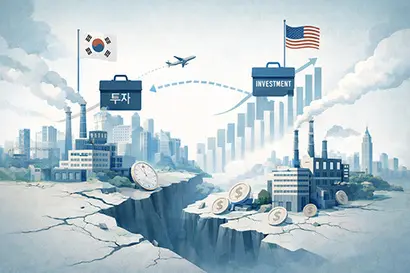
[비즈한국] Following the announcement of a joint fact sheet between South Korea and the U.S., which highlights the reduction of mutual tariffs and Korea's $350 billion investment in the U.S., the pace of investment by the Korean government and companies into the U.S. has been accelerating. With the ruling Democratic Party of Korea pushing for a special act on U.S. investment (Special Act on Strategic Investment Management between South Korea and the U.S.) and Korea Zinc010130 announcing a large-scale investment in a U.S. smelter, concerns are rising that domestic investment by these companies might decrease. In particular, as domestic firms are currently struggling to meet production demand, there are warnings that the "golden time" to expand domestic investment might be missed.
President Lee Jae-myung held a follow-up public-private meeting with business leaders at the Presidential Office in Yongsan on the 16th of last month following the tariff negotiations between Korea and the U.S. He stated, "While many worked hard during the recent trade and security negotiations, it was the business leaders, including those present here, who worked the hardest." President Lee added, "There are concerns that excessive investment in the U.S. might lead to a decrease in domestic investment," urging them to pay attention to domestic investment. He emphasized, "If you can provide practical and specific feedback on what can be deregulated, lifted, or abolished, I will resolve those issues quickly."
President Lee's direct request to business leaders for an expansion of domestic investment reflects growing anxiety over the potential contraction of the domestic economy as investments in the U.S., such as Korea Zinc's 10 trillion won smelter construction announcement, get underway. Looking at the situation in Japan, which has pledged to invest $550 billion, it is difficult to dismiss these concerns as mere worry. According to the Nikkei, there is a saying among Japanese firms that "you must join the 'Billion (dollar) Club' to get in the good graces of U.S. President Donald Trump."
There is a perception that the Trump administration will only engage with companies that invest at least $1 billion in the U.S. Amid this atmosphere, Mitsubishi Heavy Industries and Toshiba have pledged up to $100 billion for next-generation nuclear reactor projects, and SoftBank Group has promised $25 billion for artificial intelligence (AI) infrastructure.
The problem is that if Korean companies follow suit by increasing their investments in the U.S. like their Japanese counterparts, domestic investment will inevitably freeze. Given that domestic production capacity is currently failing to keep pace with actual output due to factors like recent growth in semiconductor exports, the need for increased domestic investment is higher than ever, making the potential for negative side effects even more concerning. According to the Bank of Korea and the National Data Agency, the manufacturing facility investment adjustment pressure recorded 4.67 percentage points in the third quarter of this year.
This figure for facility investment adjustment pressure is the highest in 18 months, since reaching 4.76 percentage points in the first quarter of 2024. The pressure began to decline after the first quarter of 2024, dropping to 1.28 percentage points in the first quarter of this year. However, it rose slightly to 1.32 percentage points in the second quarter and jumped to the 4-percentage-point range in the third quarter. The facility investment adjustment pressure is calculated by subtracting the production capacity growth rate from the production growth rate; a higher figure indicates that a company's production capacity is insufficient to meet actual demand.
Because of this, rising adjustment pressure typically leads to an increase in corporate facility investment within one to two quarters, making it a leading indicator for investment. Current trends in this pressure suggest a high likelihood that corporate investment will expand in the first half of next year.
In fact, the Bank of Korea projected in its economic outlook that "investment in IT sectors, such as semiconductors, will expand, continuing an overall growth trend," forecasting that the facility investment growth rate will rise from 0.8% in the second half of this year to 2.8% in the first half of next year. The Korea Development Institute (KDI), a state-run research agency, also estimated that the growth rate would rise from 0.6% in the second half of this year to 2.5% in the first half of next year, noting that "investment demand related to semiconductors remains high."
Based on this expected increase in facility investment, the Bank of Korea and KDI predicted that South Korea's economy would grow by 1.8% next year, a higher figure than this year. However, if domestic investment falls below expectations due to the impact of increased investment in the U.S., South Korea's economic growth rate next year could inevitably fall below original forecasts.