

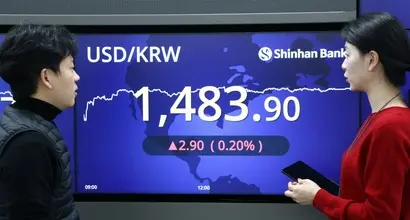
[비즈한국] As the won-dollar exchange rate soared and neared 1,500 won, the government took action to stabilize the market. On December 24, the Ministry of Economy and Finance (MOEF) unveiled plans to provide tax deductions for selling overseas stocks and returning funds to the domestic market, as well as tax benefits on dividends from overseas subsidiaries of domestic corporations. These measures aim to lure assets back into the domestic market. As the MOEF and the Bank of Korea stepped in with direct verbal interventions, the exchange rate fell sharply during intraday trading, showing immediate signs of effectiveness.
On the 24th, the MOEF announced the 'Tax Support Measures for Domestic Investment and Foreign Exchange Stabilization,' which includes tax exemptions and reductions for capital gains, as well as capital gains tax cuts for returning to the domestic stock market. The MOEF explained the background, stating, "As overseas investment by individual investors surges, the need for foreign exchange risk management to mitigate investment return volatility is growing. Despite the domestic stock market performing the best among global capital markets this year, individual investors have flocked to overseas stocks while reducing investments in domestic stocks."
The government announced three main support measures. First, it will introduce tax support for a 'Reshoring Investment Account (RIA).' Individual investors who sell overseas stocks held as of December 23, 2025, convert the proceeds into won, and invest them long-term in domestic stocks will receive tax benefits on overseas stock capital gains for one year. There will be a limit on the sell-off amount per person for capital gains tax exemption, and tax deductions will be tiered based on the timing of the return. For instance, returning to the domestic market in the first quarter of 2026 will grant a 100% tax deduction, 80% for a second-quarter return, and 50% for a second-half return.
Measures were also prepared for individual investors who lack tools to manage foreign exchange risks. The government will support major brokerage firms in launching forward exchange sale products for individual investors and provide capital gains tax benefits for those hedging foreign exchange (forward selling) on overseas stocks held until December 23. Forward selling is a method of locking in foreign currency at a contracted exchange rate to avoid risks associated with exchange rate fluctuations.
The MOEF explained, "We expect that individual investors will be able to minimize foreign exchange losses in preparation for future exchange rate declines without directly selling their overseas stock holdings, and that the foreign exchange market will see an immediate increase in dollar supply, leading to stabilization."
To adjust double taxation on dividends received by domestic parent companies from overseas subsidiaries, the government also proposed raising the non-taxable ratio for dividends from overseas subsidiaries from 95% to 100%. 'Non-inclusion in taxable income' means that dividends received from other corporations are not counted as taxable profit (revenue generated from transactions that increase a corporation's net assets). This effectively exempts domestic taxation on dividends sent by overseas subsidiaries to domestic parent companies. This measure was introduced because the surge in Foreign Direct Investment (FDI) by domestic firms led to a significant increase in retained earnings held by overseas subsidiaries, which the government now aims to bring back into the country. When domestic companies increase overseas investment and accumulate retained earnings abroad, the supply of dollars decreases, causing the exchange rate to rise.
The government intends to pursue legal amendments for these tax support measures, aiming for implementation on or after January 1, next year. For the RIA and foreign exchange hedging tax systems, benefits will be applied immediately after the launch of RIA and forward exchange sale products for individual investors starting January 1, 2026, while the expansion of the non-taxable ratio for dividends from overseas subsidiaries will apply to dividends distributed after January 1, 2026.
The MOEF expressed hope that "through these tax supports, a significant portion of the $161.1 billion (approx. 236 trillion won) in overseas stock balances held by individual investors at the end of the third quarter will be converted into domestic investments or lead to an increased supply of foreign currency through hedging." Additionally, it announced plans to expedite legislation to expand domestic investment and stabilize the foreign exchange market.
Foreign exchange authorities also issued direct messages via the media to stabilize the exchange rate. Kim Jae-hwan, Director General of the International Finance Bureau at the MOEF, and Yoon Kyung-soo, Director General of the International Department at the Bank of Korea, stated in a 'Market-Related Message from Foreign Exchange Authorities' shortly after the Seoul FX market opened on the 24th: "Excessive weakness of the won is not desirable," adding that "the series of meetings held over the past week or two and the announcements of measures by each ministry and agency were a process of organizing the situation to demonstrate the government's will and policy execution capacity."
In fact, the government is moving on multiple fronts to stabilize the exchange rate. Recently, financial authorities advised securities firms to suspend marketing related to overseas stocks. This comes as analysts identified the growing number of individual investors diving into overseas investment as a factor driving up the exchange rate. Following the authorities' recommendation, brokerage firms have successively halted events such as overseas futures commission discounts and free currency exchange fees, leading to complaints from individual investors.
The government's high-intensity intervention to stabilize the exchange rate appears to be taking effect. The won-dollar exchange rate, which had climbed to the 1,485 won range early on December 24, fell rapidly to the 1,460 won range. Lee Jae-won, an analyst at Shinhan Securities, analyzed, "As foreign exchange authorities signaled verbal intervention and additional policies, the won-dollar exchange rate plummeted by about 20 won during the day, and foreigners turned to net buying. Expectations for the promotion of domestic capital movement were reflected. It remains to be seen whether this will influence the long-term trend."