

[비즈한국] There is intense controversy over whether the non-ferrous metal smelter that Korea Zinc010130 announced it would establish locally in partnership with the US government constitutes the overseas transfer of national core technology. If it falls under this category, it must receive prior export declaration and approval from the government. If core processes, such as high-purity zinc smelting technology, are transferred abroad, Korea Zinc's entry into the US could potentially extend beyond a simple overseas investment to issues involving industrial technology protection and national security.
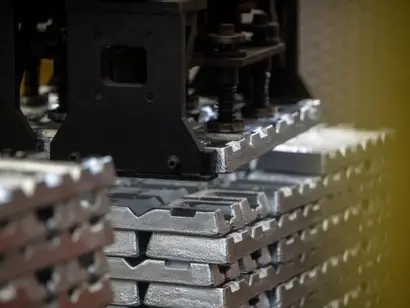
On the 15th, Korea Zinc announced a plan to build a 'non-ferrous metal smelter' in Clarksville, Tennessee, after signing a partnership with the US Department of War and the Department of Commerce. Construction of the US smelter is set to begin with site preparation in 2026, with phased operations and commercial production scheduled from 2029. The plan is to process approximately 1.1 million tons of raw materials annually to produce 540,000 tons of final products.
The production list includes a total of 13 items, ranging from basic industrial metals such as zinc, lead, and copper, to precious metals like gold and silver, as well as key strategic minerals such as antimony, indium, bismuth, tellurium, cadmium, palladium, gallium, and germanium. Semiconductor-grade sulfuric acid will also be produced. Korea Zinc stated that it would build the US smelter based on the model of its Ulsan Onsan Smelter, the world's largest non-ferrous metal production plant.
The ownership structure and investment method of this project, dubbed 'Project Crucible,' is unique in that the US government will hold shares in the parent company, Korea Zinc, through a 'third-party allocated capital increase.' The US government, companies, and Korea Zinc will establish a joint venture (Crucible JV) through capital contributions and loans, with the US Department of War participating as the largest shareholder (40.1%). This joint venture will issue new shares through a third-party capital increase, giving it approximately 10.59% of Korea Zinc's shares. Korea Zinc, having secured funds through the capital increase, will own the actual operating entity (Crucible Metals) as a 100% owned subsidiary. The US Department of War holds warrants to purchase up to 14.5% of Crucible Metals' shares at 1 cent per share.
Amid the heated controversy over this joint venture method, another claim has recently been raised: that Korea Zinc's construction of a US smelter is subject to export declaration for national core technology. The argument is that since the 'hematite process technology' for high-purity zinc smelting and the 'manufacturing and process technology for nickel (Ni) content exceeding 80% cathode active material precursors' for lithium-ion batteries are designated as national core technologies, the establishment of an overseas plant is highly likely to be considered an overseas transfer of national core technology.
Under the 'Act on Prevention of Divulgence and Protection of Industrial Technology,' an institution holding national core technology must file an export declaration with the Ministry of Trade, Industry and Energy. Subsequently, the Industrial Technology Protection Committee determines whether to approve the export.
A legal source stated, "The Ministry of Trade, Industry and Energy views the scope of national core technology exports broadly," adding, "If technology held exclusively by Korea is being transferred, export approval must be obtained." In fact, Samsung Electronics005930, while holding 100% of its semiconductor plant in Xi'an, China, underwent approval by the Industrial Technology Protection Committee before expanding into China.
Regarding whether Korea Zinc's US smelter construction is subject to export declaration, a Ministry of Trade, Industry and Energy official said, "It is difficult to confirm whether an individual case is subject to export declaration and approval," noting that "export approval involves judging the impact on national security and the national economy."
Experts predict that a 'conditional approval,' which requires measures to prevent the risk of technology leakage, is highly likely. In 2015, when POSCO005490 established a 'FINEX' steel plant in China using advanced steelmaking technology, it received conditional approval that included measures to prevent technology leakage.
Kim Min-bae, Professor Emeritus at Inha University Law School, anticipated, "At the time, the Industrial Technology Protection Committee required POSCO to dispatch a CTO (Chief Technology Officer) to the Chinese steel plant to block technology access," adding, "In Korea Zinc's case as well, it is highly likely that they will be required to meet conditions regarding physical and cyber security to limit technology accessibility."