

[비즈한국] A year after the Muan Airport disaster, Aekyung Group's liquidity crisis has yet to enter a phase of resolution. In the aftermath of the accident, Jeju Air089590 has remained unable to escape its loss-making trend. While Aekyung Group continues to sell assets and manage its finances, analysts suggest that financial uncertainty across the group still persists.
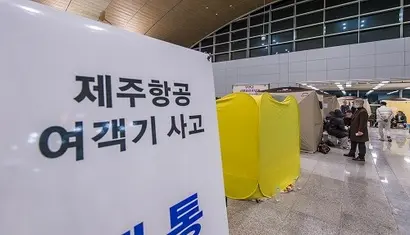
One Year After the Disaster, Jeju Air Becomes a Loss-Making Subsidiary
The first anniversary of the Jeju Air passenger plane crash that occurred on December 29 of last year at Muan International Airport is approaching. The incident severely damaged Jeju Air's brand image and spread a sense of crisis throughout its parent company, Aekyung Group. Immediately following the disaster, the stock prices of both Jeju Air and Aekyung Group plummeted, and there were even signs of a consumer boycott against Aekyung Group products spreading online.
Although considerable time has passed since the accident, the pace of Jeju Air's normalization still falls short of expectations. To restore its tarnished credibility, Jeju Air announced a large-scale safety investment plan, adjusted its flight structure conservatively, and reduced the number of flights on some routes. Consequently, passenger demand has declined. According to the Air Portal System, the number of Jeju Air passengers from January to November this year was 15,217,824. This is an 8.7% decrease compared to the same period last year (16,669,517).
The decrease in passengers led to poor performance. As of the third quarter of this year, Jeju Air's revenue was 1.1053 trillion won, down 25% from the same period last year (1.4854 trillion won). The cumulative operating loss for the third quarter was recorded at 129.5 billion won. An official from AK Holdings006840 explained, "We prioritized safety enhancements following the accident and reduced the number of flights. Naturally, this structure leads to poor financial indicators."
Once considered the representative cash cow of Aekyung Group, Jeju Air has been relegated to a subsidiary that exacerbates the group's overall financial burden due to continued losses. Analysts say that the burden of liquidity management and financial stability has grown at the group level. In this flow, Aekyung Group has begun securing cash by disposing of major subsidiaries and assets.
In October, Aekyung Group signed a final contract to sell its 63.13% stake in Aekyung Industrial018250 (consumer goods and cosmetics)—the group's founding business and flagship brand—to a Taekwang Industrial003240 consortium (SPC) for 470 billion won. Upon signing the contract, the group received 23.5 billion won, which is 5% of the deal, with the remainder to be paid next February. Previously, in August, the group sold its golf course in Gwangju, Gyeonggi Province, 'Joongbu Country Club (Joongbu CC),' to the resort company The Siena Group. The transaction, including adjacent idle land, is estimated at approximately 230 billion won.
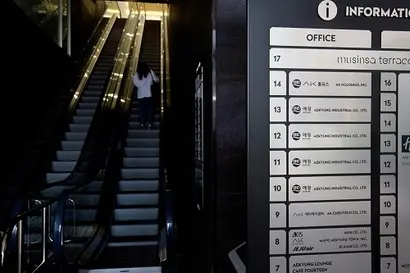
AK Plaza's Performance Recovery is the Key
Although Aekyung Group has engaged in liquidity management through asset sales, the market remains concerned about persistent uncertainty. Analysts point out that the financial burden of some subsidiaries is spreading the group's capacity thin.
AK Plaza is the most glaring example of this situation. Until the 2010s, AK Plaza held the fourth position in the department store industry, but it took a hit when its 'department store without luxury goods' strategy faced limitations during the COVID-19 pandemic, a period when luxury consumption spread rapidly. Since then, it has maintained a loss-making trend starting in 2020 and has now become a liability for the group.
Last year, AK Plaza's revenue was 289.764 billion won, with a net loss of 65.935 billion won. The deficit increased from 58.097 billion won in 2023. The cumulative revenue for the third quarter of this year was 185.804 billion won, a 15.4% decrease from the same period last year (219.593 billion won). The net loss widened to 34.815 billion won compared to the same period last year (37.992 billion won). Due to accumulated losses, AK Plaza is currently in a state of capital impairment, where total capital is less than the paid-in capital.
Aekyung Group is making all-out efforts to save AK Plaza. Recently, the holding company AK Holdings acquired a 99.11% stake (3,186,994 shares) in Mapo Aekyung Town, which was previously held by AK Plaza. The acquisition price was approximately 45.5 billion won. The stake in Mapo Aekyung Town is a non-listed real estate entity, which is a representative illiquid asset difficult for AK Plaza to sell in the short term. Consequently, it is viewed that AK Holdings supported AK Plaza's liquidity by taking over Mapo Aekyung Town.
AK Holdings explains that this is a result of aligned interests between the holding company and its subsidiary. An AK Holdings official stated, "It is for financial structure improvement and business portfolio restructuring. For the holding company, it is an investment to secure new dividend resources, and for AK Plaza, it is a measure to organize stakes and increase asset efficiency."
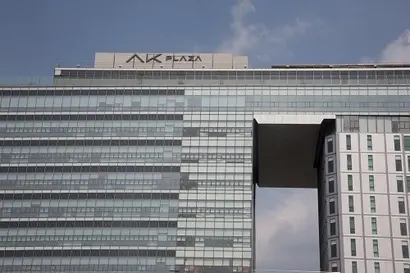
In January of this year, AK Holdings also provided liquidity support by lending 100 billion won to AK Plaza for operating funds. In October, together with Gwangju Investment & Development, it acquired 92.2% of the beneficiary certificates of 'Capstone General Private Real Estate Investment Trust No. 50,' a real estate fund held by AK Plaza. Through this, AK Plaza secured approximately 191 billion won in liquidity.
Some express concern regarding this support structure. It is pointed out that while the holding company acquiring illiquid assets or lending funds to a subsidiary may buffer subsidiary risks in the short term, there is a possibility that the burden on the holding company will accumulate if the performance recovery is delayed. Regarding this, AK Holdings emphasized, "These are normal asset transactions and financial management, not transactions intended for subsidiary support. It is not a structure that burdens the holding company."
Industry experts cite the potential performance improvement of AK Plaza as the key variable for gauging Aekyung Group's future financial uncertainty. Analysts suggest that since there is a limit to asset sales and liquidity defense by the holding company, easing the group's overall financial burden will require fundamental changes to the distribution division and a recovery in profitability.
AK Holdings plans to boost profitability by strengthening fashion merchandising, improving structural fundamentals, and cutting fixed costs. The aforementioned AK Holdings official stated, "Although there are differences in how each subsidiary responds due to various variables, the 'Value-Up' strategy announced last year remains unchanged. We will proceed with performance improvements in line with that strategy."