

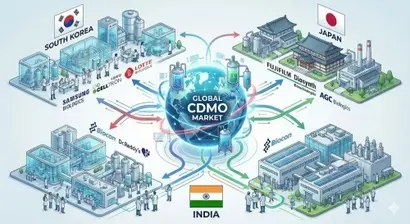
[비즈한국] The biopharmaceutical CDMO (Contract Development and Manufacturing Organization) industry is on the verge of a major transformation. This follows the passage of the U.S. Biosecure Act, which was proposed to keep Chinese biotech firms in check. While South Korea is attracting attention as an alternative to China, Indian and Japanese companies are also rapidly expanding their capabilities, signaling an intense battle for market dominance.
U.S. President Donald Trump signed the National Defense Authorization Act (NDAA), which includes the Biosecure Act, on the 18th (local time). Following the enactment of the NDAA, the U.S. Office of Management and Budget (OMB) is required to publish a list of "companies of concern in biotechnology" within one year. It is highly likely that Chinese biotech firms, including CDMOs like WuXi AppTec and WuXi Biologics, as well as genomics firm BGI and medical device firm MGI, will be included.
In particular, WuXi Biologics and WuXi AppTec, which hold a large share of the CDMO industry, are expected to take a direct hit. Not only will it become virtually impossible for them to secure new contracts from U.S. pharmaceutical companies, but existing contracts are also subject to a maximum five-year grace period, making the departure of clients within that timeframe inevitable. The Biosecure Act was enacted under the pretext of protecting the health and genetic information of U.S. citizens from companies of concern, and it prohibits companies receiving U.S. government funding from using equipment or services provided by "adversarial foreign biotech firms."
With the passage of the Biosecure Act, expectations are mounting that domestic CDMO firms such as Samsung Biologics207940, Celltrion068270, Lotte Biologics, ST Pharm237690, and Prestige Biologics334970 will benefit. Domestic CDMO firms have strong capabilities in the mass production of antibody-based biopharmaceuticals.
Samsung Biologics operates plants 1 through 5 in Songdo, Incheon, holding a world-leading production capacity of 785,000 liters. The company plans to secure a total production capacity of 1.325 million liters by completing its 8th plant by 2032, cementing its position as the world's top CDMO. Furthermore, on the 19th, it decided to acquire a 60,000-liter antibody drug manufacturing facility from GSK in Maryland, USA, for $280 million (413.6 billion won), marking the acquisition of its first overseas production base. Lotte Biologics plans to build three production facilities by 2030 to produce 360,000 liters of biopharmaceuticals, aiming to start operating its first plant in 2027. Additionally, ST Pharm maintains an overwhelming presence in oligonucleotide CDMO, which is the API (Active Pharmaceutical Ingredient) for RNA therapeutics.
However, some analysts suggest that South Korea may not be able to monopolize the indirect benefits of the Biosecure Act, as Indian and Japanese companies are also aggressively growing their CDMO capabilities.
India, the 2nd largest producer of synthetic drugs
India has established itself as one of the world's top two production countries for synthetic drugs alongside China. Recently, it has been active in large-scale investments and M&A in the biopharmaceutical CDMO sector. Piramal Pharma decided in May to invest $90 million (133.3 billion won) in the U.S. It is expanding sterile injection filling facilities in Kentucky and increasing API production facilities in Michigan. Jubilant Pharm invested $132 million (195.5 billion won) and started operating a new sterile injectable fill-finish facility in Washington state last October. Syngene International is rapidly growing its CDMO capabilities through an M&A strategy. In July 2023, it decided to invest $86 million (127.4 billion won) to convert a 20,000-liter vaccine plant acquired from Stelis Biopharma in India into an antibody therapeutic production facility. Last March, it also acquired Emergent BioSolutions' Baltimore plant for $36.5 million (54.1 billion won).
Oh Ki-hwan, head of the Bio-Economy Research Center at the Korea Biotechnology Industry Organization, commented, "India has the advantage of having many drug registration experts, as it is one of the countries that exports the most synthetic drugs to the U.S.," and predicted that "they will easily approach the expansion into the biotech field as well."
Japan, strong in ADC and cell therapy modalities
Japan is excelling in new modalities. Daiichi Sankyo's breast cancer treatment Enhertu has led the opening of the global ADC (Antibody-Drug Conjugate) market, leading to assessments that Japan possesses a strong infrastructure for ADC therapeutics. In particular, Japan, a powerhouse in chemicals and materials, has strengths in the linkers and payloads (drugs) that are essential elements of ADCs.
Fujifilm has the capability to perform all processes from antibody production to the conjugation of linkers and payloads. In the U.S. states of Texas and North Carolina, where it recently decided to invest an additional $1.2 billion (1.7756 trillion won), it plans to mass-produce antibodies, while it will conduct process development and conjugation in Grangemouth, UK. Ajinomoto possesses its own ADC conjugation platform technology, 'AJICAP.' Because AJICAP is a site-specific conjugation technology that does not require gene modification, it is sought after by global pharmaceutical companies looking to reduce the development time for ADC treatments.
Japanese CDMO companies are in a favorable position to attract ADC clients moving away from WuXi XDC, the specialized ADC subsidiary of WuXi Biologics, which ranks second in global ADC CDMO revenue. While domestic firms like Samsung Biologics and Lotte Biologics have also begun expanding into the ADC field, they have yet to accumulate significant experience in winning commercial drug CMO contracts.
Japan also maintains competitiveness in the Cell and Gene Therapy (CGT) field by establishing solid foundational technology and the world's most daring and flexible regulatory system. As the country that first developed Induced Pluripotent Stem Cell (iPSC) technology, it leads the global regenerative medicine market with its original technology in cell therapies. Furthermore, Japan's Ministry of Economy, Trade and Industry (METI) is leading the 'Manufacturing Infrastructure Development Project for the Social Implementation of Regenerative, Cellular, and Gene Therapies,' working to lower manufacturing costs for cell therapies and achieve self-sufficiency in raw materials. Companies can be reimbursed for up to 50% of their manufacturing facility investment costs, reducing the burden of investment.
As the CDMO industry emerges as a key field for K-Bio, government support measures have been introduced domestically. On the 2nd, the Special Act on Regulatory Support for Biopharmaceutical CDMO Companies (CDMO Special Act) was passed. The procedure, which previously required manufacturing permits for export-only drugs under the Pharmaceutical Affairs Act and the Act on the Safety and Support of Advanced Regenerative Medicine and Advanced Biopharmaceuticals (Advanced Regenerative Medicine Act), is expected to be simplified to a mere notification process.