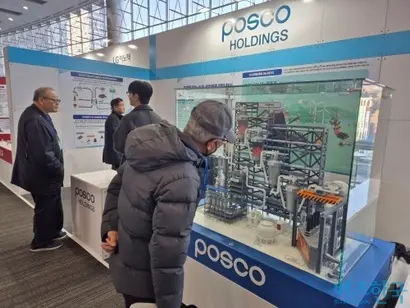
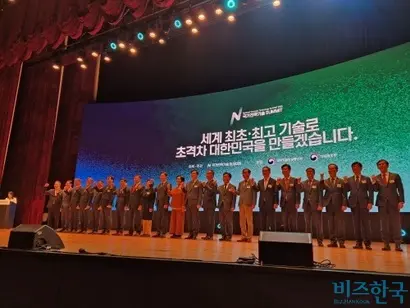
[비즈한국] As the global race for technological hegemony, led by the U.S. and China, intensifies, securing national strategic technologies has emerged as a critical task that goes beyond economics and industry to dictate diplomacy, national security, and global competitiveness. With science and technology now recognized as national strategic assets, there is a growing consensus that technology development and industrial infrastructure should not rely solely on the private sector, but rather on a national-level cooperative system involving the government, universities, and research institutions. To share this sense of urgency, the ‘National Strategic Technology Summit’ was held on December 18 at the COEX Auditorium in Gangnam-gu, Seoul.
National strategic technologies refer to core technologies that have a decisive impact on a nation's economic prosperity, diplomatic and security capabilities, and the creation of future new industries. These are technologies specifically managed and fostered at the national level to ensure technological sovereignty, with South Korea enacting the ‘Special Act on Fostering National Strategic Technologies’ in 2023 to address these needs.
The summit was attended by key figures from industry, academia, research, and government, including Deputy Prime Minister and Minister of Science and ICT Bae Gyeong-hoon, Democratic Party lawmaker Choi Min-hee, LS Electric Chairman Koo Ja-kyun, and Seoul National University President Yoo Hong-lim.
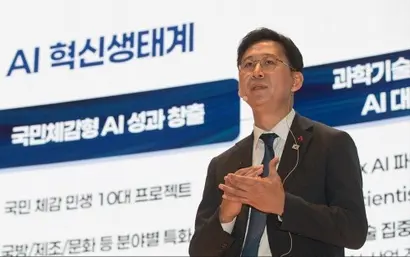
In Part 1, themed ‘The NEXT National Strategic Technologies to Lead the World,’ Deputy Prime Minister Bae delivered a keynote speech, followed by relay presentations from representatives of industry, academia, and research. In his keynote, Deputy Prime Minister Bae set a goal of becoming one of the top three AI powerhouses, declaring, "We will announce the Korean version of the Genesis Mission next March or April." He added, "We will support corporate challenges by relaxing corporate matching ratios to a maximum of 50% for participation in national strategic technology R&D and establishing new rapid-response R&D funds."
The Genesis Mission is an AI national strategy announced by U.S. President Donald Trump last November, a large-scale project that utilizes federal scientific data and computing power to solve national challenges through AI. With the participation of global IT giants like Nvidia, Google, OpenAI, and Microsoft, it is being called the AI version of the ‘Manhattan Project.’
Pohang University of Science and Technology (POSTECH) President Kim Sung-keun compared the concepts of High Tech (mature technology with established markets) and Deep Tech (basic/fundamental technology before market formation) in his presentation, emphasizing the necessity of strengthening deep tech capabilities. President Kim pointed out, "National strategic technologies are currently being selected loosely without distinguishing between high tech and deep tech," adding, "Even though nearly 20 years have passed since the concept of deep tech was introduced, related support remains weak."
In Part 2, three sessions were held to discuss: △Innovation strategies for national strategic technologies to enter the top 3 AI powerhouses, △Technological self-reliance and cooperation in an era of supply chain restructuring, and △Strategies to preempt next-generation national strategic technologies to lead future industries, followed by discussions among experts from industry, academia, research, and government.
Bae Soon-min, Head of KT030200 AI Future Lab, presented on the topic of ‘Strategies for Securing Core AI Technologies and Creating Super-Gaps’ in Session 1. Lab Head Bae emphasized, "AI is not a problem that can be solved by spending tens or hundreds of billions of won to recruit one genius," adding, "The compensation system across the entire AI ecosystem must be improved so that many talented people can work passionately."
Korea’s AI competitiveness as evaluated by the OECD was also mentioned. Kang Ha-yeon, Chair of OECD AIGO and GPAI, noted, "The OECD highly evaluates the AI acceptance of Korean companies and the government's proactive stance," but pointed out, "I believe the qualitative sophistication level is lower compared to the numbers." She continued, "The government-led volume strategy that was effective in the industrialization era is not effective in the AI field," emphasizing the need to resolve the AI gap between companies and prepare support measures for small and medium-sized enterprises.
In Session 2, as supply chain risks expand, diversifying supply chains to secure technological sovereignty emerged as a major topic. Kwon Seok-jun, a professor of chemical engineering at Sungkyunkwan University, said, "Just like Vietnam, which tries not to belong to either the U.S. or China, a strategy that targets the ‘gray zone’ between the U.S. and China is necessary."
On the other hand, voices pointing out the realistic limitations of supply chain diversification also emerged. Yeon Won-ho, head of the Global Economic Security Office at Hyundai Motor005380, stated, "Diversifying supply chains is often unrealistic, so stockpiling is a more practical response for companies," adding, "To resolve this fundamentally, preemption through technology development is important."
In Session 3, the importance of preempting future material technologies was discussed. Lee Chang-hoon, Vice President of the Korea Institute of Materials Science (KIMS), emphasized, "Heat-resistant materials for aircraft engines are monopolized by a few global companies, and the production volume of those companies virtually determines the entire production volume of aircraft engines. It is essential to preemptively develop material technologies through the cooperation of industry, academia, research, and government to secure super-gap national strategic technologies."