

[비즈한국] I must start with an apology to Coupang. I wrote a column I shouldn't have (Related article: [Desk Column] Coupang’s 33.7 million personal data leak, “It’s no big deal”). I wrote that it was “no big deal” and that “it would eventually blow over quietly.” Perhaps that piece, in effect, put Coupang at ease. It may have reinforced the judgment that this was a manageable incident and that they only needed to hold out for a while. I have no way of knowing where that article was shared within Coupang, but if someone with decision-making power even slightly thought this way, I can hardly escape responsibility for the column.
Of course, a single column does not dictate the crisis management strategy of a large corporation like Coupang. However, I mistakenly thought I was all too familiar with how personal data leak incidents are consumed in Korean society. The accident is big, the response is standard, and public opinion cools down quickly. It had always been that way. So, I thought it would be the same this time.
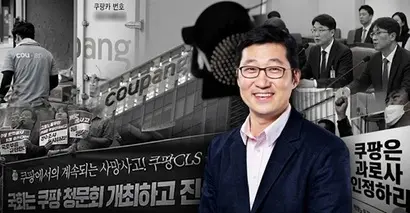
The data leak itself is still not a huge deal. While the number 33.7 million is large, a large number does not always lead to a major fallout. The problem lies not in the accident, but in the handling of it. The personal data leak incident has already faded from the minds of the public and consumers. Instead, it has been replaced by the “arrogance” of self-proclaimed global CEO Bom Kim.
According to standard crisis management manuals, Chairman Kim should have appeared before the National Assembly to bow his head and apologize. Regardless of sincerity, repeating apologies while bowing is the “typical scene” for a major corporation to provide the public with a justification for forgiveness. The National Assembly is not a court that issues verdicts; it is where the eyes of the people—who want to see a face taking responsibility—are fixed. There is a reason why the owners of conglomerates even larger than Coupang feel the need to bow their heads.
U.S. citizen and Chairman Bom Kim underestimated Korean society. This is where the nature of this matter shifts by 180 degrees. The emotion remaining for Korean consumers now is not “anxiety” over a data leak, but “displeasure” toward the company Coupang. Specifically, it is displeasure over how lightly Coupang viewed the political power and institutions of the nation of Korea, and by extension, the Korean consumers themselves.
Chairman Kim refused to appear before the National Assembly, using global business as an excuse. However, 90% of Coupang’s revenue comes from Korea. Its logistics centers, workers, and the consumers who suffered the breach are all in Korea. A company whose very existence would be impossible without the Korean market suddenly puts on the mask of a “global company” only when it's time to be held accountable. This so-called “selective globalism”—acting like a Korean company when making money, but a global company when facing responsibility—is seen by Koreans as nothing more than deception. Worse, putting forth a foreign executive who is not fluent in Korean as a substitute was the worst possible move.
The National Assembly is a space that views such calculated evasion as the ultimate insult. The current barrage of attacks is less about anger over the data leak and more of a reaction to the feeling of being disregarded by a single company. The extreme responses, including discussions about potential travel bans, are an extension of this emotional retribution.
Where exactly does Chairman Bom Kim’s confidence come from? It stems from Coupang’s monopolistic status in the Korean market. Consumers are uneasy while using Coupang, but they know well that because there is no substitute with both dawn delivery and price competitiveness, they have no choice but to reopen the Coupang app despite their complaints. This certainty led Chairman Kim to the misjudgment that “consumers won't leave, even if I don't show up or provide an explanation.”
Monopolies always meet the same end. When market checks fail to function, politics eventually draws its sword. This is why politicians from both sides of the aisle are speaking with one voice in the National Assembly. A “platform fear” is being shared that the Coupang platform has become too big and, at the same time, indispensable. Now that a political consensus has formed that “it’s time to take action,” Coupang is likely to face a harsher price than ever before.
Above all, Coupang and Chairman Bom Kim ignored the minimum level of courtesy required by Korean society. There are countless cases where companies that believed they were untouchable in the market have been condemned by political and public judgment. This serves as a strong warning not only to Coupang but to all monopolistic platforms. The price for underestimating Korea while earning money here is always greater than one thinks.