

[비즈한국] While Netflix Services Korea (Netflix) and the National Tax Service (NTS) are engaged in a legal battle over 78 billion won in corporate taxes, it has been confirmed that all penalty dispositions imposed by tax authorities during the audit process have been dismissed. Following a tax audit of Netflix between 2020 and 2021, the NTS imposed 80 billion won in additional corporate taxes. The NTS had issued fines for violations of the Framework Act on National Taxes after Netflix failed to submit certain documents during the audit, but the company received non-punishment rulings through the three-trial process.

In 2021, the NTS imposed 80 billion won in corporate taxes on Netflix. This followed Netflix reporting 415.4 billion won in domestic revenue in 2020 while paying only 2.2 billion won in corporate tax—about 0.5% of its revenue. Netflix defines itself as a distributor that 'resells' subscription memberships of its overseas corporate entities. It reduced its tax burden by classifying most of its revenue as payment for subscription memberships and funneling it to its foreign entities.
Viewing this method as tax avoidance, the NTS conducted an intensive tax audit on Netflix from August 2020 to May 2021. At the time, media reports indicated that the tax audit had been upgraded to a tax crime investigation, which typically occurs when there is suspicion of tax evasion.
The tax authorities, including the Jongno District Tax Office, imposed fines for violating the Framework Act on National Taxes, claiming that Netflix refused to submit required documents during the audit. Although the exact amount was not disclosed, it is known to be in the hundreds of millions of won. Lim Seong-hyo, a tax accountant at BizTax RichHigh branch, stated, "It appears the tax authorities filed a complaint with the prosecution, judging that Netflix had committed tax evasion," adding, "They likely viewed the failure to properly submit materials as an active measure to hinder tax collection."
However, it has been confirmed that the penalty dispositions issued by the tax authorities at the time were all dismissed in court. Although the Jongno District Tax Office imposed fines on Netflix in July 2021 for failing to submit tax documents, the Seoul Central District Court issued a non-punishment (dismissal) decision in July 2024 under the Act on the Regulation of Violations of Public Order. Despite the prosecution's appeal against the decision, the court maintained its dismissal ruling.
The court determined that Netflix had cooperated relatively diligently with the document submission process. It noted that during the nine-month audit, the NTS requested 178 items, and Netflix failed to submit or provided insufficient materials in only 17 instances. The court also took into account that some of the unsubmitted documents were materials from foreign entities that were difficult for Netflix to obtain and provide.
The court also considered the principle that tax audits should be conducted to the minimum extent necessary. It cited the fact that the tax authorities had already issued a corporate tax assessment against Netflix, and that a previous fine imposed in February 2021 during the same audit had also been dismissed.
The prosecution filed an appeal in October 2024, but in July 2025, the second-instance court also judged the non-punishment decision to be justified, concluding that Netflix had not intentionally evaded the submission of documents. The prosecution filed a final appeal, but the Supreme Court dismissed it on October 22 through a non-proceeding judgment (rejecting the appeal without a trial on the merits), finalizing the cancellation of the fines four years after the initial disposition.
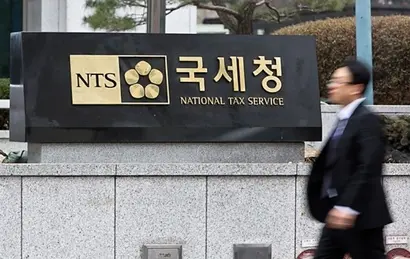
Meanwhile, as Netflix and the NTS remain locked in a tight standoff over the legal basis for the corporate tax imposition, attention is turning toward the outcome of the tax litigation. After being assessed 80 billion won in corporate tax in 2021, Netflix filed a tax appeal to get the money back. However, the Tax Tribunal judged that approximately 78 billion won of the 80 billion won in back taxes was lawful.
Consequently, Netflix filed an administrative lawsuit in November 2023 against the heads of the Jongno District Tax Office, the Jung-gu District Office, and the Jongno-gu Office to cancel the corporate tax imposition. The lawsuit has been ongoing for over two years, with the final hearing scheduled for December 19.
The crux of the lawsuit is the ownership of copyright. The NTS argues that Netflix receives copyrights from its overseas entities and exercises them in Korea, thereby incurring a withholding tax obligation. Conversely, Netflix argues that the entity transmitting the content is the overseas entity, and the costs paid to it are not royalty fees for copyright use. Netflix Services Korea maintains that as a distributor, it has no withholding obligation.
Tax avoidance by global companies like Netflix remains a subject of persistent controversy. In 2024, Netflix generated 899.7 billion won in revenue in Korea, but with 732.4 billion won categorized as payment for membership purchases, its corporate tax payment for that year was only 3.9 billion won. Netflix was also criticized during the National Assembly's Science, ICT, Broadcasting, and Communications Committee audit this October. Rep. Choi Su-jin of the People Power Party pointed out, "It is natural to pay taxes if you are actually providing services in Korea," adding, "They avoid paying taxes while making enormous profits in Korea."